- Title
- Dagger (Khanjar)
- Date Made
- circa 1850
- Medium
- Rock crystal hilt; steel blade
- Dimensions
- Overall: 13 1/4 x 3 1/4 in. (33.66 x 8.26 cm)
- Accession Number
- M.76.2.18
- Curatorial Notes
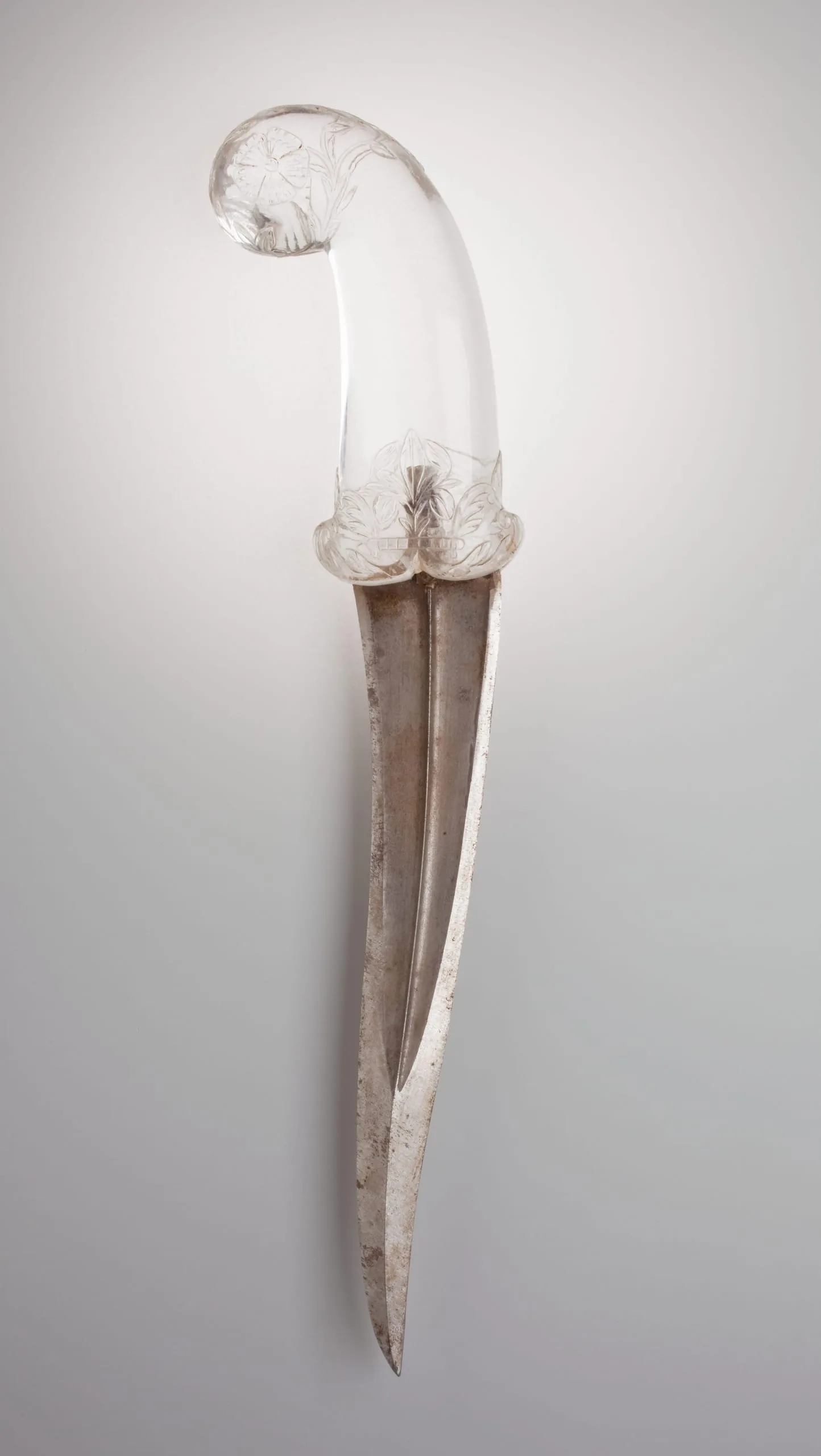
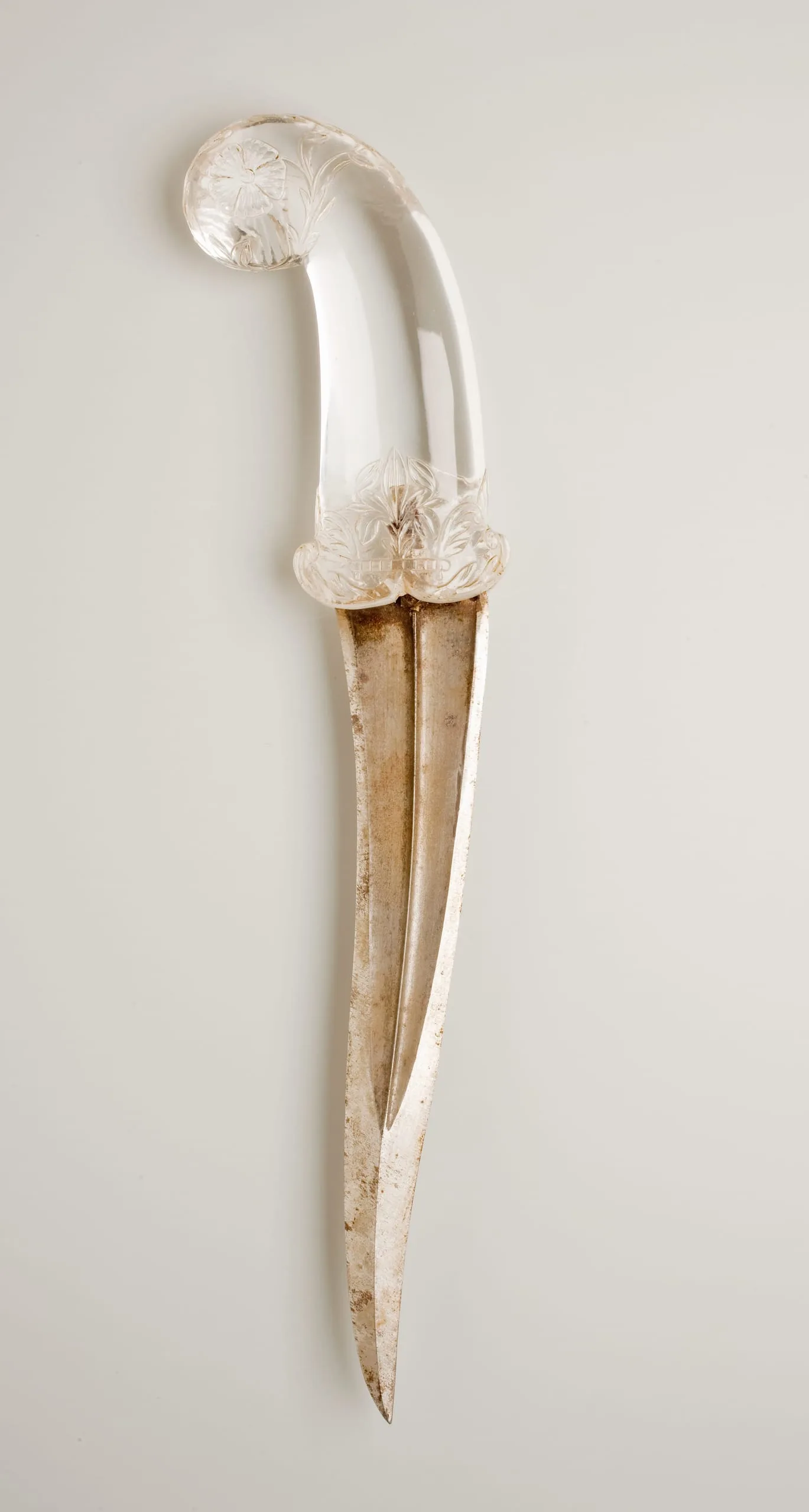
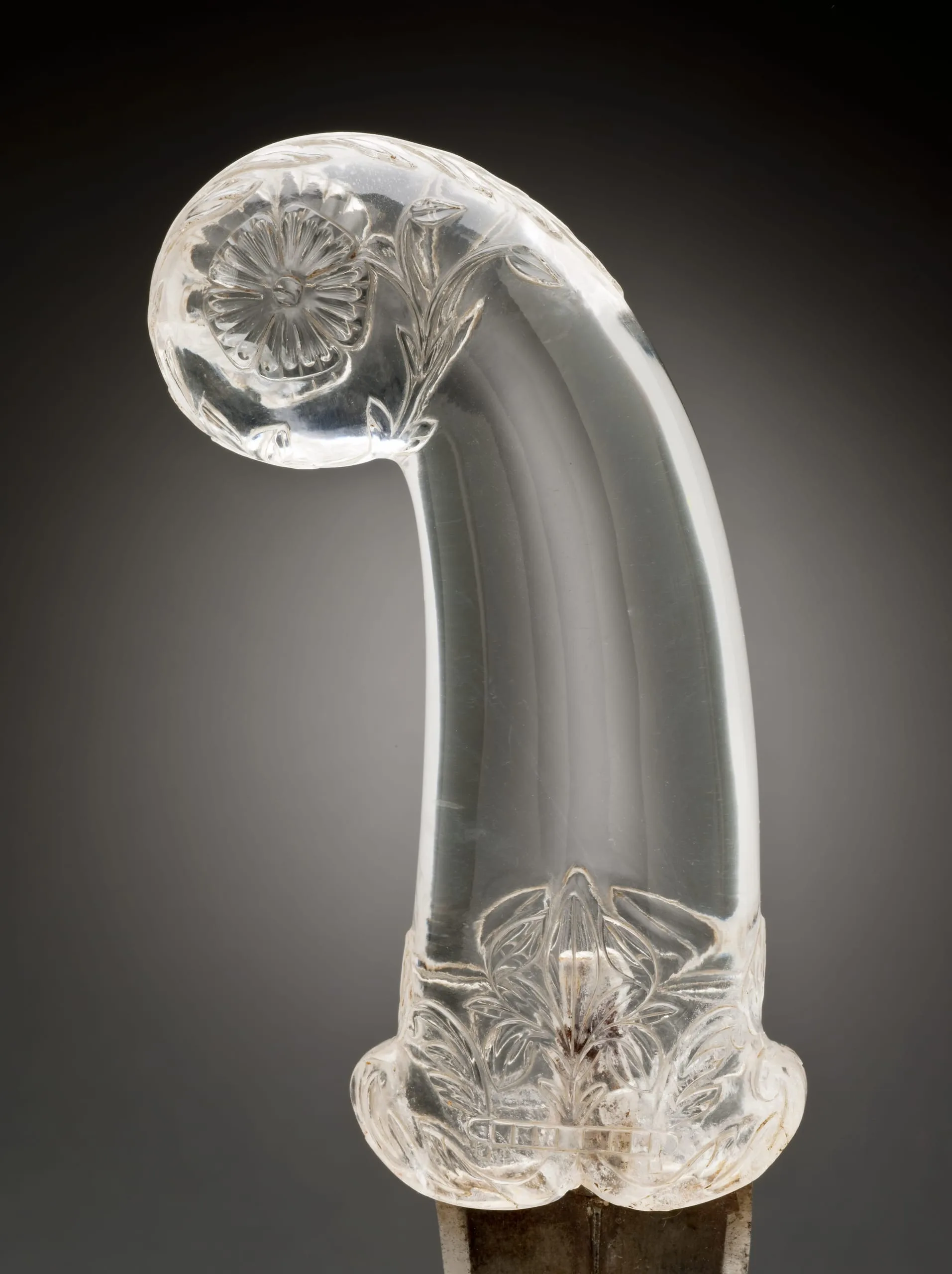
The rock crystal pistol-grip hilt of this khanjar dagger epitomizes Mughal lapidary prowess. The clear quartz imparts a somber stylishness, while the crisply rendered floral motifs enliven the surface with a lush vitality. The center of each side of the hilt butt is graced with an open dianthus flower, which rises from stalks bearing buds and pointed leaves. The foliate stalk curves around the edge of the hilt. The quillon block near the mouth of the hilt is embellished in the center with an iris flanked by split acanthus leaves. Their separate stalks rise from beneath a horizontal segmented bar that serves as a groundline. Alternatively, the bar could be read as the side edge of a tray, perhaps footed depending on one's interpretation. This visually distinctive groundline is also found in contemporaneous bidri-ware of the Deccan and Lucknow enameling, as well as in mid-17th-century palatial architecture in Amber, Rajasthan. Split acanthus leaves adorn the edges of the quillons. The double-edged blade has a tapering median ridge and a reinforced tip that recurves upward. The short tang of the blade is visible within the rock crystal. It is undetermined if the current blade is original.
Rock crystal carving (technically, abrading) has an ancient heritage in South Asia. The principal center of production was in western India near the coastal city of Cambay (present-day Khambhat) in Gujarat, where it was long used to make Buddhist and Hindu amulets and votive objects.
- Selected Bibliography
- Rosenfield, John. The Arts of India and Nepal: The Nasli and Alice Heeramaneck Collection. Boston: Museum of Fine Arts, Boston, 1966.