- Title
- Ceremonial Vessel
- Date Made
- circa 2600-2450 BCE
- Medium
- Earthenware with ceramic paint
- Dimensions
- 19 1/2 x 10 in. (49.53 x 25.4 cm)
- Accession Number
- AC1997.93.1
- Curatorial Notes
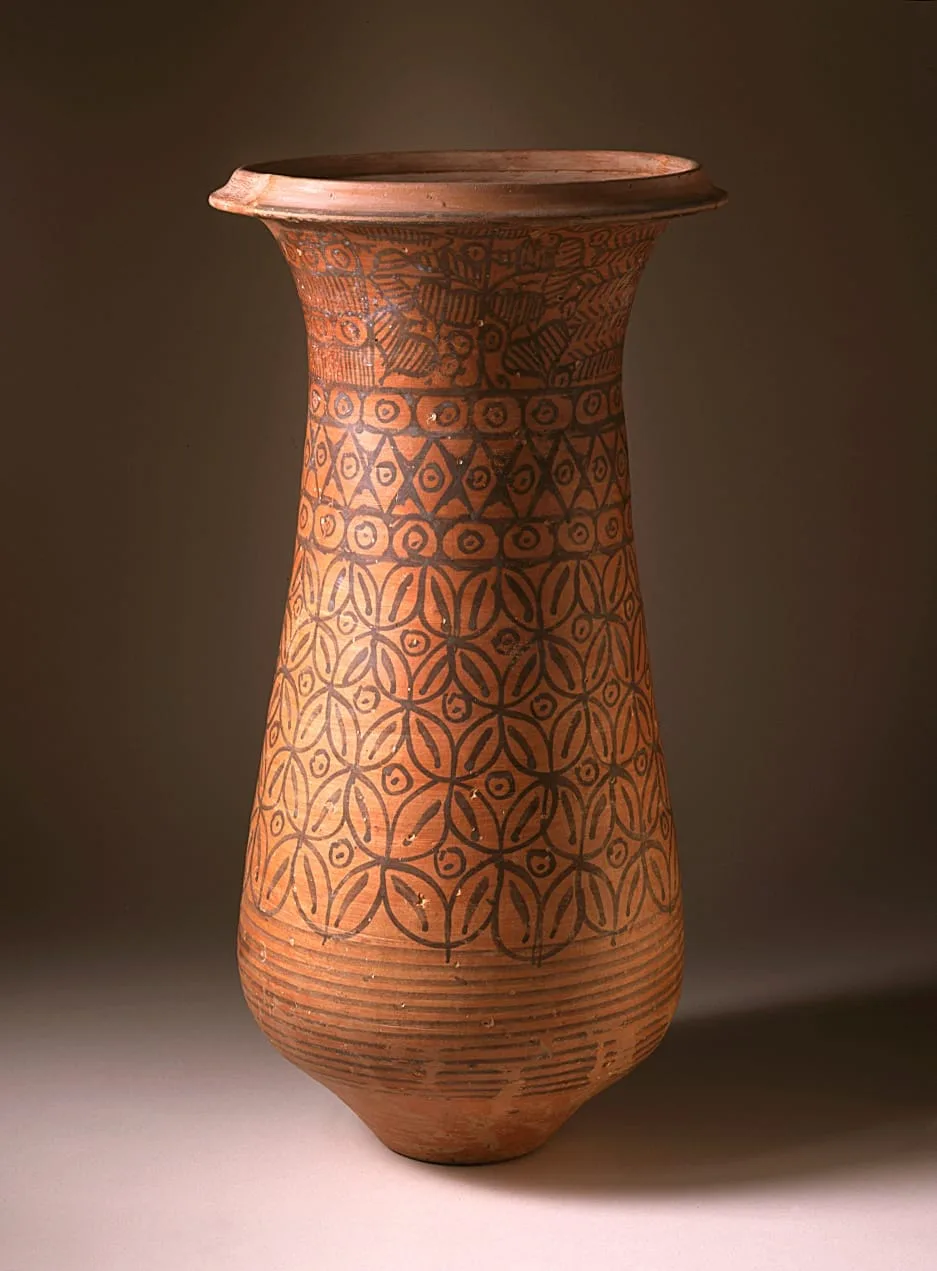
This Ceremonial Vessel epitomizes the large earthenware jars and pots produced by the ancient Indus Valley Civilization. It is adorned with elaborate vegetal and geometric painted decoration arranged in horizontal registers. The upper register of the neck is ringed with several panels of exuberant botanical motifs, including a palm tree with broad, sweeping fronds and a pipal tree (ficus religiosa), the sacred tree of South Asia par excellence. Beneath the upper register is a tripartite band of decoration consisting of a roundel border, a diamond-with-roundel band, and a roundel border. The central band of decoration on the lower body is formed by a grid of intersecting circles arranged in a pattern of quadralobed leaves. This motif is characteristic of the refined sense of composition and design found on Indus Valley Civilization vessels and was the favored design pattern for this type of large jar. The lower registrar features parallel lines above a tapering flat base.
The original function of the Ceremonial Vessel was presumably for undetermined ritual purposes, as similar jars have been discovered alongside domestic altars. Originally, it would have had a domed lid and a ring stand for support. A closely related vessel is in the Museum of Fine Arts, Boston (39.2978).