LACMA

ShopMembershipMyLACMATickets
LACMA
Los Angeles County Museum of Art
5905 Wilshire Blvd.
Los Angeles, CA 90036
info@lacma.org
(323) 857-6000
Sign up to receive emails
Subscribe
© Museum Associates 2025

Museum Hours

Monday

11 am–6 pm

Tuesday

11 am–6 pm

Wednesday

Closed

Thursday

11 am–6 pm

Friday

11 am–8 pm

Saturday

10 am–7 pm

Sunday

10 am–7 pm


  • About LACMA
  • Jobs
  • Building LACMA
  • Host An Event
  • Unframed
  • Press
  • FAQs
  • Log in to MyLACMA
  • Privacy Policy
© Museum Associates 2025
Collections

Unknown
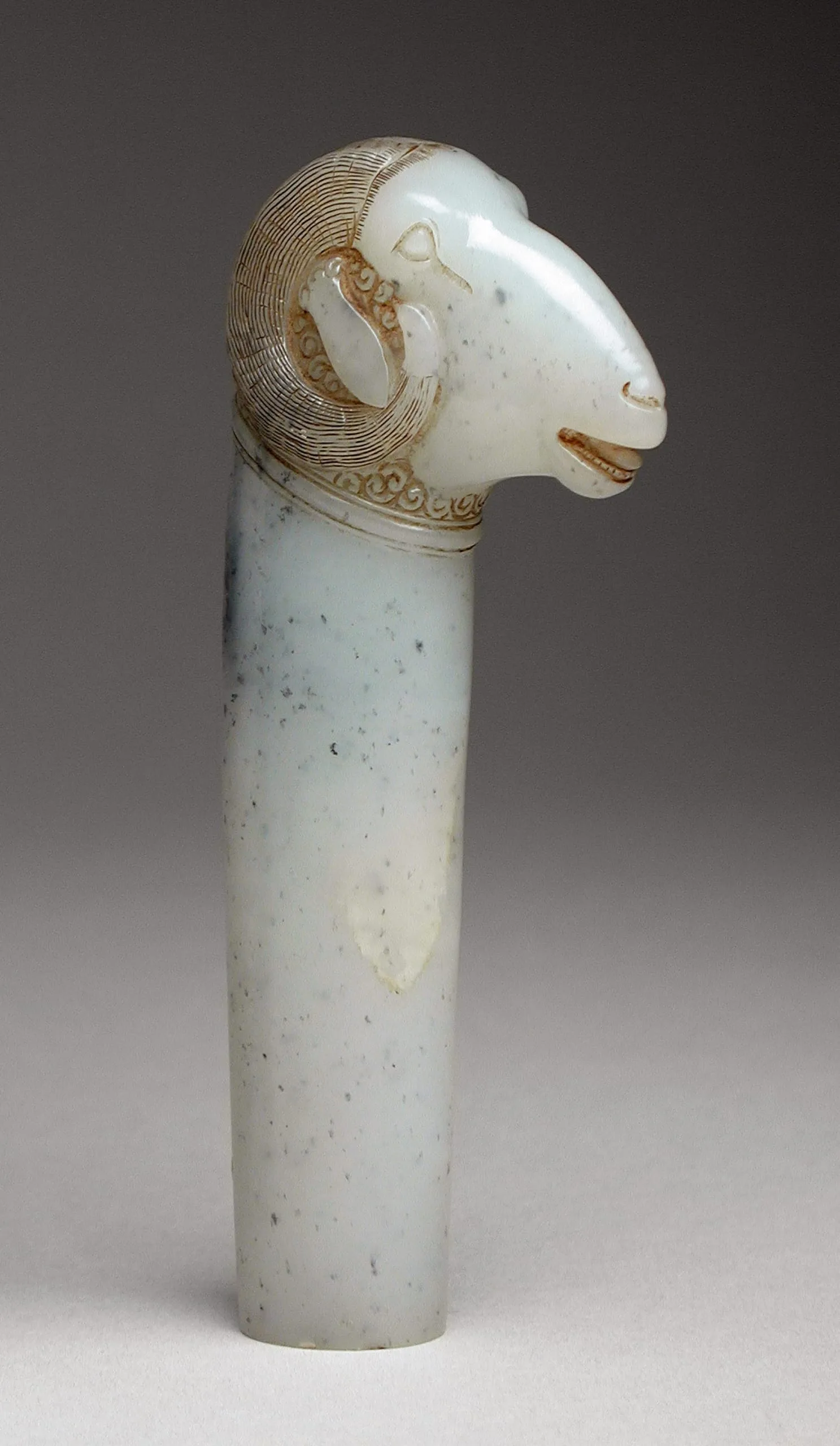
Dagger Hilt with Ram's Headcirca 1650-1700

Not on view
Jade sculpture of a ram's head atop a smooth cylindrical handle, pale blue-gray stone with incised horn detail and russet-brown pigment highlights
Artist or Maker
Unknown
Title
Dagger Hilt with Ram's Head
Place Made
India, Mughal empire
Date Made
circa 1650-1700
Medium
Mottled white nephrite jade
Dimensions
4 3/16 x 1 3/4 x 5/8 in. (10.63 x 4.44 x 1.58 cm)
Credit Line
From the Nasli and Alice Heeramaneck Collection, Museum Associates Purchase
Accession Number
M.76.2.12
Classification
Arms and Armor
Collecting Area
South and Southeast Asian Art
Curatorial Notes

The terminal of this mottled white nephrite jade hilt is sensitively portrayed with anatomical accuracy in the form of a ram’s head. It has curled horns, pendant ears, tightly compacted swirls of hair, and a long muzzle with an open mouth revealing its tongue and teeth. The cylindrical grip tapers slightly to a perpendicular end. Given the scale and outline of the grip, it is likely the hilt was intended for use with a straight single-edged blade featured on a type of knife or dagger known generally as a kard.

Lions, horses, nilgais (blue-gray Indian antelopes), camels, elephants, parrots, rams, and goats were the favored animals reproduced with keen observation by the Mughal artists for use as hilts on knives, daggers, and swords. The naturalistic renditions of the animals were precisely modeled with distinct bone structures, pliant soft tissue, and flowing or curly hair. Great attention was paid to identifying detail, as is evident in a comparison between this ram's head hilt and an ivory knife hilt in the form of a wild goat's head, now in LACMA’s collection (M.91.179.3). Despite the obvious anatomical similarities of the two beasts, their distinct identities are clearly indicated by the differing treatment of the ram’s longer and less angular snout, pendant ears, and in particular, by the distinguishing presence of the goatee under the chin of the wild goat.
Selected Bibliography
  • Rosenfield, John. The Arts of India and Nepal: The Nasli and Alice Heeramaneck Collection. Boston: Museum of Fine Arts, Boston, 1966.
  • Pal, Pratapaditya, Janice Leoshko, Joseph M. Dye, III, Stephen Markel. Romance of the Taj Mahal. Los Angeles: Los Angeles County Museum of Art, 1989.
  • Markel, Stephen. "The Use of Flora and Fauna Imagery in Mughal Decorative Arts." Marg 50, no. 3 (March 1999).