LACMA

ShopMembershipMyLACMATickets
LACMA
Los Angeles County Museum of Art
5905 Wilshire Blvd.
Los Angeles, CA 90036
info@lacma.org
(323) 857-6000
Sign up to receive emails
Subscribe
© Museum Associates 2026
  • About LACMA
  • Jobs
  • Building LACMA
  • Host An Event
  • Unframed
  • Press
  • FAQs
  • Log in to MyLACMA
  • Privacy Policy
© Museum Associates 2026
Collections

Calligraphic Panellate 15th century

On view:
Geffen Galleries
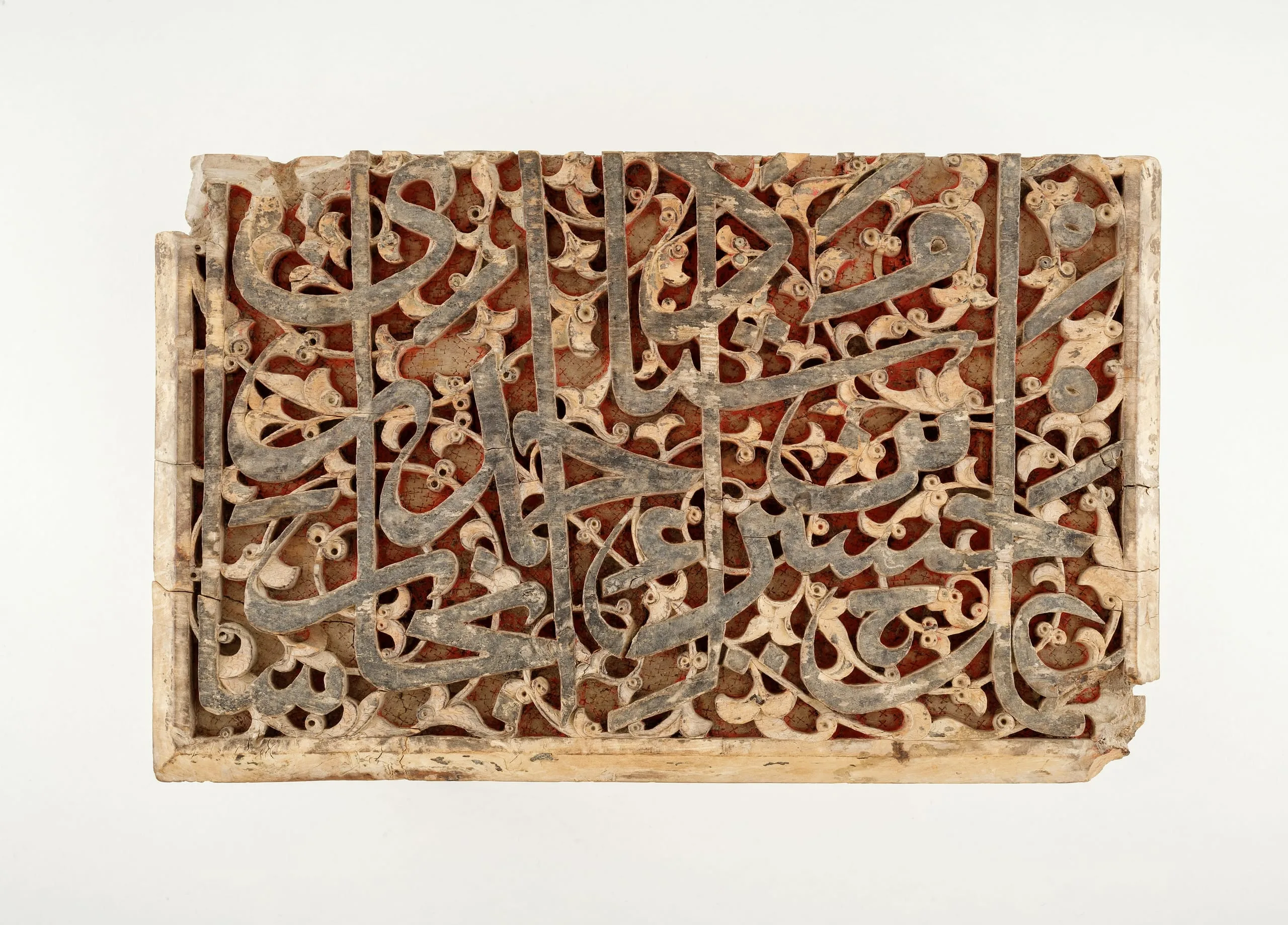
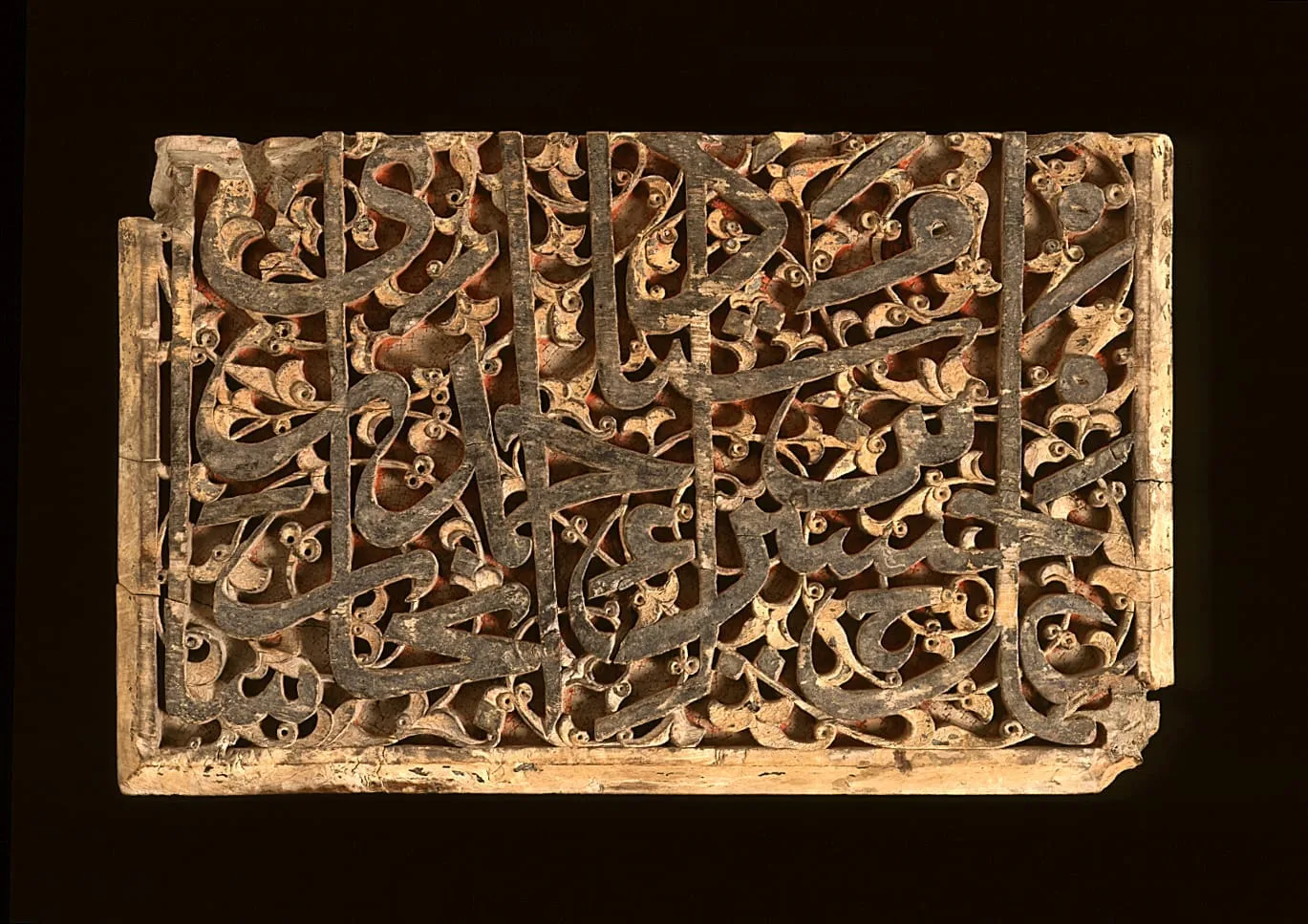
Carved wood panel with pierced openwork Arabic calligraphy in cursive script over a rust-red ground, interwoven with arabesque vine and palmette decoration, ivory-toned frame with age wear
Carved wooden panel with openwork Arabic calligraphy in flowing cursive script, interwoven with dense arabesques of scrolling vegetal motifs; pale wood with traces of red pigment visible through the pierced ground.

Unknown, Calligraphic Panel, late 15th century, Los Angeles County Museum of Art, Indian Art Special Purpose Fund, photo © Museum Associates/LACMA

Title
Calligraphic Panel
Place Made
Iran, Caspian region
Date Made
late 15th century
Period
Timurid (1370-1506)
Medium
Wood, carved, with traces of polychrome
Dimensions
7 x 11 1/4 x 1 1/8 in. (17.7 x 28.5 x 2.8 cm)
Credit Line
Indian Art Special Purpose Fund
Accession Number
M.76.3
Classification
Wood
Collecting Area
Art of the Middle East: Islamic
Curatorial Notes

In Muslim cultures, words are used not only to communicate but to decorate. Because it is through writing that the Qur’an is transmitted, scripts in the Arabic alphabet were devised and perfected to be worthy of divine revelation. On this account, calligraphy became the most important art form regardless of the text. This concern with beautiful writing extended beyond the page to inscriptions on buildings as well as objects of all sorts, including metalwork, coins, ceramics, stone, glass, textiles, and woodwork, as here.

This panel, which probably came from a door, was originally painted. The sole decoration is the inscribed signature of its maker. It is signed Husayn ibn (son of) Master Ahmad, wood carver of Sari (in the Iranian province of Mazandaran, in the southern Caspian region), whose family members—including his father, brother, and uncle—evidently shared the same profession, to judge by the signatures on several other examples of wood carving. Written in thuluth, a monumental script with large, rounded proportions, the seven words of the inscription are deeply carved in three horizontal registers and set against a scrolling-leaf background. The tall, vertical letters of the lowest register are elongated so that they intersect with the letters of the lines above, and the text unfolds not only from right to left but from top to bottom.
Selected Bibliography
  • Komaroff, Linda. Islamic Art at the Los Angeles County Museum of Art. Los Angeles: Museum Associates, 2005.
  • Lo Terrenal y lo Divino: Arte Islámico siglos VII al XIX Colección del Museo de Arte del Condado de Los Ángeles. Santiago: Centro Cultural La Moneda, 2015.

  • Komaroff, Linda. Beauty and Identity: Islamic Art from the Los Angeles County Museum of Art. Los Angeles: Los Angeles County Museum of Art, 2016.