- Title
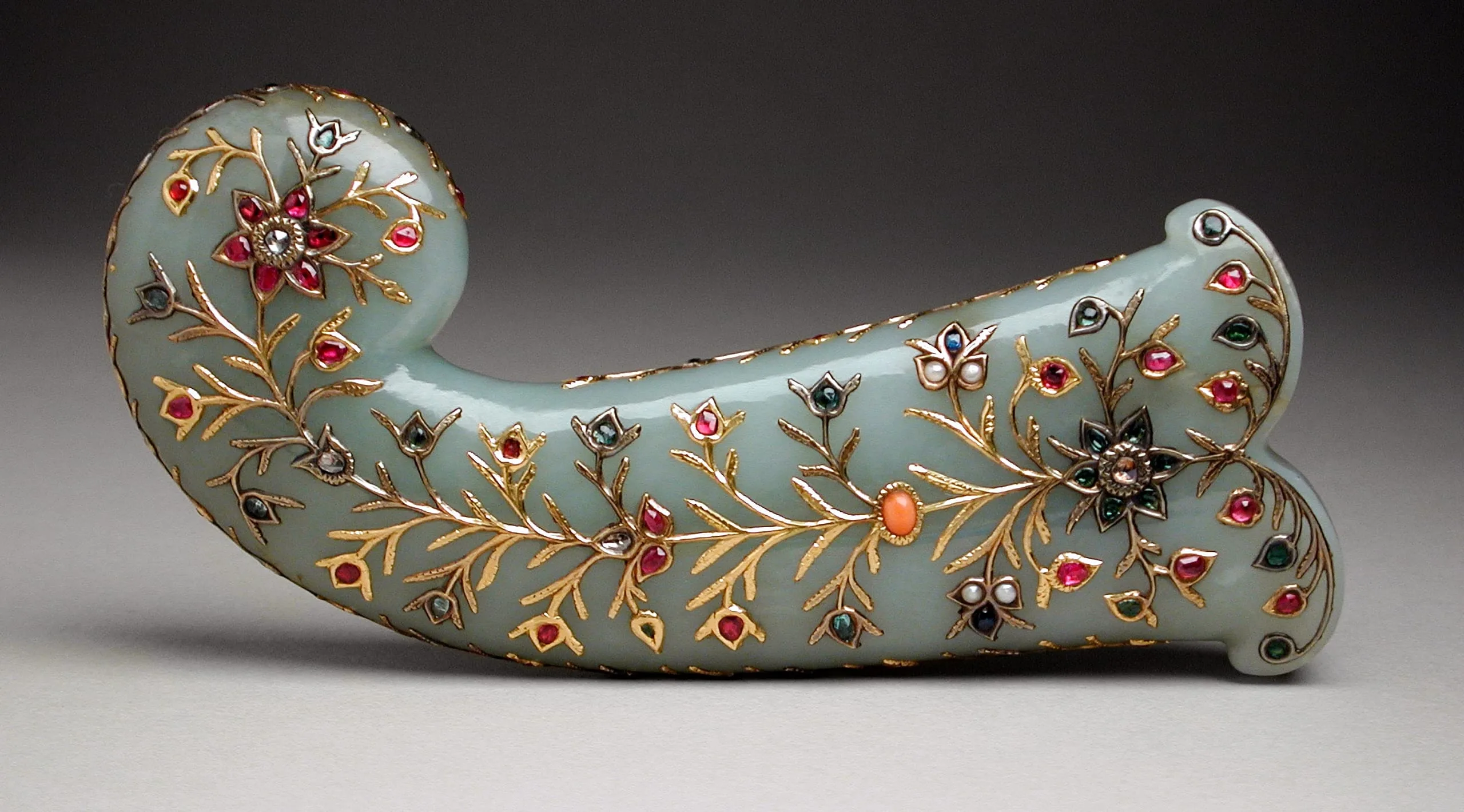
- Dagger Hilt
- Date Made
- circa 1850
- Medium
- White nephrite jade inlaid with rubies, emeralds, pearls, coral, spinels, sapphires, and glass set in gold
- Dimensions
- 5 5/8 x 3 3/4 x 7/8 in. (14.29 x 9.53 x 2.22 cm)
- Accession Number
- M.76.2.17
- Curatorial Notes
This ornate dagger hilt is made of white nephrite jade. The sides and edges are embellished with flowering plants richly inlaid in gold with blossoms made of rubies, emeralds, pearls, coral, spinels, sapphires, and glass set in compression mounts. Mughal and Deccani jade dagger hilts were often inlaid with rubies and emeralds from at least the mid-17th century onward, but the larger variety of gemstones and the complex composition of the flowering plants suggest the LACMA hilt was created in the 19th century when lavishly ornamented dagger and sword hilts were fashionable and often refitted onto earlier blades.
The curved pistol-grip form of the hilt, hook-shaped with a rounded terminal, was derived from European gun handles and the weaponry traditions of Ottoman Turkey and Safavid Iran. The distinctive form may have inspired the creation of Indian dagger and sword hilts made in the visually similar shape of a parrot's head, some complete with beaks and inset eyes. Judging primarily from pictorial evidence, South Asian parrot-head hilts may have first appeared in the Deccan during the 16th century. By the reign of the Mughal Emperor Aurangzeb (r. 1658-1707), who likely encountered this hilt style during his many years of military campaigns in the Deccan, the pistol-grip hilt was widely employed on the type of Mughal daggers known as a khanjar that typically features a curved double-edged blade.
- Selected Bibliography
- Rosenfield, John. The Arts of India and Nepal: The Nasli and Alice Heeramaneck Collection. Boston: Museum of Fine Arts, Boston, 1966.