- Title
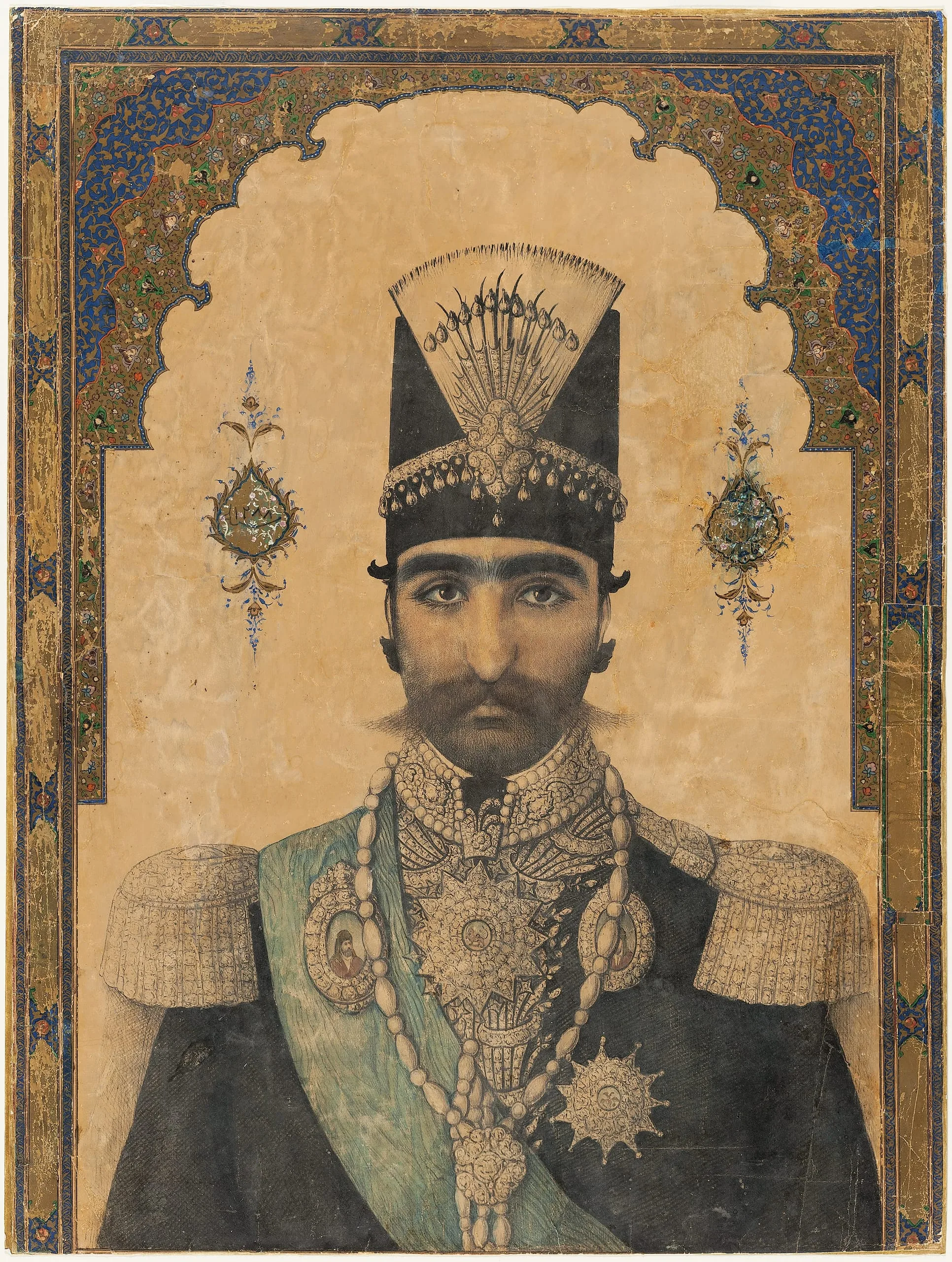
- Portrait of Nasir al-Din Shah (reigned 1848-1896)
- Date Made
- 1288 AH/ 1871-2
- Medium
- Ink, opaque watercolor and gold on paper
- Dimensions
- 24 x 16 in. (60.96 x 40.64 cm)
- Accession Number
- AC1992.211.1
- Curatorial Notes
Likenesses were made of Nasir al-Din Shah (r. 1848–96) as no other Iranian ruler before him, documenting in paintings and photographs his teenage years up to the time of his death. Likely based on a photograph, the shah is shown here clothed in a European style military jacket with epaulettes, and jeweled portraits of the Shi‘ite Imams, probably ‘Ali and Hasan, along with royal insignia. The archlike illuminated Persianate frame references the past, while the realistic depiction reflects more recent Western influences, including the advent of portrait photography. Two ornate medallions on either side of the shah’s head preserve the royal sitter’s name and the date 1288 AH/1871-2.
The artist of this portrait, made when the shah was about forty, probably modeled the shah’s image after an earlier photograph, which he then translated into ink and color. Yet this image of Nasir al-Din assimilates and literally re-frames the photo’s European pictorial conventions in which the artist has captured the optical naturalism of an albumen photograph with hand-colored elements. The undefined background of sepia and beige evokes the type of backdrop one might find in a commercial studio during this period. In contrast, the outer frame, topped with scalloped corner pieces, bear intricate vegetal motifs and illuminated elements that its original viewers would readily recognize from earlier Iranian manuscript traditions. These features purposefully juxtaposed photography’s monochrome aesthetic with the jewel-like palette of Persian painting to create a new form of portraiture.
- Selected Bibliography
- Komaroff, Linda. In the Fields of Empty Days: The Intersection of Past and Present in Iranian Art. Los Angeles: Los Angeles County Museum of Art; Munich; New York: DelMonico Books-Prestel, 2018.
- Balaghi, Shiva. "Mining the Past." Canvas 14, no.4 (2018): 114-117.
Komaroff, Linda. "Islamic Art Now and Then." In Islamic Art: Past, Present, Future, edited by Sheila Blair and Jonathan Bloom, 26-56. New Haven, New York, and London: Yale University Press, 2019.