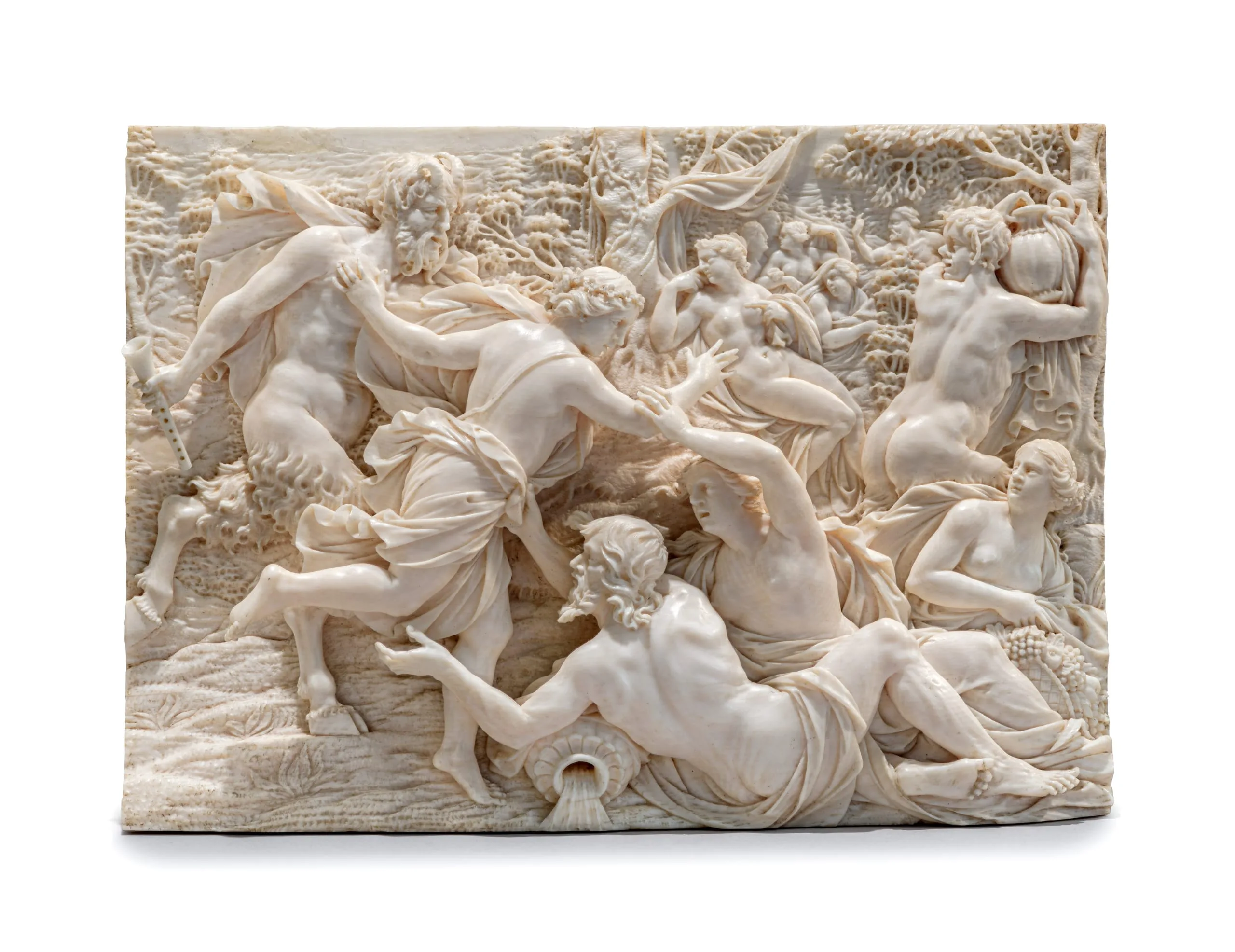
This miniature ivory relief is one of a series of three by sculptor Ignaz Elhafen that depict episodes from Ovid’s Metamorphoses. In the story, the satyr Pan chases the nymph Syrinx, who escapes his grasp by transforming into reeds. Elhafen’s version of the scene shows the moment her father, the river god Ladon, and another nymph reach out for Syrinx as she flees. The relief is based on Michel Dorigny’s 1666 etching after his 1657 painting Pan Pursuing Syrinx. Elhafen often drew from print sources for his ivory works, combining different references and reusing figures in multiple compositions. In adapting Dorigny’s two-dimensional picture to a three-dimensional format, he layered the scene with background figures, like the group of nymphs receding into the distance to the right of Syrinx, and vegetal details such as the canopies of branches. Sculptured ivory reliefs like this were prized by elite European collectors because they represented the technically difficult human manipulation of a fragile material. Collectors looked for traces of the ivory’s original form, including its grain, the curve of the tusk, irregular surface qualities, and areas of golden coloration.
Ivory had been traded across African and Asian trade networks since antiquity. Starting in the late fifteenth century, many of these networks were disrupted by the Portuguese seizure of key East African port cities. By the seventeenth century, Portugal’s monopoly in the trade of gold, ivory, and enslaved African people was challenged by France and especially the Dutch West India Company, which occupied several forts on the coast of West Africa. While carved ivory objects were also imported from India and Sri Lanka, tusks like those used to sculpt this relief were shipped from Africa to Europe, where they probably arrived via the port of Amsterdam, before traveling along trade routes to merchants and courts throughout the continent.
2025