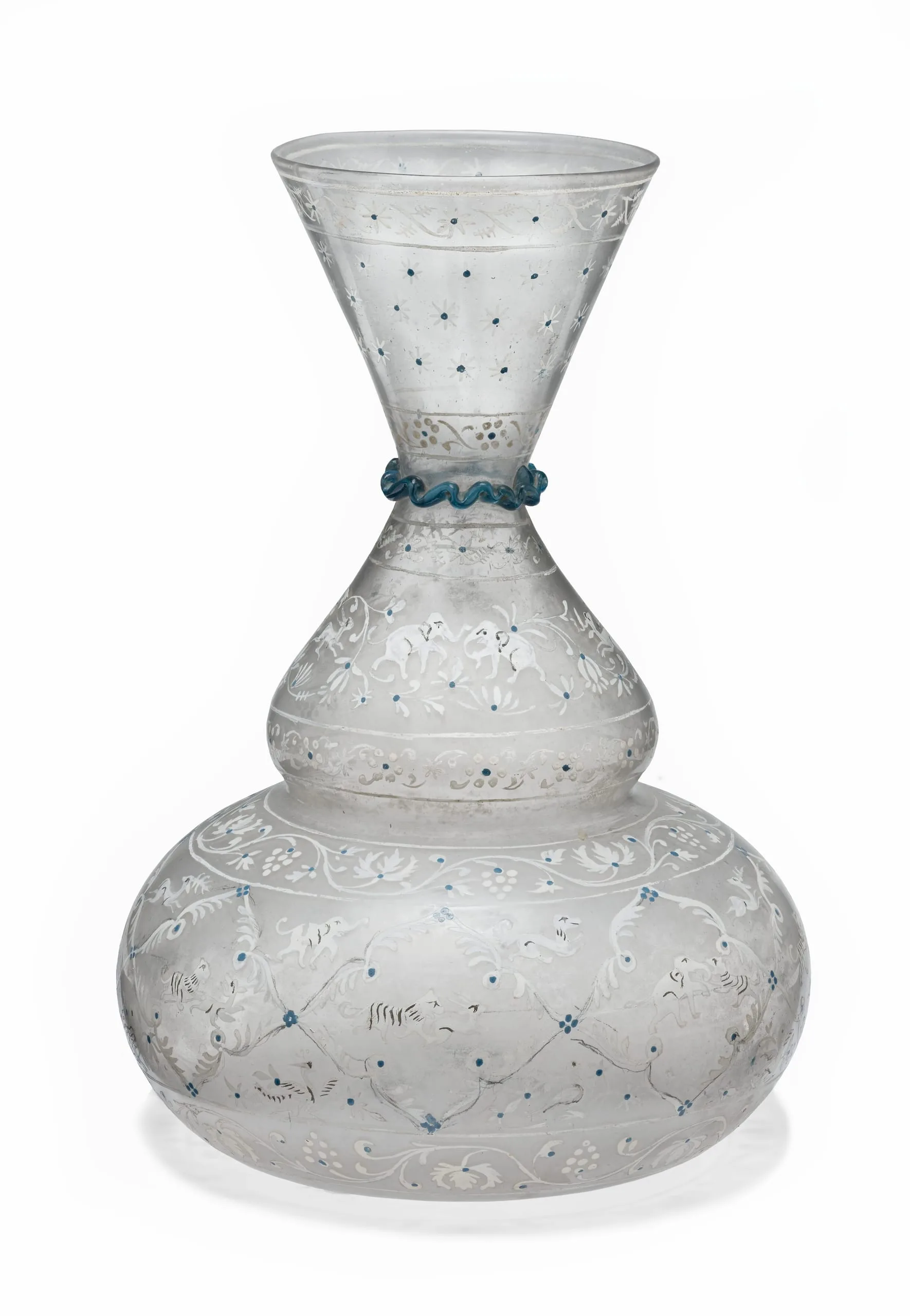
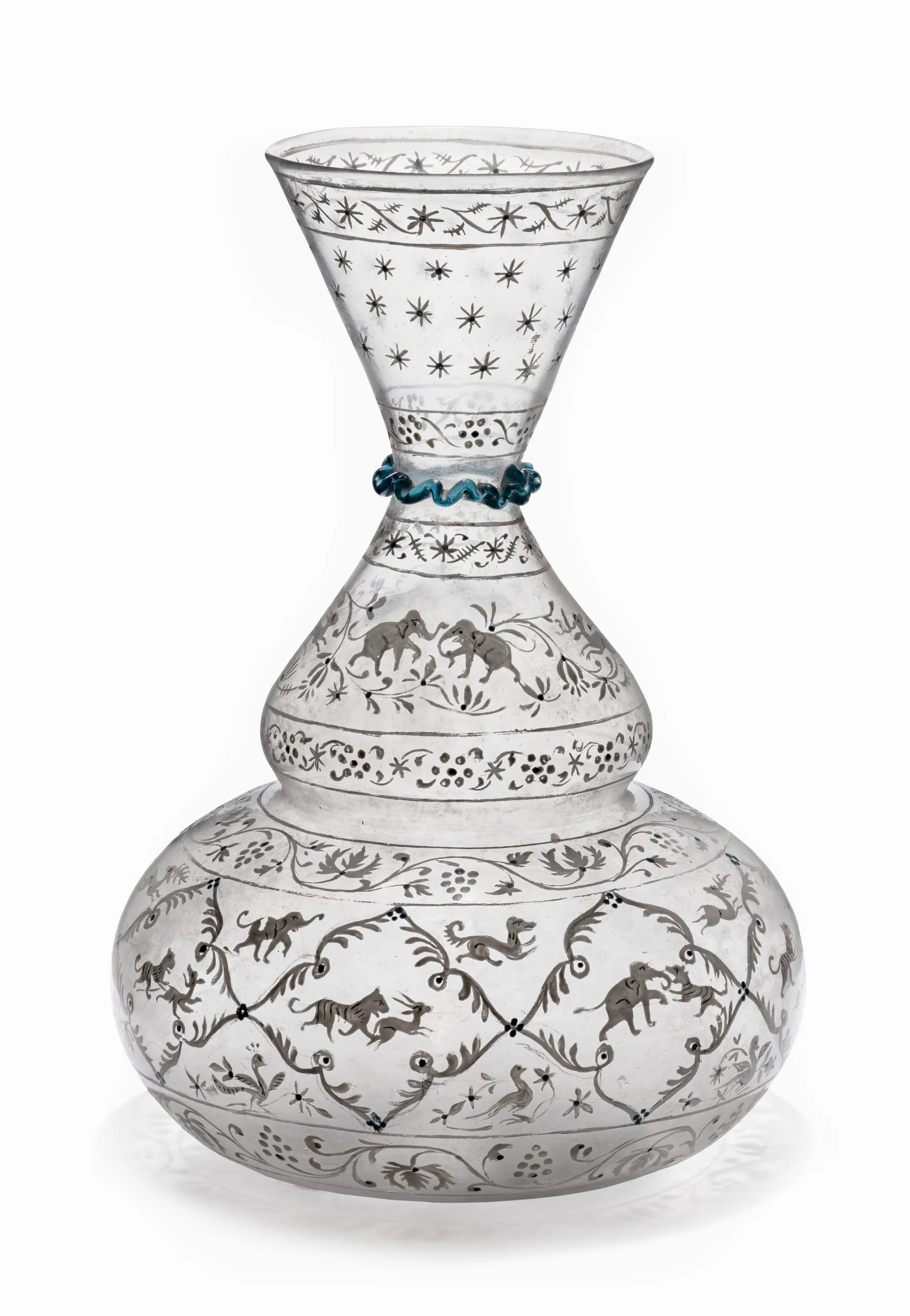
The earliest and rarest glass vessel in the museum’s South Asian collection is a flower vase of clear Venetian or façon de Venise glass with enameled decoration, attributed to c. 1670–1700. The hourglass-shaped vase has an irregular, meandering ribbon of peacock-blue glass—a characteristic of Venetian and façon de Venise glassware—encircling the throat at its narrowest diameter. Beneath the trailing ribbon, the vessel flares out into an inverted funnel that curls back to a short, vertical neck above a slightly flattened, bulbous body. The ribbon and the vessel’s distinctive shape help determine the vase’s date and place of origin. Pattern drawings sent with manufacturing orders in 1669-1671 by the London glass dealer John Greene to Allesio Morelli, a Venetian glassmaker specializing in the international glass trade, stipulate such hourglass-shaped flower vases. Greene may have re-exported some of the wares he received or additional flower vases could have been sent from Venice directly to India and other venues in the lucrative Eastern glass market.
LACMA’s Indianate flower vase is embellished with enamel designs most likely executed by a European artist working in what was imagined to be an Indian style. The enamel decoration
, predominately white with blue accents, features a star pattern on the upper neck, while on the lower neck and body are various animals and hunting scenes, the latter of which are set within a cuspate trellis pattern of split acanthus leaves. A fascinating technical feature of the vase is that the painted enamel decoration has the dichroic property of exhibiting different colors by reflected or transmitted light. Accordingly, despite being executed in the same enamel color, the design elements that appear white are due to their reflected light, whereas the patterns that appear golden are due to transmitted light.
A mate to the LACMA flower vase, albeit with a more Islamicate decorative program, is in the Minneapolis Institute of Art (82.10.5).
See Stephen Markel, "Western Imports and the Nature of Later Indian Glassware," Asian Art 6:4 (Fall 1993): p. 46, fig. 8.