LACMA

ShopMembershipMyLACMATickets
LACMA
Los Angeles County Museum of Art
5905 Wilshire Blvd.
Los Angeles, CA 90036
info@lacma.org
(323) 857-6000
Sign up to receive emails
Subscribe
© Museum Associates 2025

Museum Hours

Monday

11 am–6 pm

Tuesday

11 am–6 pm

Wednesday

Closed

Thursday

11 am–6 pm

Friday

11 am–8 pm

Saturday

10 am–7 pm

Sunday

10 am–7 pm


  • About LACMA
  • Jobs
  • Building LACMA
  • Host An Event
  • Unframed
  • Press
  • FAQs
  • Log in to MyLACMA
  • Privacy Policy
© Museum Associates 2025
Collections

Unknown
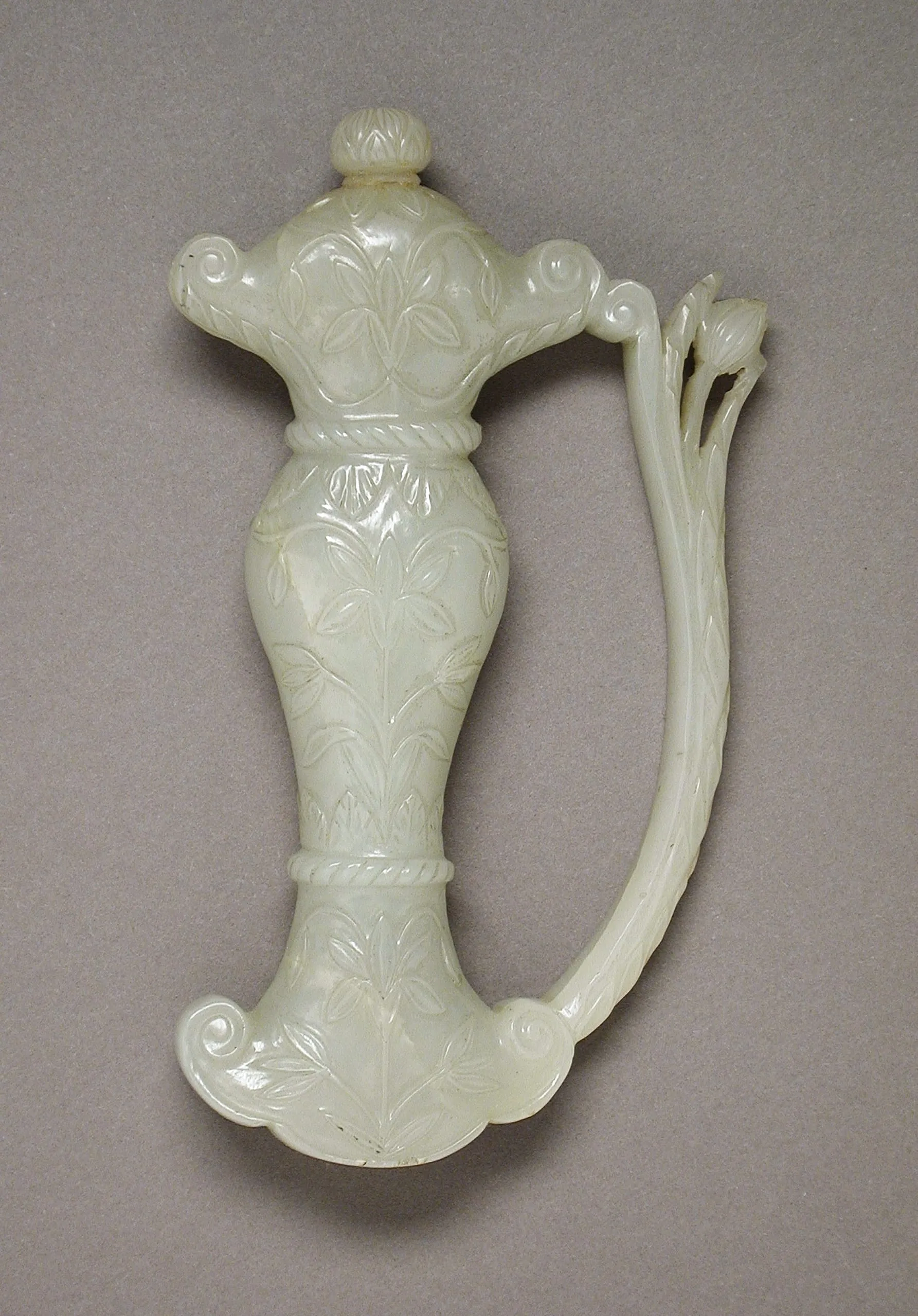
Dagger Hilt for a Young Princelate 17th century

Not on view
Pale celadon jade ewer with sinuous double-gourd body, allover vine-scroll relief carving, scrolled volutes, and curved handle
Artist or Maker
Unknown
Title
Dagger Hilt for a Young Prince
Place Made
India, Mughal empire
Date Made
late 17th century
Medium
White nephrite jade
Dimensions
4 3/4 x 2 3/4 x 3/4 in. (12.07 x 6.99 x 1.91 cm)
Credit Line
From the Nasli and Alice Heeramaneck Collection, Museum Associates Purchase
Accession Number
M.76.2.8
Classification
Arms and Armor
Collecting Area
South and Southeast Asian Art
Curatorial Notes

Intricately fashioned from a single piece of white nephrite jade, this diminutive hilt has a lotus bud finial on the pommel, a baluster vase-shaped grip framed by twisted borders and rows of acanthus leaves, scrolling quillons (cross guards) at the mouth of the hilt and on the pommel bars, and a knuckle-bow (finger guard) in the form of a sprig of acanthus leaves terminating in a single lotus bud. The surface is enlivened with six blossoming irises executed in shallow relief.

The small scale of the hilt suggests that it was made for a youthful prince. Portraits of Mughal and Rajput young princes show them wearing proportionally scaled weaponry. A number of swords and daggers made for princely children survive in royal collections in Rajasthan. Based on comparisons to extant weapons with jade or rock crystal hilts made in the same form, this hilt was likely made for a dagger, although given its small size it is also conceivable it was intended for a prince’s sword.

During the reign of Emperor Jahangir (r. 1605-27), Mughal decorative arts began to shed their earlier Timurid and Safavid stylistic features to create a fully developed form of creative expression emphasizing bountiful floral imagery. Emperor Shah Jahan (r. 1628-58) not only continued his father Jahangir's love of floral imagery in the decorative and pictorial arts, but also codified formalized representations of flowering plants as the dynastic leitmotif that was perpetuated by the succeeding Mughal emperors.
Selected Bibliography
  • Rosenfield, John. The Arts of India and Nepal: The Nasli and Alice Heeramaneck Collection. Boston: Museum of Fine Arts, Boston, 1966.
  • Markel, Stephen. "The Use of Flora and Fauna Imagery in Mughal Decorative Arts." Marg 50, no. 3 (March 1999).
  • Pal, Pratapaditya, Thomas W. Lentz, Sheila R. Canby, Edwin Binney, 3rd, Walter B. Denny, and Stephen Markel. "Arts from Islamic Cultures: Los Angeles County Museum of Art." Arts of Asia 17, no. 6 (November/December 1987): 73-130.