- Title
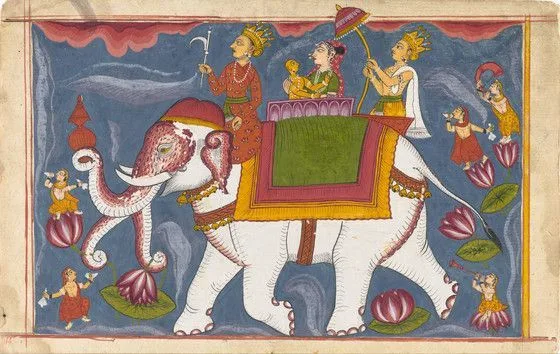
- Indrani Conveying the Infant Jina Rishabhanatha on Airavata, Folio from a Bhaktamara Stotra (Hymn of the Immortal Devotee)
- Date Made
- circa 1800-1825
- Medium
- Opaque watercolor on paper
- Dimensions
- Image (Image): 6 3/4 x 9 7/8 in. (17.145 x 25.0825 cm)
Sheet (Sheet): 7 1/4 x 11 3/8 in. (18.42 x 28.8925 cm)
Frame: 14 × 19 in. (35.56 × 48.26 cm)
- Accession Number
- AC1992.170.1
- Curatorial Notes
The Bhaktamara Stotra (Hymn of the Immortal Devotee) was composed in Sanskrit by the Jain preceptor Manatunga (circa 7th century). It eulogizes the Jina Rishabhanatha, the first Jain savior (jina or tirthankara) of the present time cycle of Jain cosmology.
This folio from a dispersed series of the Bhaktamara Stotra depicts Indrani conveying the infant Jina Rishabhanatha (or Adinatha) under an honorific parasol in a howdah on the multi-trunked divine elephant Airavata. After Queen Marudevi gave birth to Rishabhanatha, Indra and his wife Indrani (or Sachi) descended from Indra’s heaven and went to Marudevi’s bed chamber in the palace. Indrani placed her in a trance and substituted a duplicate child for the baby Jina. They then took Rishabhanatha in a grand procession to the cosmic Mount Meru for the lustration rites (Janmabhisheka) that he performs on newborn Jinas with 1008 sacred water vessels (see its series mate AC1992.270.2). After the ceremony, the baby Jina was returned to his mother and exchanged for the surrogate infant. Here, celestial nymphs (apsarasas) dance and blow horns to celebrate the auspicious occasion.
See also M.74.102.4.