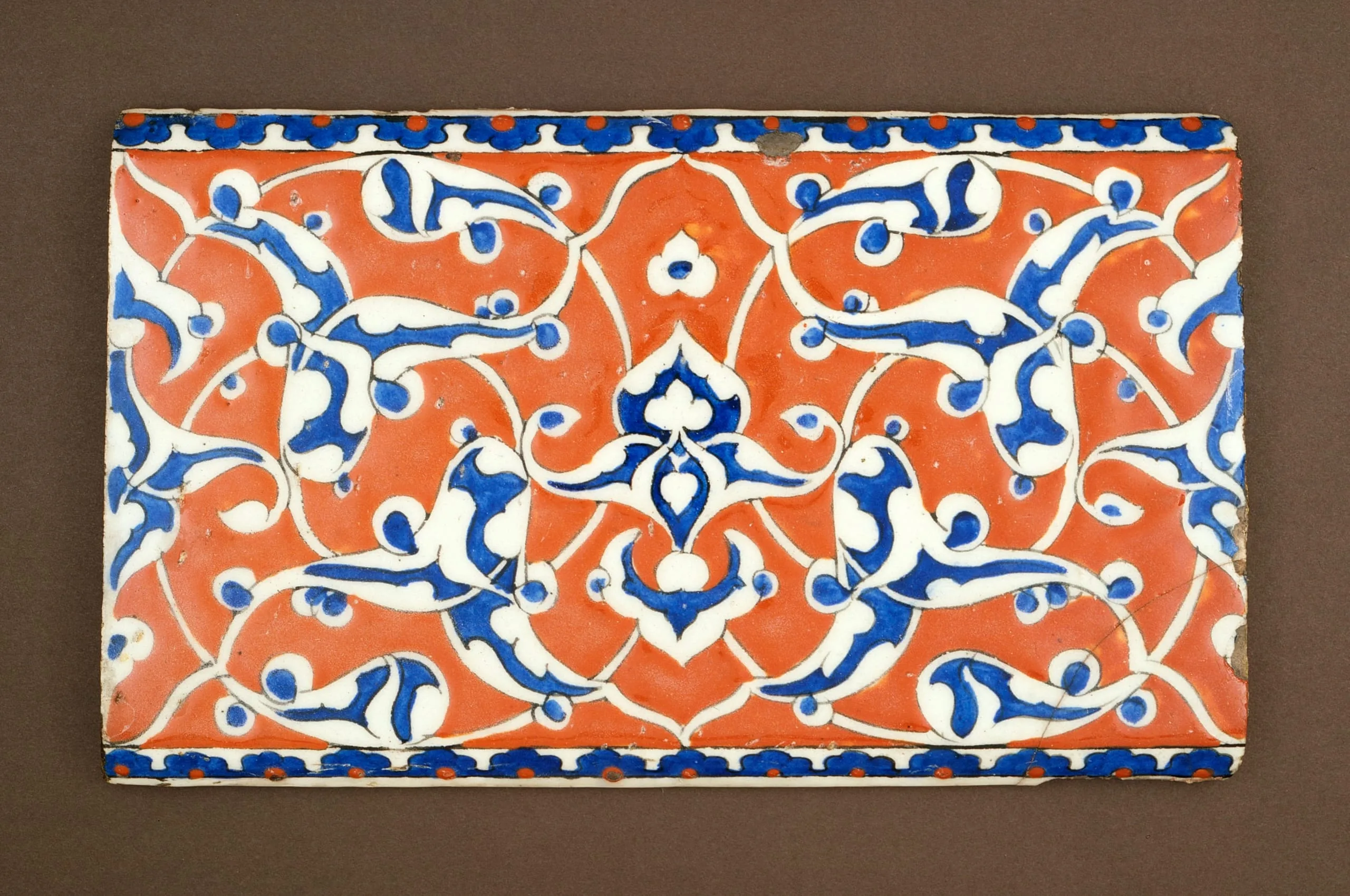
Ceramics made in Iznik, in western Turkey, represent one of the most renowned and influential arts of the Ottoman period. The Iznik kilns, about 85 miles southeast of the capital, Istanbul, produced both tableware and architectural revetment such as this. Tiles were first manufactured at Iznik around the early 16th century, however, production increased dramatically in the second half of the century as the court sponsored more and more new buildings.
Tiles of this general type were popular in the second half of the sixteenth century, serving as borders for other multi-tile panels that graced the mosques and palaces of Istanbul. Tiles of this same design were used in the royal living quarters of Murad III at the Topkapi Saray Palace, as well as in its large domed antechamber dating to 1578. Such tiles are today widely dispersed, perhaps as a consequence of a devastating fire in the Harem in 1665, and can be found in museum collections the world over. (See https://collections.lacma.org/node/198922>M.2000.31 for another but different tile from this same section of the palace).