- Title
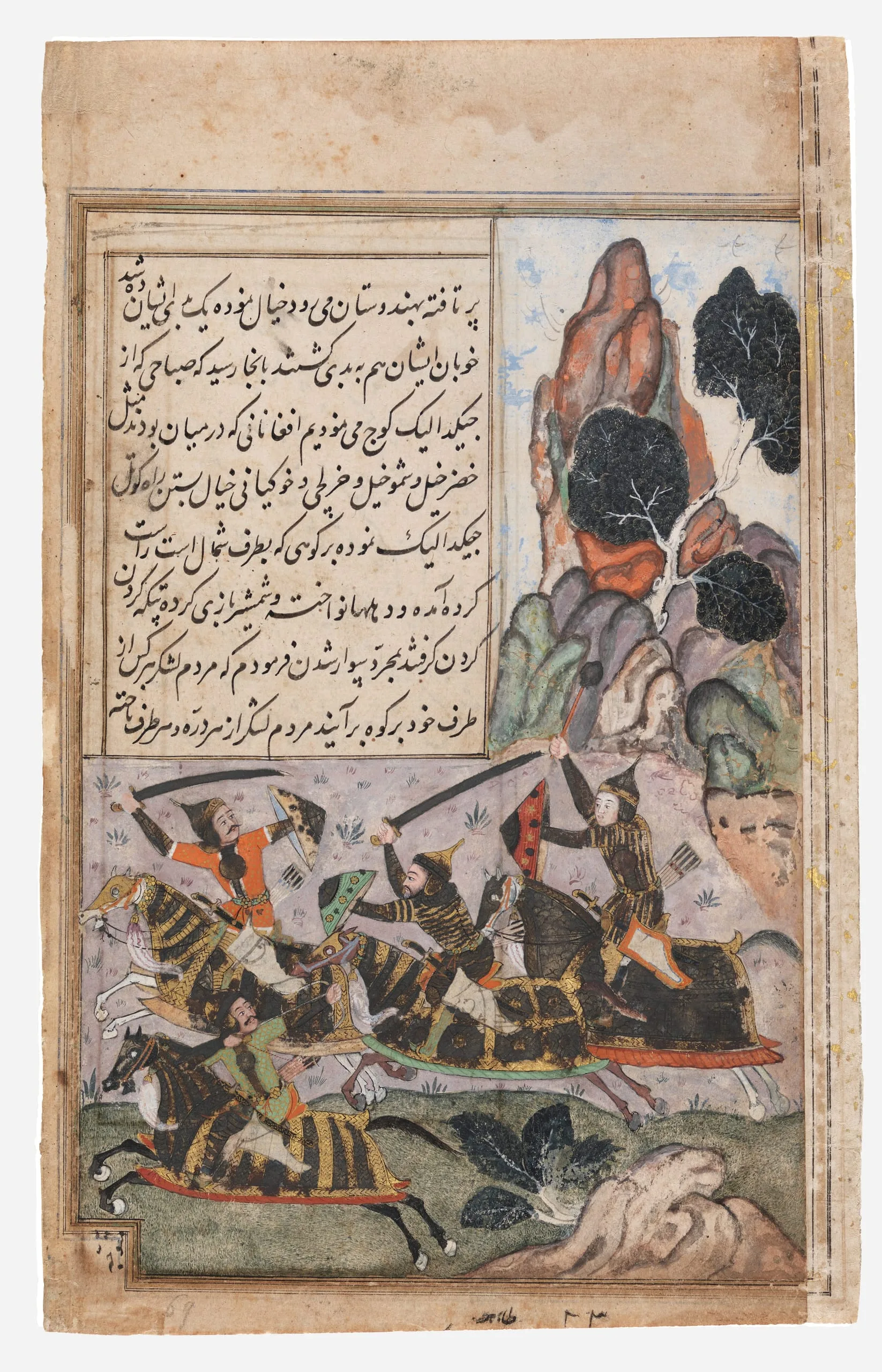
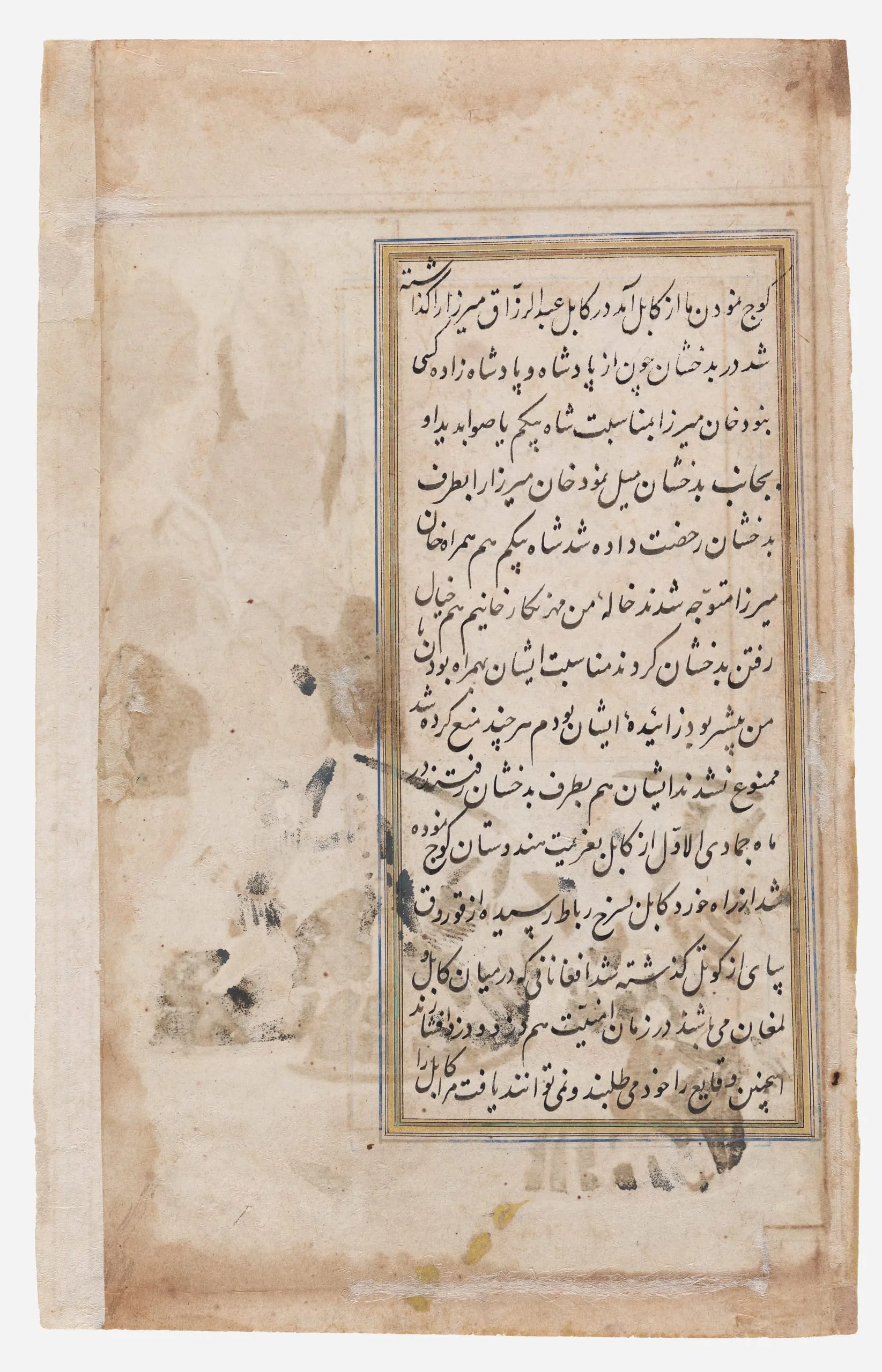
- Babur Marches from Kabul to Hindustan in 1507 (recto); Text (verso); Folio from a Baburnama (Memoirs of Babur)
- Date Made
- 1589-1590
- Medium
- Opaque watercolor, gold, and ink on paper
- Dimensions
- Image: 8 5/8 x 5 7/8 in. (21.91 x 14.92 cm); Sheet: 10 1/2 x 6 5/8 in. (26.67 x 16.83 cm)
- Accession Number
- M.91.348.1
- Curatorial Notes
The Baburnama (Memoirs of Babur) is an autobiography written in Chagatai Turkish by the Mughal Emperor Babur (r. 1526 30). Several translations into Persian were produced for Babur’s grandson, Emperor Akbar (r. 1556-1605). This folio and M.81.8.7 are from the earliest Baburnama, which was supervised by Abd al-Rahim, Khan Khanan and presented to Akbar in November 1589. The manuscript was dispersed in 1913, with twenty of the original 191 illustrations now held by the Victoria and Albert Museum, London.
This folio is the right half of a double-page illumination. The facing composition on the left-hand page cannot now be traced. The episode illustrated occurred at the start of Babur’s second Hindustan campaign in September-October 1507. As Babur and his army marched out of Kabul, Afghanistan, they were blocked in the Jagdalak Pass by miscreant Afghans intending to rob them. Babur ordered his men to mount their horses and gallop towards them from all sides. The intimidated Afghans took flight and Babur went up the mountain in pursuit. He shot one of them in the arm and was captured. Several captured Afghans were impaled to set an example. The painting depicts a mountainous landscape with two of Babur’s mounted warriors attacking two fleeing Afghans on horseback. The Afghan in the foreground turns around on his horse and fires an arrow back at his attackers in the classic Parthian shot. His cohort above him also turns around to do battle with his sword and shield.
- Selected Bibliography
- Pal, Pratapaditya. Indian Painting, vol.1. Los Angeles: Los Angeles County Museum of Art, 1993.
- Komaroff, Linda. Beauty and Identity: Islamic Art from the Los Angeles County Museum of Art. Los Angeles: Los Angeles County Museum of Art, 2016.