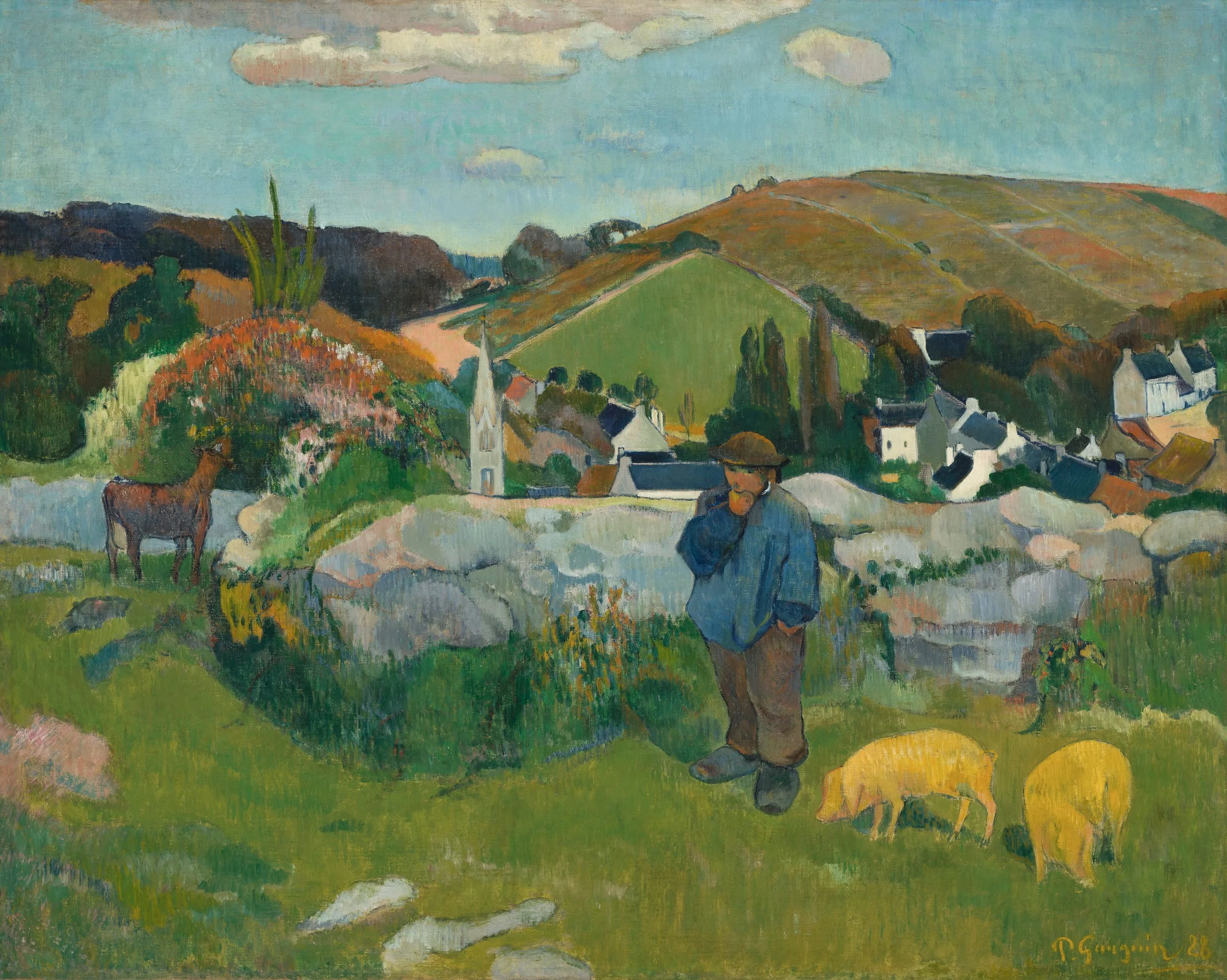
An exemplar of Gauguin’s style in all its pastoral fantasy, this colorful painting depicts the landscape of Pont-Aven, a rural village in Brittany. The central character, the swineherd, stands near his two pigs along the banks of the river Aven, rooftops and houses of the town just visible in the valley below, with cultivated hills rising in the distance. Gauguin made his second visit to Pont-Aven in 1888, the year this was painted. The region of Brittany appealed to the artist for its perceived simplicity via its inhabitants’ agricultural lifestyle and active folk traditions, and a landscape unadulterated by modern industry.
The painting’s provenance illustrates how the market for Impressionist, Post-Impressionist, and other avant-garde works helped shape museum collections. The Swineherd was once owned by Gustave Fayet (1865−1925), an artist and avid collector who was one of Gauguin’s early patrons. It would pass through the hands of influential dealers like the Wildenstein Gallery, which sold it to Norton Simon in 1955. It was one of two important purchases of late nineteenth-century French art that Simon made that year, the other being a Pissarro, which focused his collecting tastes and resulted in the founding of a museum dedicated to his artworks. Lucille Ellis Simon (1911−2000), a philanthropist and ex-wife of the collector, donated funds for art and educational programs to LACMA, eventually gifting The Swineherd on the occasion of the museum’s 25th anniversary.
2024