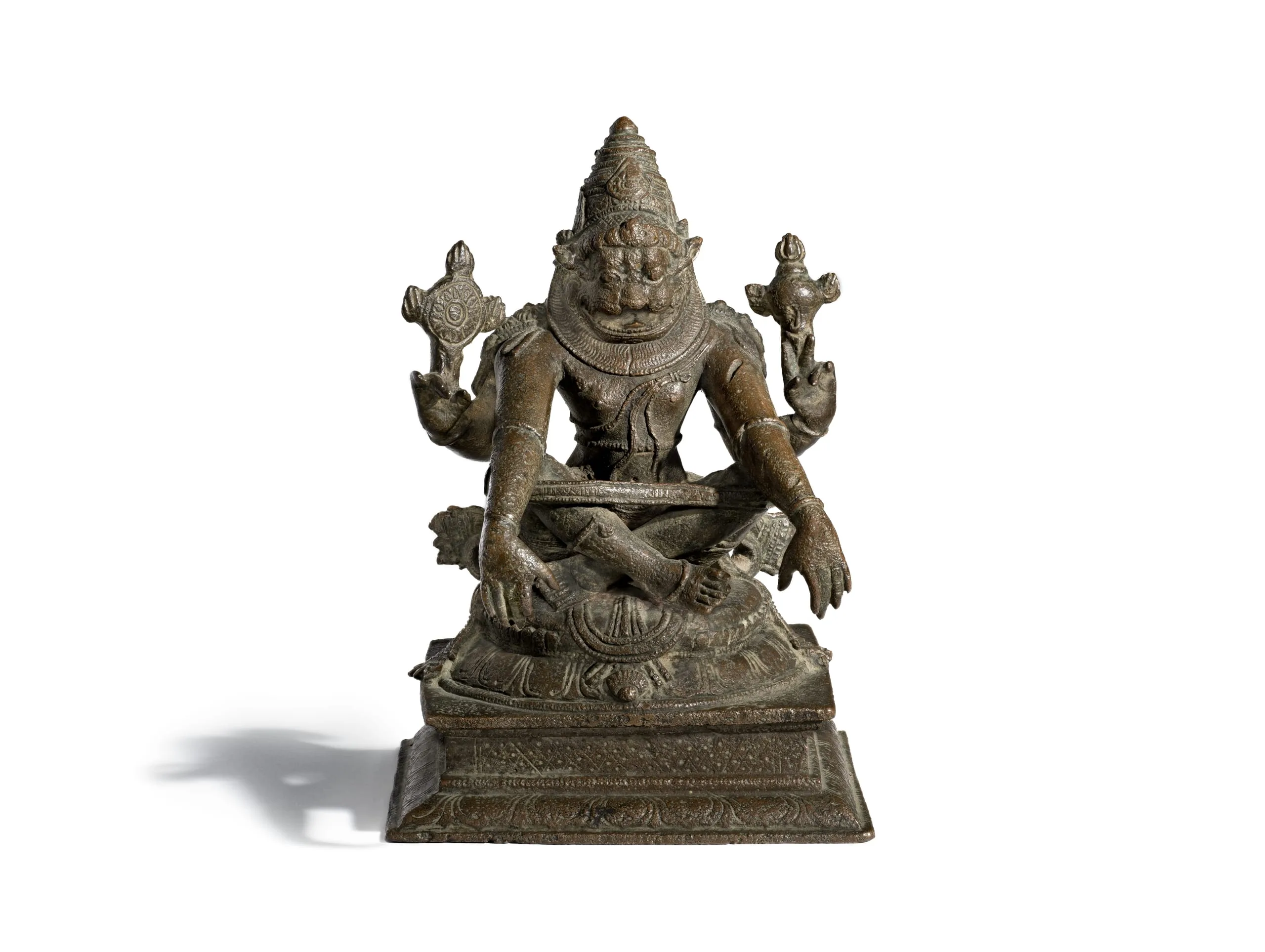
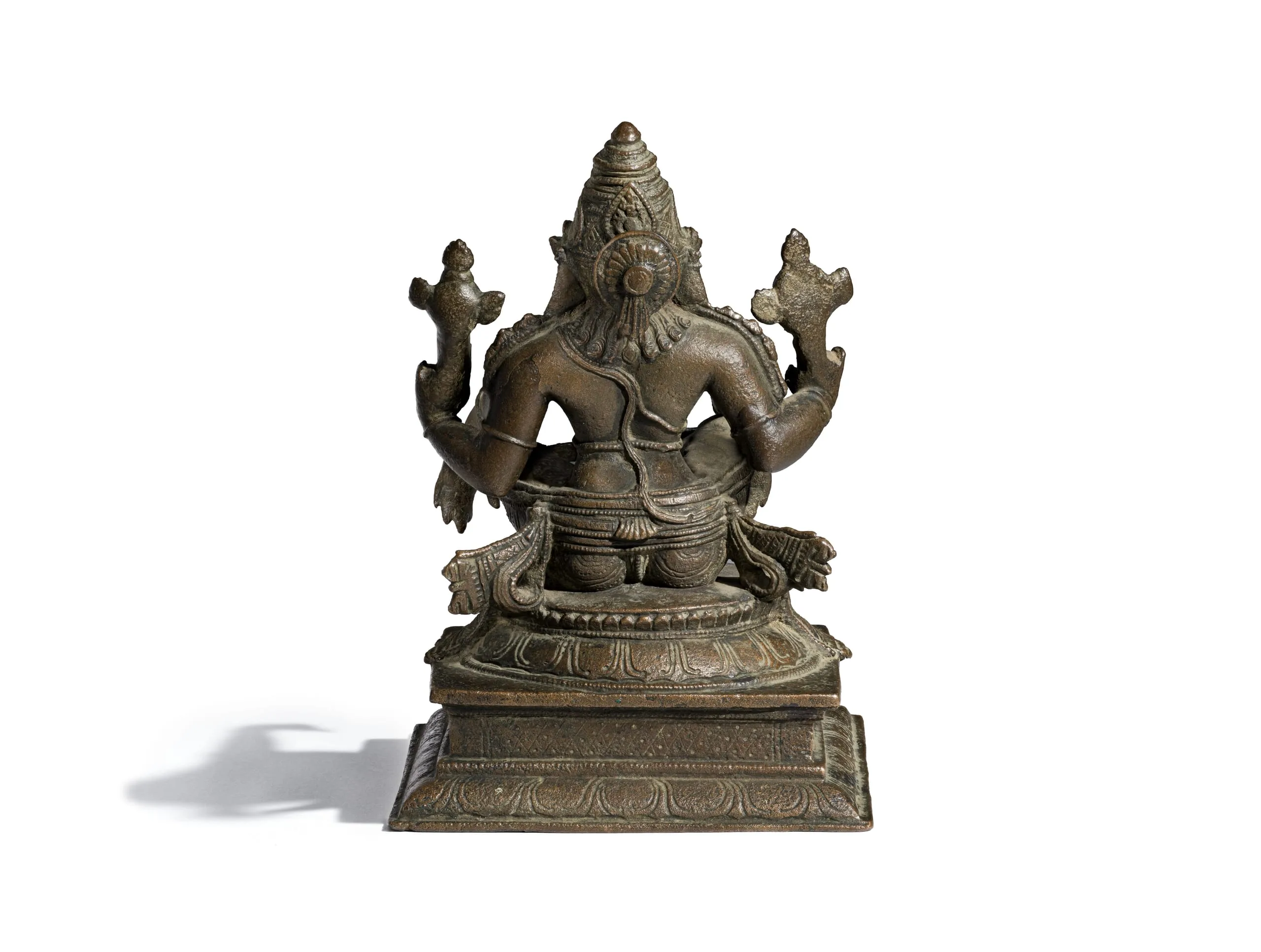
Representations of Narasimha, the Man-Lion avatar of the Hindu god Vishnu, first appear in Indian art by at least the 2nd century CE when they were shown in a benign theriomorphic form as a seated lion (see M.82.18.1). By the Gupta period in the 4th-6th century, Narasimha was portrayed as an iconic image (see M.81.90.20) or in a fierce form engaged in combat with the Demon King Hiranyakashipu (for example, see Cave 3 at Badami, Karnataka, dating from 578). By the 18th century, northern Indian paintings typically depict Narasimha disemboweling Hiranyakashipu (see M.82.42.8). In southern India beginning around the 12th century, there are also portrayals of Narasimha in a peaceful attitude (shanta) as Yoga-Narasimha, The Lord of Yoga, when he is meditating after destroying Hiranyakashipu. This iconographic form parallels the aspect of Shiva as Yoga-Dakshinamurti, The Teacher of Yoga (see M.76.98a-b and M.82.221).
Yoga-Narasimha sits on a lotus base in the yogic squatting posture (utkutika asana) with his legs crossed and supported by a meditation band (yoga patta) around his knees. He wears a tiered conical crown (karanda mukuta) with a circular nimbus (shirashchakra), a waist sash, and the Brahmanical sacred thread (yajñopavita) over his left shoulder. He is four-armed. His extended principal hands rest on his knees with his palms facing downward. His upper right hands hold the discus (sudarshana chakra), while his upper left hand holds the conch (panchajanya shankha).
Comparable Yoga-Narasimha images are in the Cleveland Museum of Art (1973.187), Nelson Atkins Museum of Art, Kansas City (63-2), Metropolitan Museum of Art, New York (2000.284.4), and Musée Guimet, Paris (MG 2697).