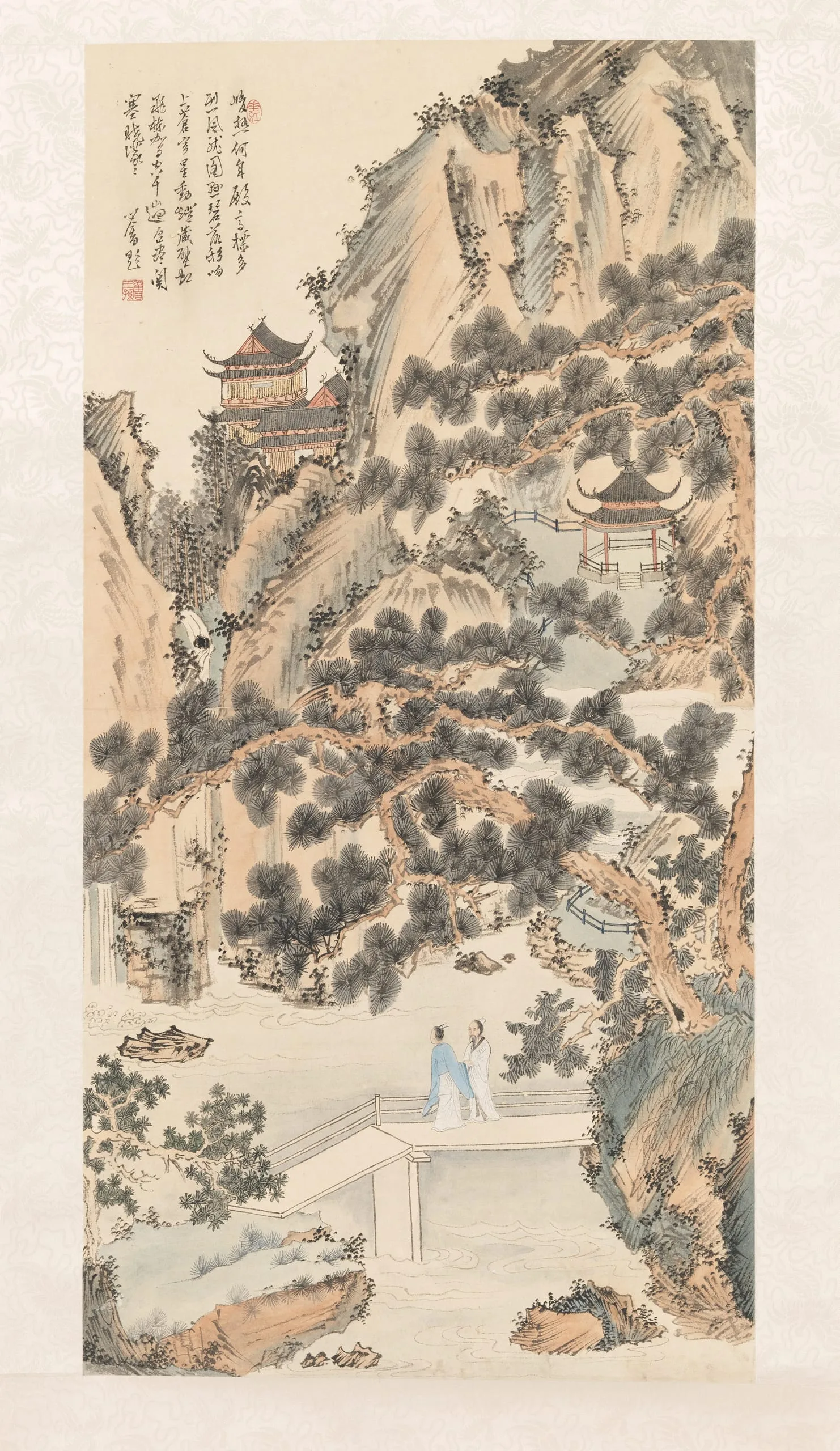
Pu Ru was one of the preeminent Chinese painters of the early twentieth century. This hanging scroll can be dated to the 1930s on the basis of several similar dated works in Chinese collections. Painted in a traditional style derived from such Song-dynasty artists as Li Tang (ca. 1050s–after 1130), the scroll depicts two gentlemen conversing on a bridge under pine trees. Behind the figures, a steep mountain ascends to the top of the painting. The landscape contains many angular rocks and pine trees, with an open-air pavilion and larger palatial buildings in the upper reaches. Pu Ru’s poem, inscribed in the upper left corner, reflects his mastery of classical Chinese calligraphy and poetry:
When did palaces appear on these lofty peaks?
Strong winds often blow their high signboards.
Dragon paintings suspended against the blue sky,
Owls [owl’s-tail roof ornaments] kiss the high vault of heaven.
Moving stars are like lamps hidden by screens,
As rainbows fly, ridge beams ride the void.
Encircled by a thousand mountains,
The pass is cold, the dawn nebulous.
—Inscribed by Xinyu [Pu Ru]
Born a prince of the Manchu imperial house, Pu Ru was a cousin of the Xuantong emperor (also known as Pu Yi), last ruler of the Qing dynasty. After the fall of the Manchu dynasty in 1911, Pu Ru continued to live in China until 1949, when he moved to Taiwan. There he worked as a traditional literati artist and taught at Taipei’s National Taiwan Normal University.
Stephen Little
2017