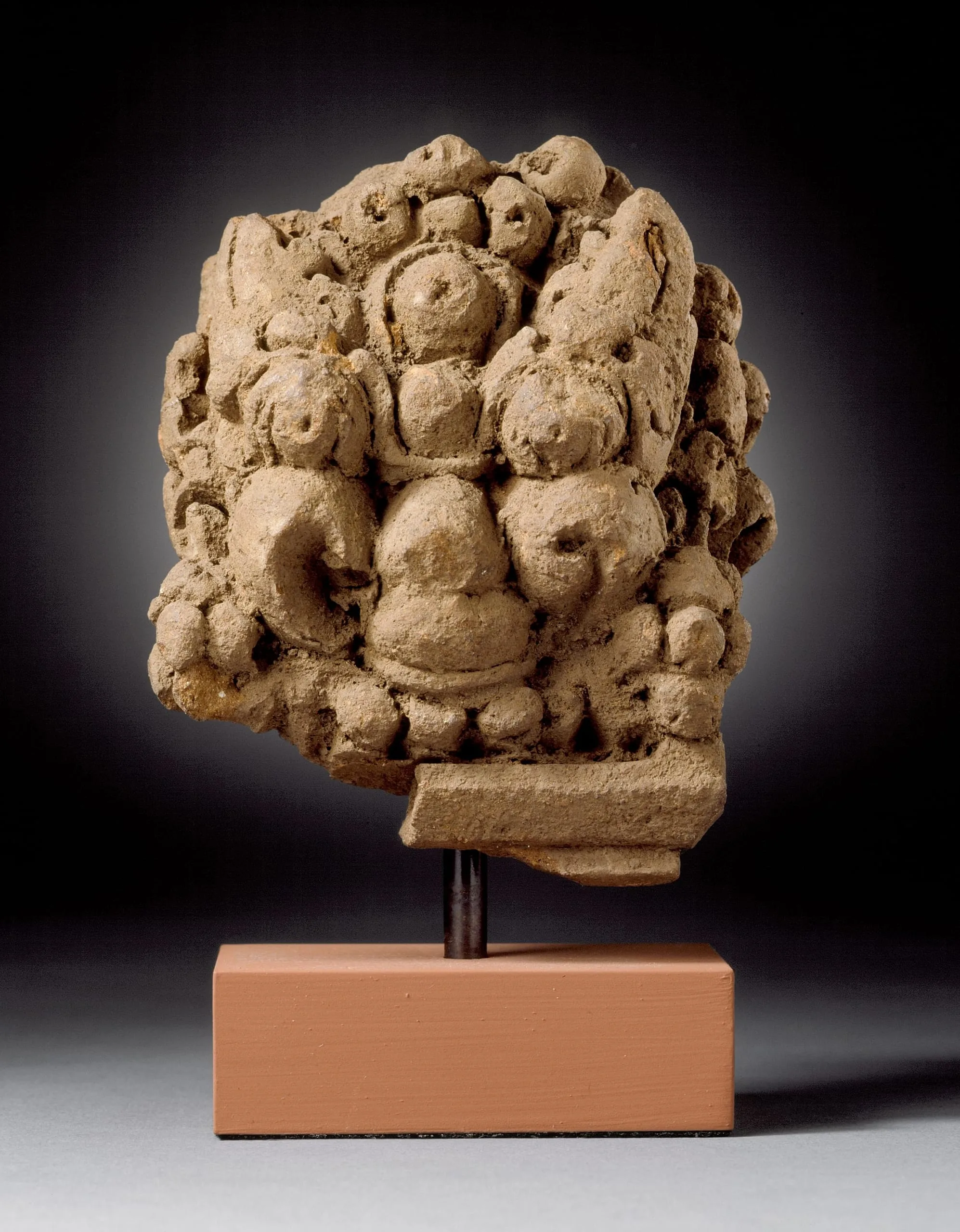
The most common apotropaic motif found in Indonesian art and architecture is the demonic mask known as a kala head (kala [time, death, or black] shiras). They resemble and may be derived from the Indian "Face of Glory" (kirttimukha), and may also relate to the Chinese gluttonous creature (taotie) and the Tibetan zipac or zeeba. Kala heads are typically represented to ward off danger, but they can also be used as a decorative motif. They are portrayed in a variety of media, see M.78.10.1 and M.91.232.1 (copper alloy), M.78.87.1 (stone), and M.86.346.2 (earthenware). Central Javanese representations usually lack a lower jaw, but Eastern Javanese depictions typically feature both jaws.
This kala head has the standard bulging eyes, horns, fangs, and fierce expression. Although partially fragmentary on the bottom edge, the remaining bottom frame suggests there was no lower jaw, or it is to be understood as hidden behind the frame.
A comparable Eastern Javanese earthenware kala head is in the National Museum of Asian Art, Washington (S2017.8.15).