- Title
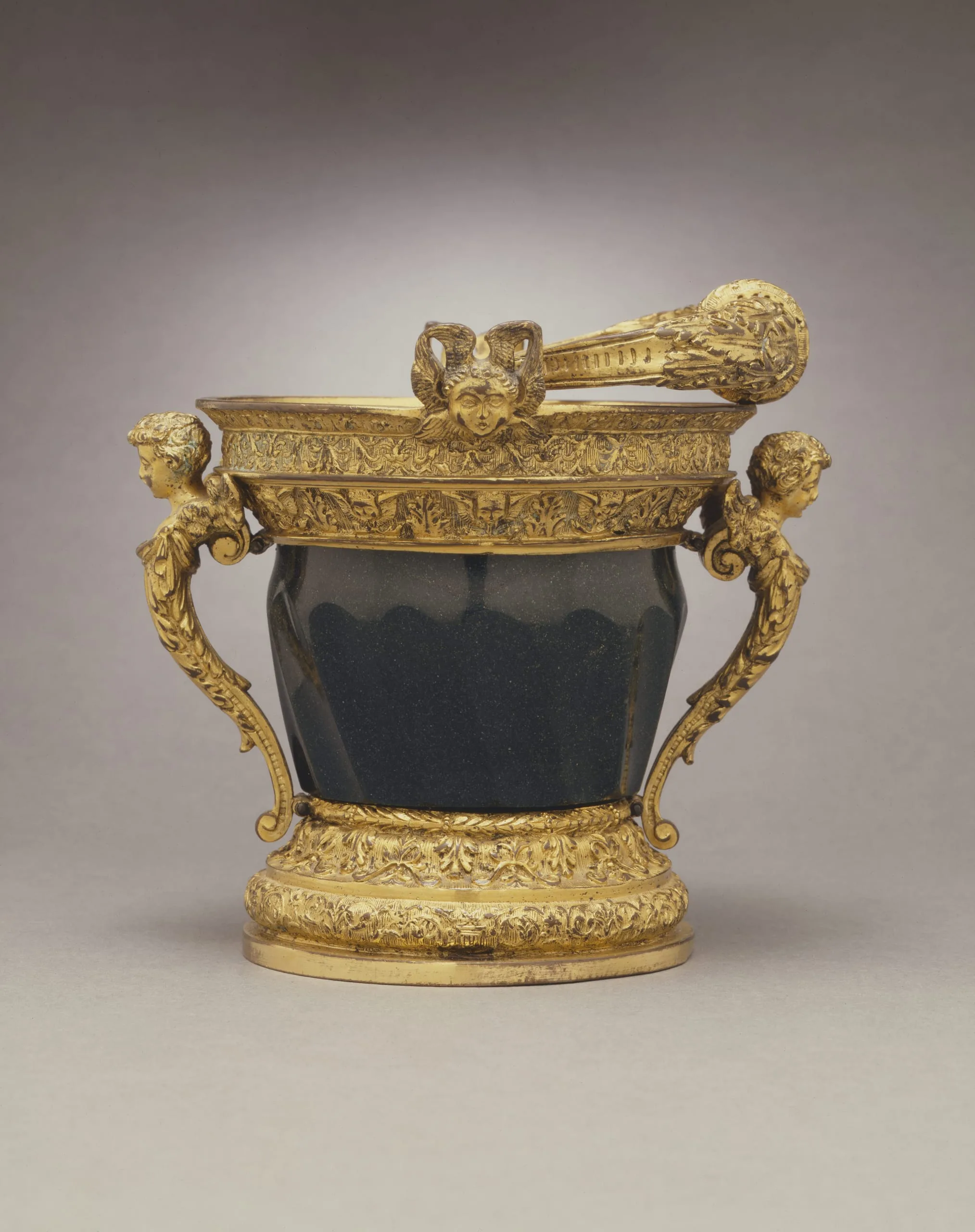
- Holy Water Bucket
- Date Made
- circa 1520
- Medium
- Serpentine stone, gilt bronze
- Dimensions
- 4 1/8 x 5 3/8 in. (10.48 x 13.65 cm); Diameter: 4 3/4 in. (12.07 cm)
- Accession Number
- AC1992.152.103
- Curatorial Notes
The combination of serpentine stone and elaborately cast and gilt bronze makes this a particularly luxurious object. Serpentine, a green metamorphic stone, could be easily carved and polished to create a lustrous, waxy surface. This vessel, known as an aspersorium, was intended to hold holy water used in the Roman Catholic ritual of asperges, in which a priest sprinkles water on the congregation before mass. The bucket would have been accompanied by an equally lavish aspergillum, or baton, that the priest would dip into the water and wave throughout the church. Both holy water and the ritual of asperges were symbolic of purification and the cleansing of sin. The design of the cast and gilt mounts, as Timothy Schroder has documented, is indebted to Northern European ornament prints that were widely available throughout Europe. A nearly identical holy water bucket formerly in the French royal collection was brought from Italy to France in the early 1500s. The similarity of its ornament to that found on bronze mortars and bells made in Venice and Padua further suggests that both buckets were created in Northern Italy.
- Selected Bibliography
- Thomas, Nancy, and Constantina Oldknow, eds. By Judgment of the Eye: The Varya and Hans Cohn Collection. Los Angeles: Hans Cohn, 1991.