LACMA

ShopMembershipMyLACMATickets
LACMA
Los Angeles County Museum of Art
5905 Wilshire Blvd.
Los Angeles, CA 90036
info@lacma.org
(323) 857-6000
Sign up to receive emails
Subscribe
© Museum Associates 2025

Museum Hours

Monday

11 am–6 pm

Tuesday

11 am–6 pm

Wednesday

Closed

Thursday

11 am–6 pm

Friday

11 am–8 pm

Saturday

10 am–7 pm

Sunday

10 am–7 pm


  • About LACMA
  • Jobs
  • Building LACMA
  • Host An Event
  • Unframed
  • Press
  • FAQs
  • Log in to MyLACMA
  • Privacy Policy
© Museum Associates 2025
Collections

Unknown
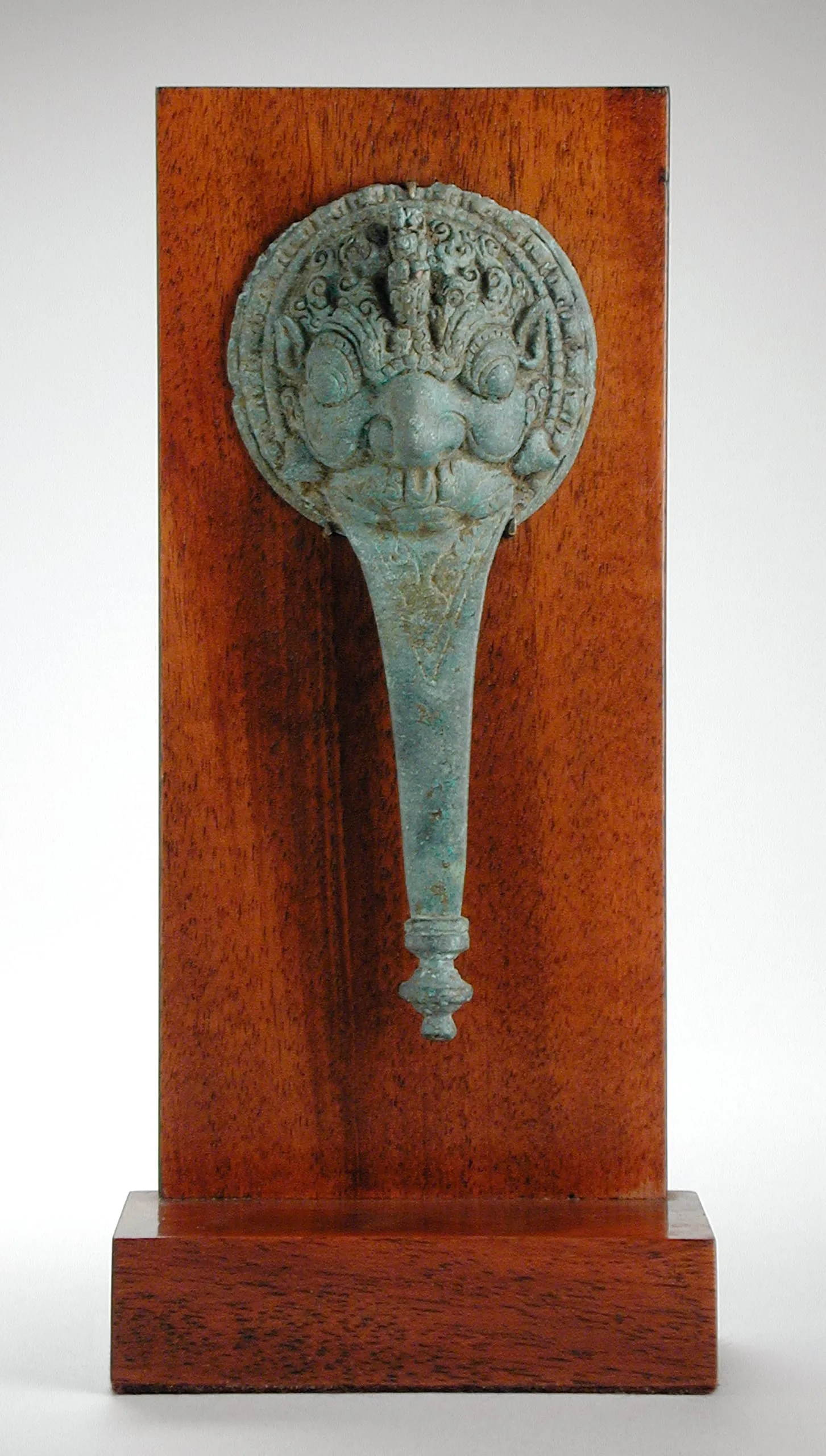
Handle with a Kala Head13th century

Not on view
Bronze object with blue-green patina mounted on a wooden panel, featuring a circular disk with a relief face, horns, and flanking animal figures above a tapering handle with a finial
Artist or Maker
Unknown
Title
Handle with a Kala Head
Place Made
Indonesia, Eastern Java
Date Made
13th century
Medium
Copper alloy
Dimensions
6 x 2 1/2 x 3/4 in. (15.2 x 6.4 x 1.9 cm)
Credit Line
Gift of Mr. and Mrs. Werner G. Scharff
Accession Number
M.91.232.1
Classification
Tools and Equipment
Collecting Area
South and Southeast Asian Art
Curatorial Notes

The most common apotropaic motif found in Indonesian art and architecture is the demonic mask known as a kala head (kala [time, death, or black] shiras). They resemble and may be derived from the Indian "Face of Glory" (kirttimukha), and may also relate to the Chinese gluttonous creature (taotie) and the Tibetan zipac or zeeba. Kala heads are typically represented to ward off danger, but they can also be used as a decorative motif, such as on this handle. They are portrayed in a variety of media, see M.78.10.1 (copper alloy), M.78.87.1 (stone), and M.91.300.1 (earthenware). Central Javanese representations usually lack a lower jaw, but Eastern Javanese depictions typically feature both jaws.

This kala head has the standard bulging eyes, horns, fangs, and fierce expression. In place of a lower jaw, however, the artist has ingeniously envisioned the creature’s long tongue as a handle. It would have likely been mounted on a furniture door or drawer.