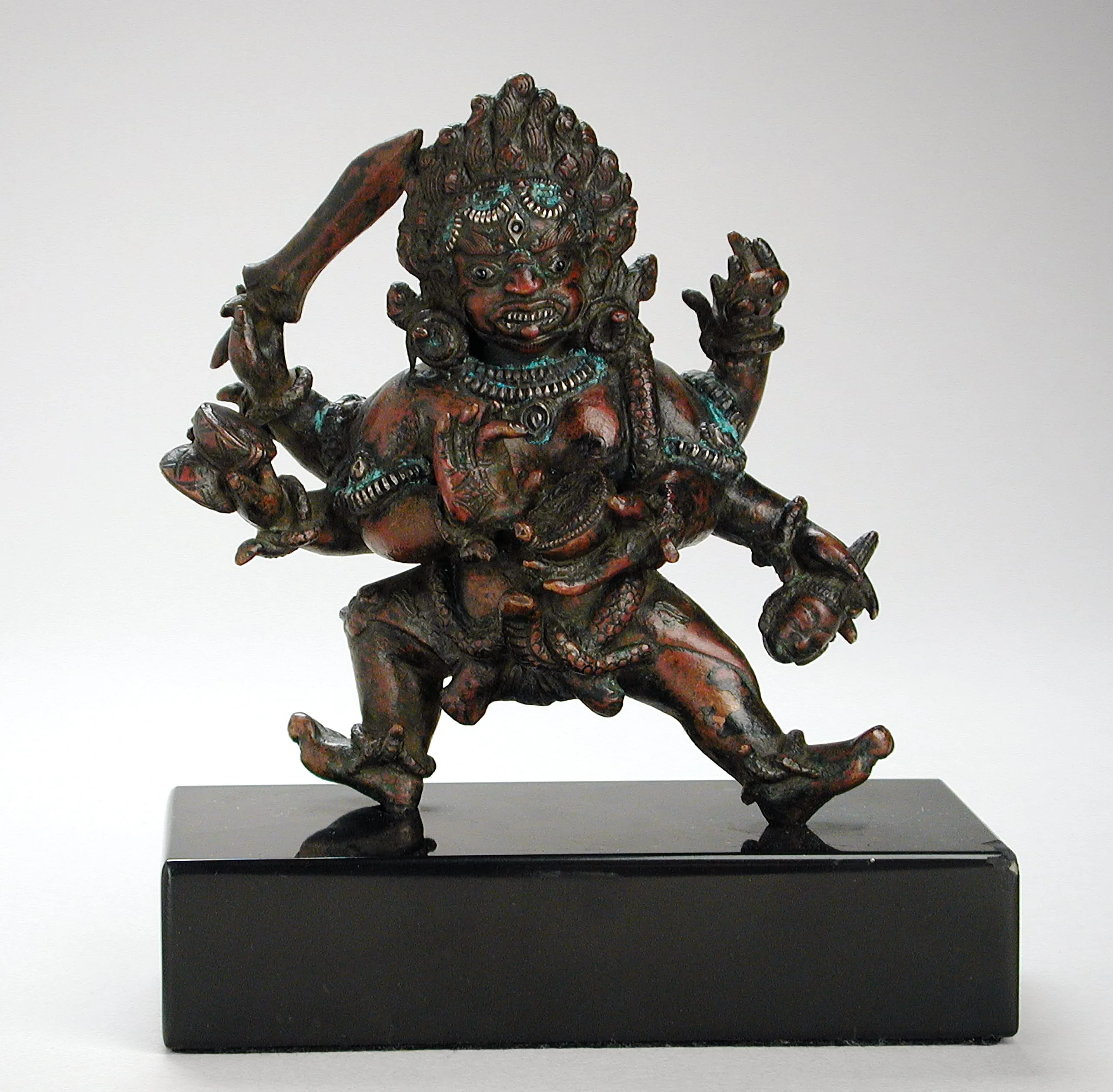
Bhairava (frightful) is a violent or powerful (ugra) form of the Hindu god Shiva. The deity’s creation is told in the lingodbhava myth about the origin of a colossal column of flame arising from the cosmic ocean (see M.74.138.4). According to the myth, Brahma and Vishnu were arguing boastfully over who was the more powerful, when suddenly they came upon the column of flame. Brahma took the form of his mount, a white gander, and flew upward to find the flame's summit. Vishnu sought the fire's origin by diving into the ocean in his boar incarnation (see also M.72.53.8 and M.87.160.2). When neither god could find an end to the column, which was actually a linga (Shiva’s aniconic symbol), Shiva triumphantly emerged from its side and proclaimed his supremacy. Because Brahma had falsely proclaimed to have found the upper origin of the column (which was cosmologically the axis mundi connecting heaven and earth), the enraged Shiva cut off Brahma’s fifth head for lying and was condemned to wander the earth as a naked beggar.
Bhairava is accordingly represented as naked except for an elephant skin (gaja ajina) draped around his waist, a belt made of entwined snakes, and serpentine ornaments, including the Brahmanical sacred thread (yajñopavita) over his left shoulder. He has a fierce facial expression with a glowing red complexion, bulging eyes, furrowed brows, fangs, and flaming hair that forms a nimbus (see also M.83.48). He has Shiva’s third eye of wisdom (jñana netra), and six arms. His principal left hand holds a skull cup (kapala) filled with blood. His principal right hand is held in the ring gesture (kataka mudra). In his upper right hand, he brandishes a sword (khadga). In his lower right hand, he holds an hourglass-shaped pellet drum (damaru) (see also M.85.298.2, M.86.127, and AC1998.34.1). In his upper left hand, he holds what is likely a small shield (khetaka). In his lower left hand, he carries Brahma’s decapitated head. Bhairava stands in a militant posture (alidha asana) with his right leg bent forward and his left leg extended. He originally stood on one or two prostrate human figures representing ignorance, ego, and the forces of evil. By standing on them, the deity symbolizes the triumph of divine truth over human delusion and the destruction of cosmic obstacles. See also M.70.42.4, M.81.206.2, and M.86.338.3.