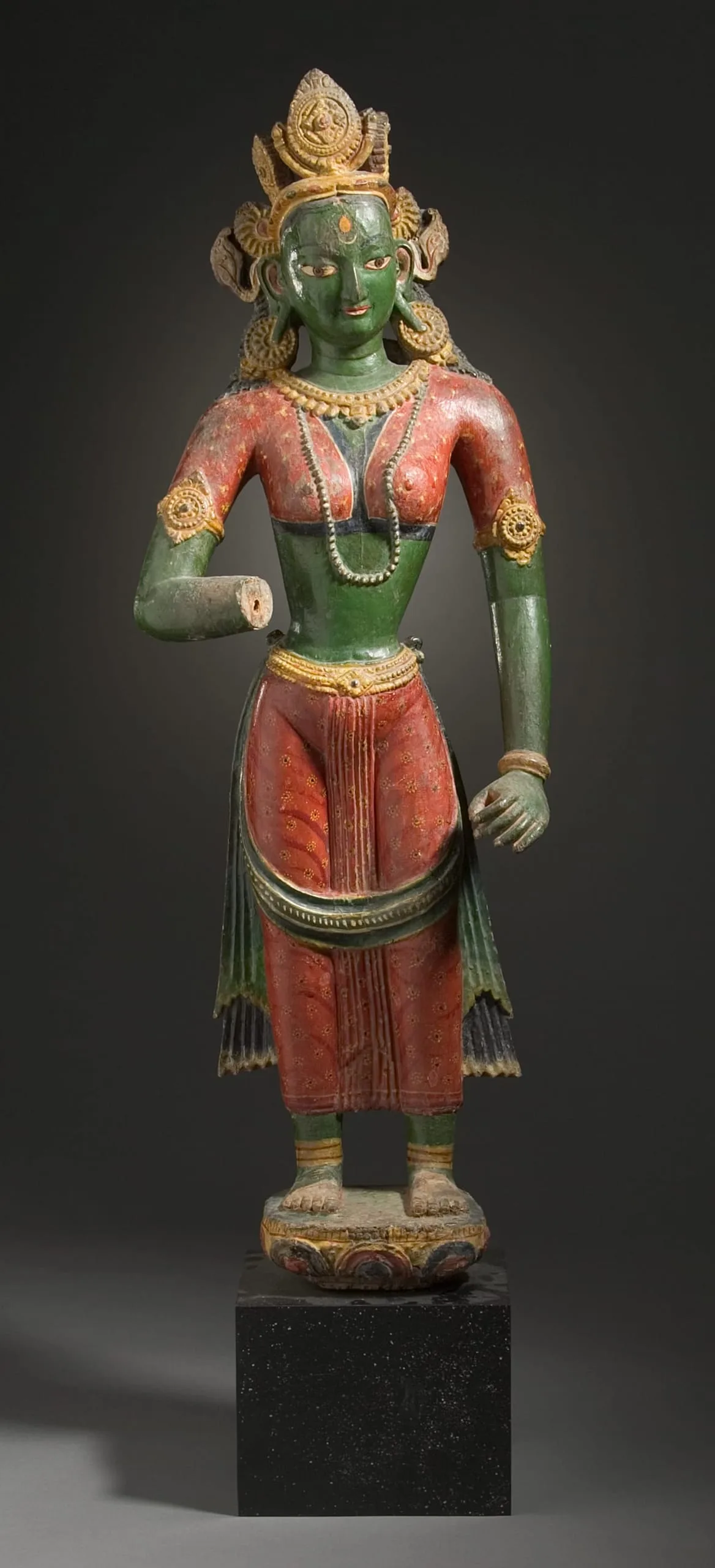
- Title
- The Buddhist Goddess Shyama (Green) Tara
- Date Made
- 18th century
- Medium
- Wood with paint
- Dimensions
- 35 3/4 x 12 1/2 x 5 5/8 in. (90.81 x 31.75 x 14.29 cm)
- Accession Number
- M.91.232.7
- Curatorial Notes
Green Tara is one of the most popular Buddhist protective goddesses in Nepal and Tibet. She is said to have been born from the Bodhisattva Avalokiteshvara’s tears of compassion. There are many forms of Tara, all of whom help practitioners overcome hindrances and difficulties on the path to Enlightenment. Each Tara has a different symbolic character and associated color. Green Tara is a gracious form regarded as the savior from all suffering and the symbol of Enlightenment in female form. She is often propitiated for longevity. Green Tara is also the wisdom component of Enlightenment (prajna) associated with the transcendental Jina Buddha Amoghasiddhi.
This standing image of Green Tara is crowned and has golden jewelry. She wears a midriff-baring blouse (choli) and a long skirt (ghagra or lhenga), both red with gold flowers. Her left hand extends to beside her thigh and once held a separate blue lotus, which is her standard attribute. Her right hand is now missing, but judging from the position of the forearm is unlikely to have been held in her normal gesture of ‘gift-giving’ (varada mudra).