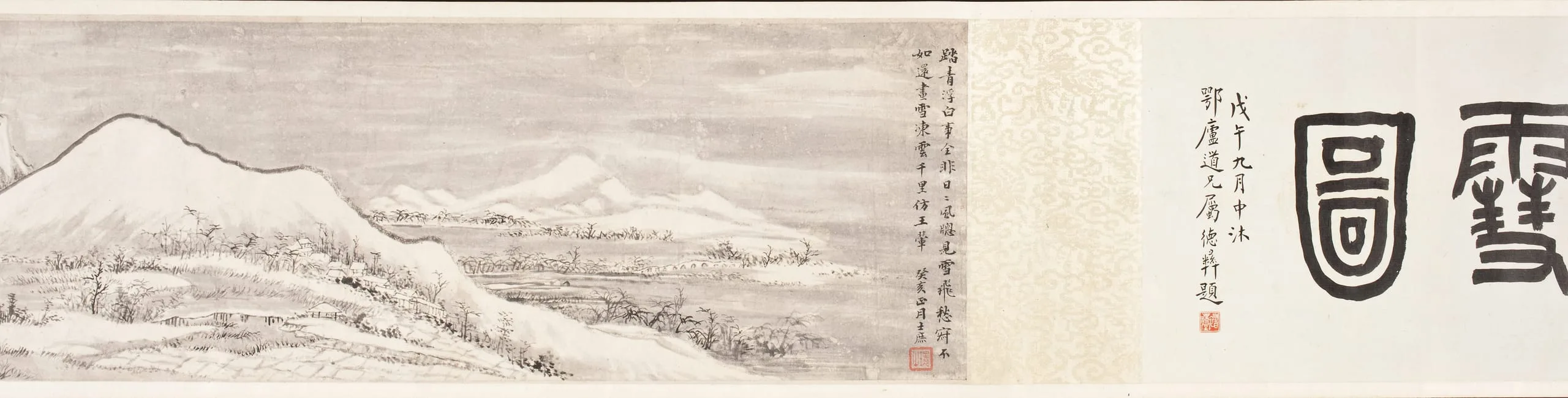
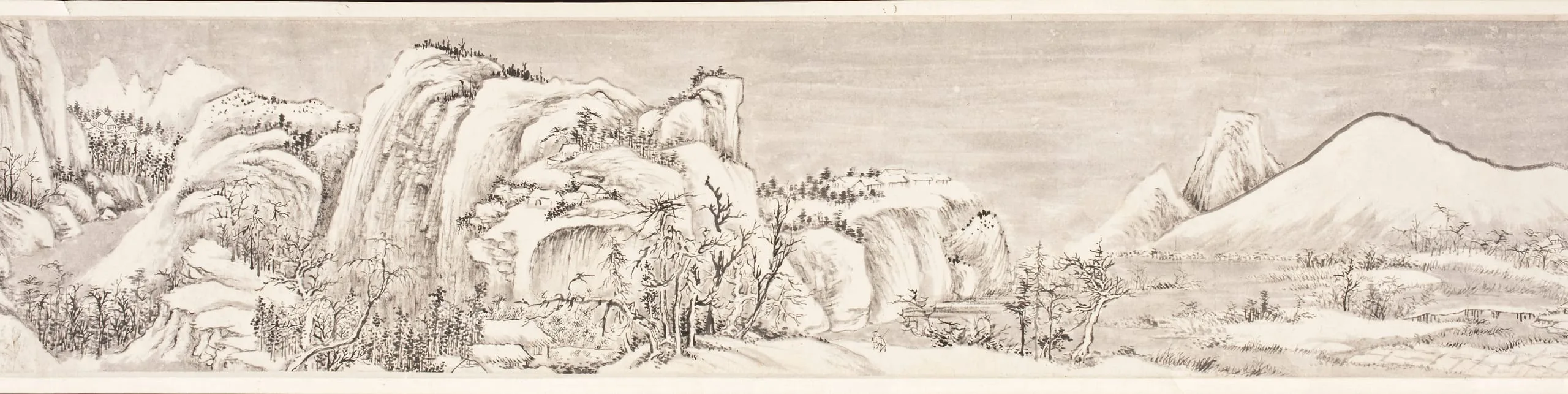
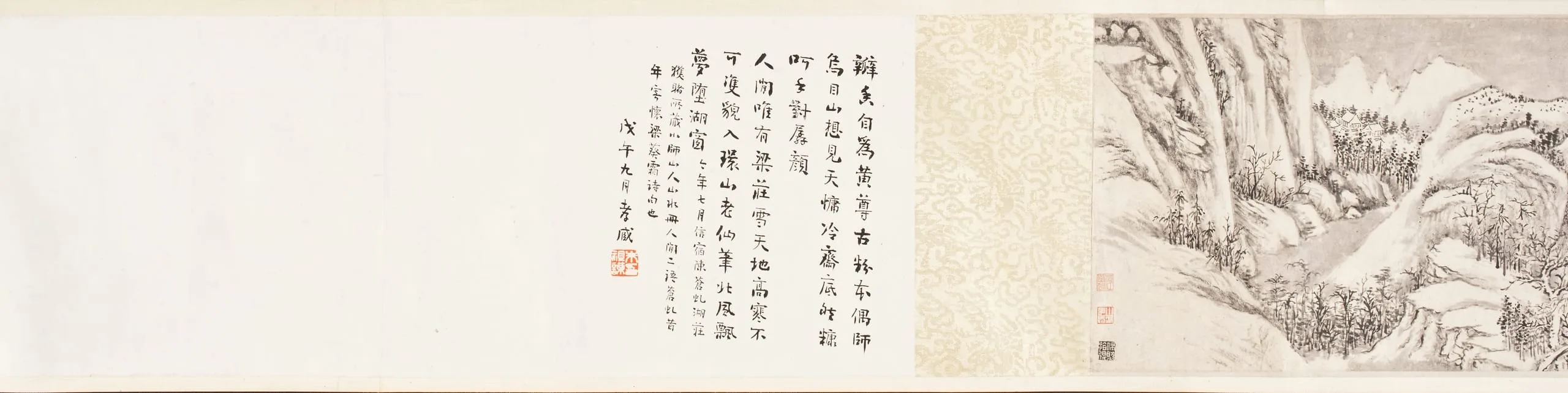
Dominating this composition is a large hill submerged in snow. The hill’s presence is amplified by a dark, heavy outline against an ink-washed background that suggests an icy winter’s day. Mountains, trees, and waterways are rendered in a classic manner. The unforgiving landscape is somewhat warmed by the presence of two fishermen walking home. Fang Shishu’s brushwork captures infinite variations of dark, light, dry, and wet ink. The inscription reads: “When going for an outing in the spring, everything is covered with white and nothing can be recognized, / Every day at the window, wind is blowing, snow flying, / Rather than worrying, I would rather paint the snow, / Frozen clouds thousands of miles away, here I imitate Wang Hui [1632−1717]. / The first month of the year guihai [1743], Shishu.” The seal reads: “Huanshan [the artist’s sobriquet].” Fang was a native of Anhui Province, where a great painting tradition emerged in the seventeenth century. His work falls in the lineage of the Qing-dynasty Orthodox School of Dong Qichang and the so-called Four Wangs (Shimin, Jian, Hui, and Yuanqi).
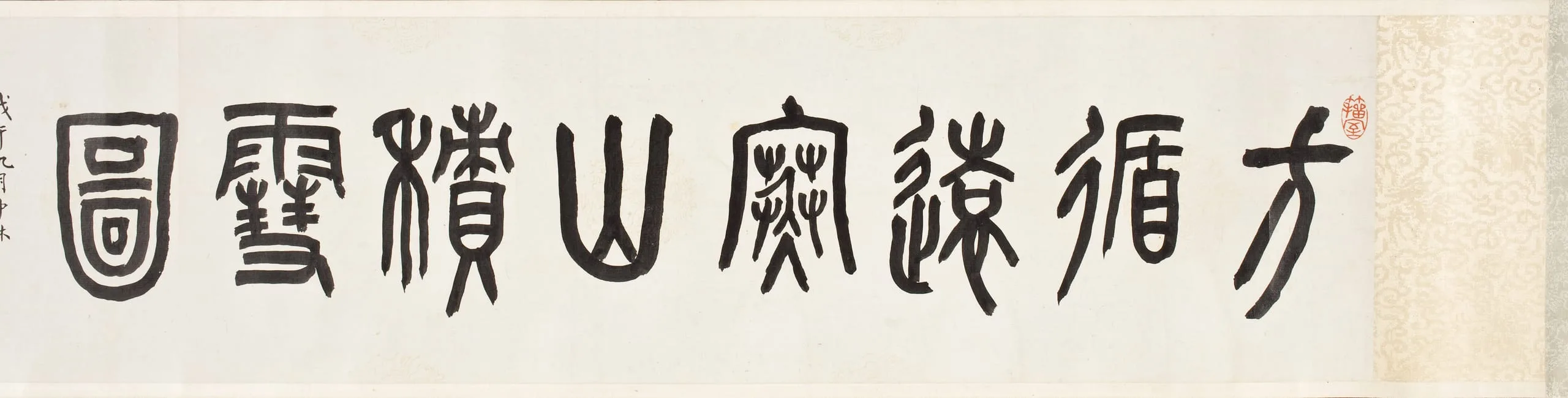
The scroll opens with a beautifully written title: “Fang Xunyuan’s painting of Snow Piled Up in the Cold Mountains / In the middle of the ninth month of the year wuwu [1918], inscribed on [this painting] belonging to Brother E’lu, Deyi,” with the seal “Zhu Litang.” “Brother E’lu” was the studio name of the wealthy merchant and connoisseur Xi Guangxu, who amassed a large collection of paintings. He befriended many artists, among them Zhu Deyi (style name Litang), a painter and calligrapher in Hangzhou with a special interest in epigraphic study (jinshi xue). Xu Guangxu took many calligraphy works, paintings, and epigraphic stelae in his collection to Zhu Deyi for inscribing, as in this scroll. Another example is the album by Shitao titled Traveling among Mountains (https://www.artfoxlive.com/product/109131.html).
Wan Kong
2024