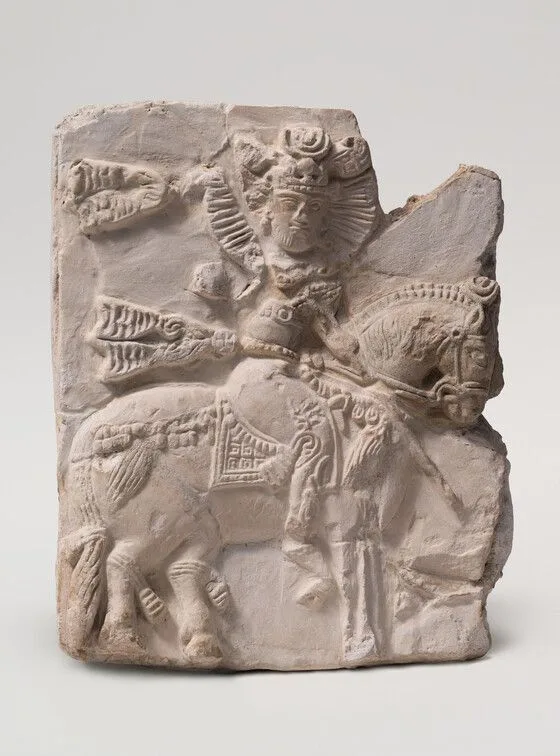
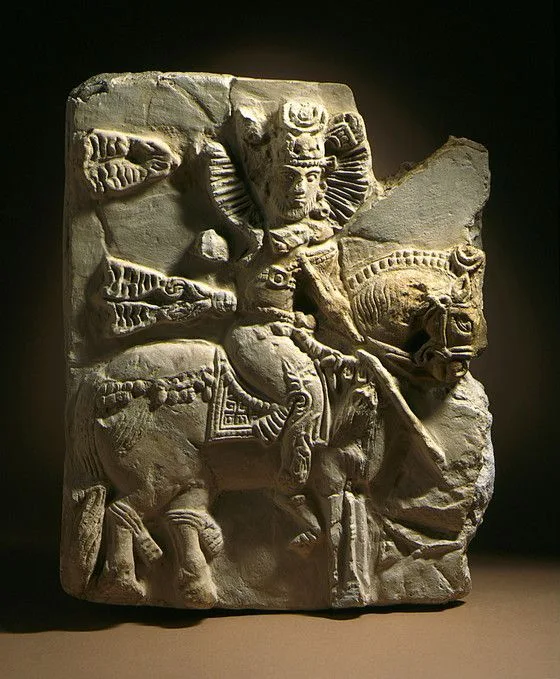
The advent of Islam in Iran around 651, initiating a new faith and leadership, did not immediately impact visual culture. Rather, traditional imagery, especially that associated with power and prestige, continued to utilize the narratives of kingship of the recently displaced Sasanian dynasty. This molded stucco plaque, probably from the palatial citadel of Chal Tarkhan, in northwestern Iran, epitomizes such continuity during this transitional period. It depicts a king hunting on horseback. His royal status is evident not only from the Sasanian-style crown in the form of a crescent and globe flanked by wings, but the crimped halo behind his head, which is perhaps intended as the farrah, an ancient Iranian notion of the light radiating from the sovereign’s body. This royal device is often included in depictions of the king hunting on Sasanian silver-gilt plates.
Although the royal prey is missing here, matching molded wall plaques discovered in the main palace at Chal Tarkhan indicate that the king is hunting wild boar. Rather than a generic depiction of a royal hunter, the image, repeated as multiples in its original setting perhaps depicts the Sasanian ruler Bahram Gur or Bahram V (r. 420-436), whose fame, especially as a great hunter, was carried forward into Persian literature by the early eleventh century. In support of the Bahram Gur attribution, contemporaneous stucco plaques of Bahram Gur hunting with his paramour Azada were also excavated from the same palace at Chal Tarkhan. Here, , a theme derived from Sasanian kingship was repurposed as a decorative device with regal connotations, suggesting that it may have already passed into legend havingalready lost its former historical associations. Similarly, the Sasanian crown was transformed into an abstract motif in a variety of mediums from the early Islamic era (see M.73.5.641 and M.73.5.238).
2025