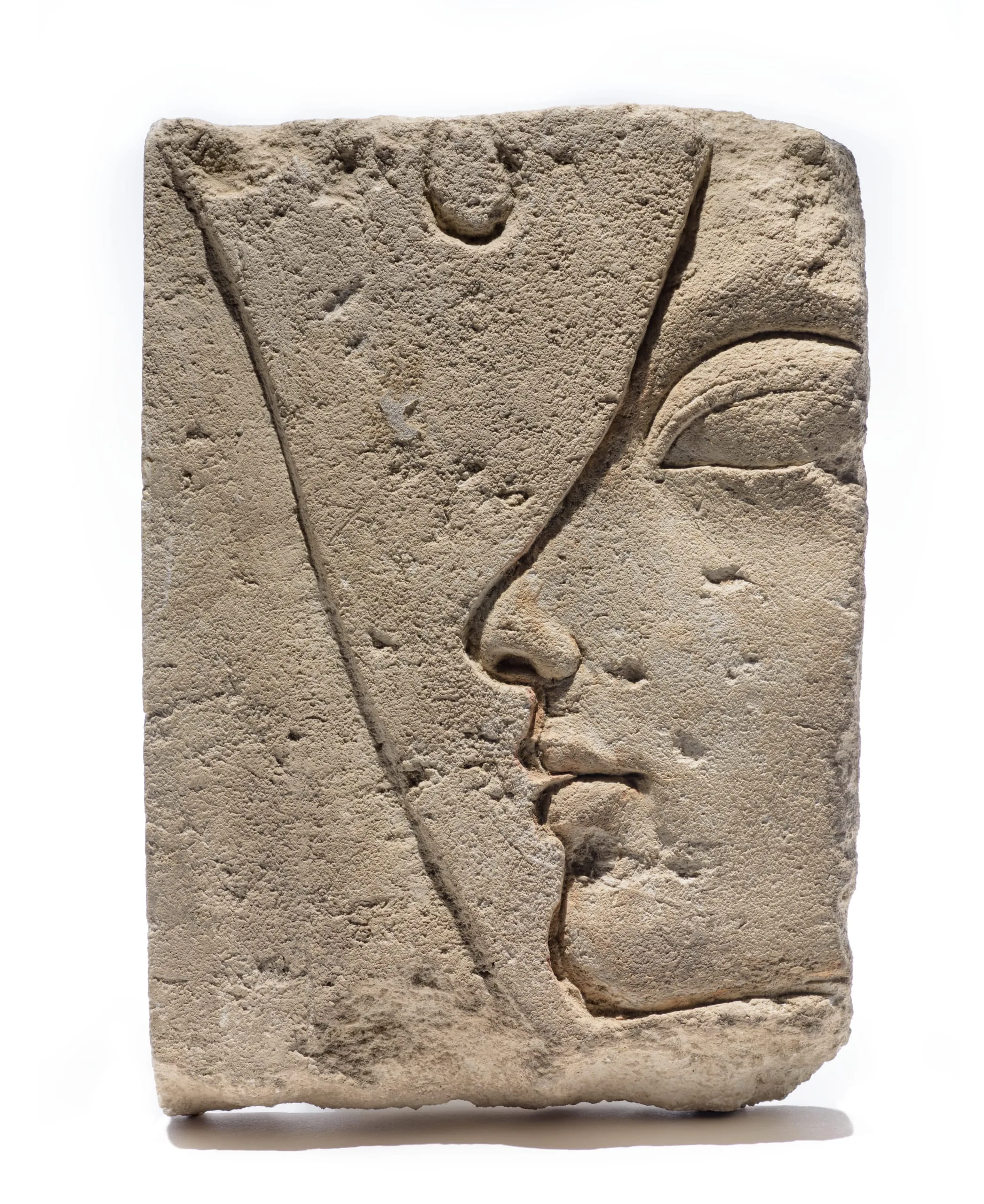
The rendering of human figures in the so-called “Amarna style” employed an aesthetic vocabulary unlike that of prior or later periods in ancient Egypt. Emerging during the reign of Akhenaten (1349−1336 BCE), it was intended to reflect his adoption of a new religion, with the focus on the life-giving rays of the sun disk, Aten. The style is characterized by a new naturalism of forms, although often with elongated heads, slender limbs, and strong facial features. Other aspects of the style include a new physical intimacy among royal family members and the inclusion of the Aten as a central motif, often with sun rays depicted as hands offering symbolic ankhs to individuals. Here, the deeply outlined and softly modeled face likely depicts one of the king’s six daughters. The loop of an inverted ankh is visible above her forehead, and the curved form on the left side of the relief is probably the dress of her mother Nefertiti. This section of relief was presumably part of a standardized scene portraying the royal family beneath the rays of Aten, who brought an ankh to the nostrils of each figure.
Provenance: With Mathias Komor (d. 1984, New York); sold to Hans Cohn 1968, gift to LACMA 1992.
Publication
Thomas, Nancy, and Constantina Oldknow, eds. By Judgment of the Eye: The Varya and Hans Cohn Collection. Los Angeles: Hans Cohn, 1991, 11819.