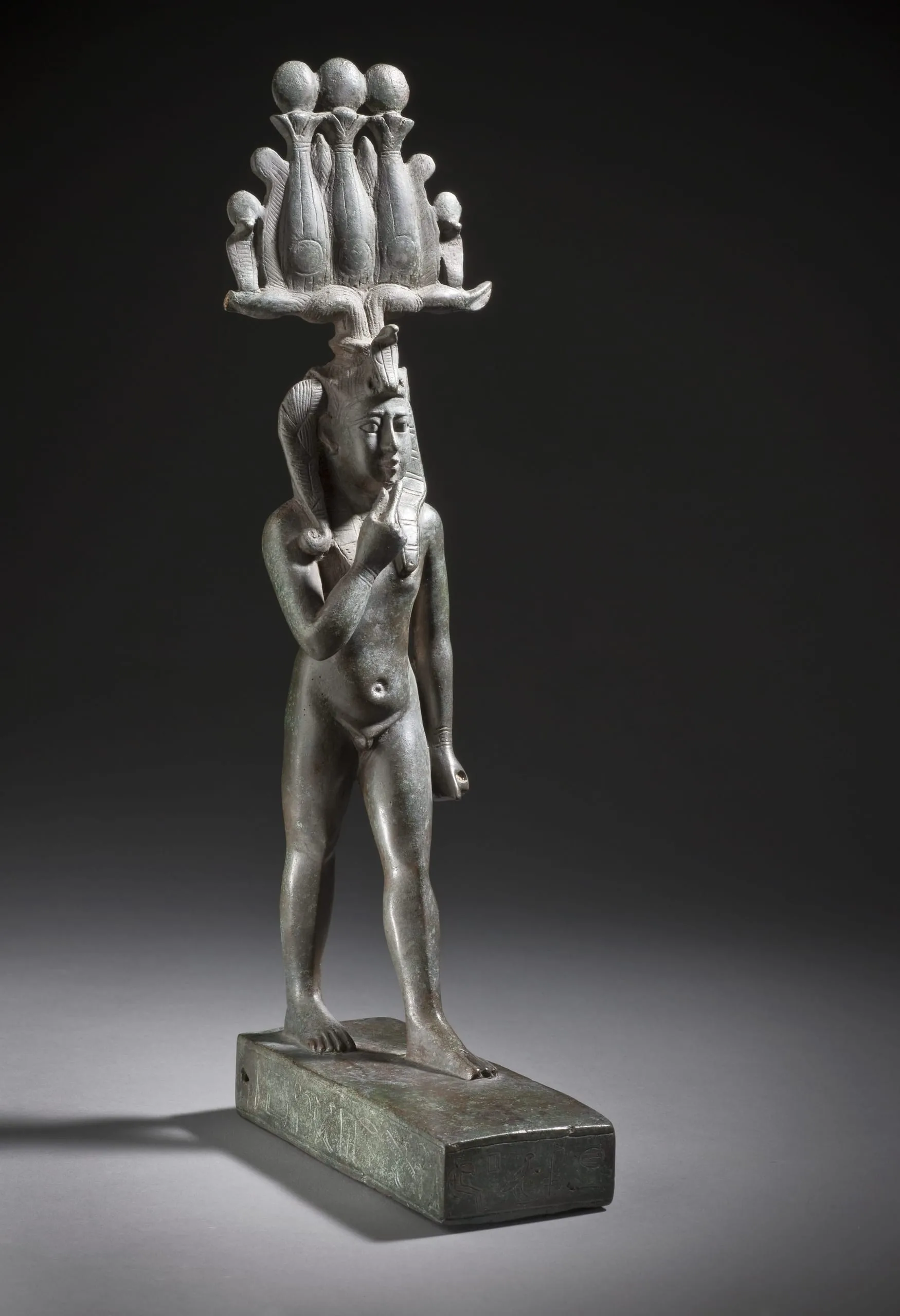
This bronze statuette of the god Khonsu shows him the guise of a child, called Khonsupakhered—naked, well fed, with a plaited sidelock of hair, and his right forefinger brought to the lips in a youthful gesture. He wears a striped nemes headdress and uraeus topped with an ornate hemhem crown, formed of twisted animal horns, three upright rushes, sun disks, and, at each side, ostrich feathers and additional uraei. The work’s function as a votive offering is confirmed by the hieroglyphic inscription on the base: “Khonsupakhered, may he grant life to Parehi, son of Nakhty and of the mistress of the house, Tadiiynefret, daughter of Padisheshty.”
Khonsu, like Thoth, was a lunar deity, and was often depicted with a crescent moon supporting a full moon disk as his headdress. His name translates as “the traveler,” probably a reference to his transit across the night sky marking the passage of the nocturnal hours. During the New Kingdom, he gained prominence as one of the Theban triad, which included his father Amun, the most revered Egyptian god, and his mother Mut. A major precinct dedicated to Khonsu was constructed at the Temple of Amun, Karnak. During the later dynasties and into the Ptolemaic Period (323−30 BCE), his fame grew as a healing deity, with his influence expanding beyond the borders of Egypt. Cults to the moon god were established at Memphis, Edfu, and Hibis, and he was cited in texts for his ability to cure illness and to protect humans against animal predators.
Provenance: Tigrane Pacha d’Abro; Michael E. Abemayor, New York, sold to Hans Cohn, 1967. Gift to LACMA, 1992.
Publication
Pacha 1911, no. 4.