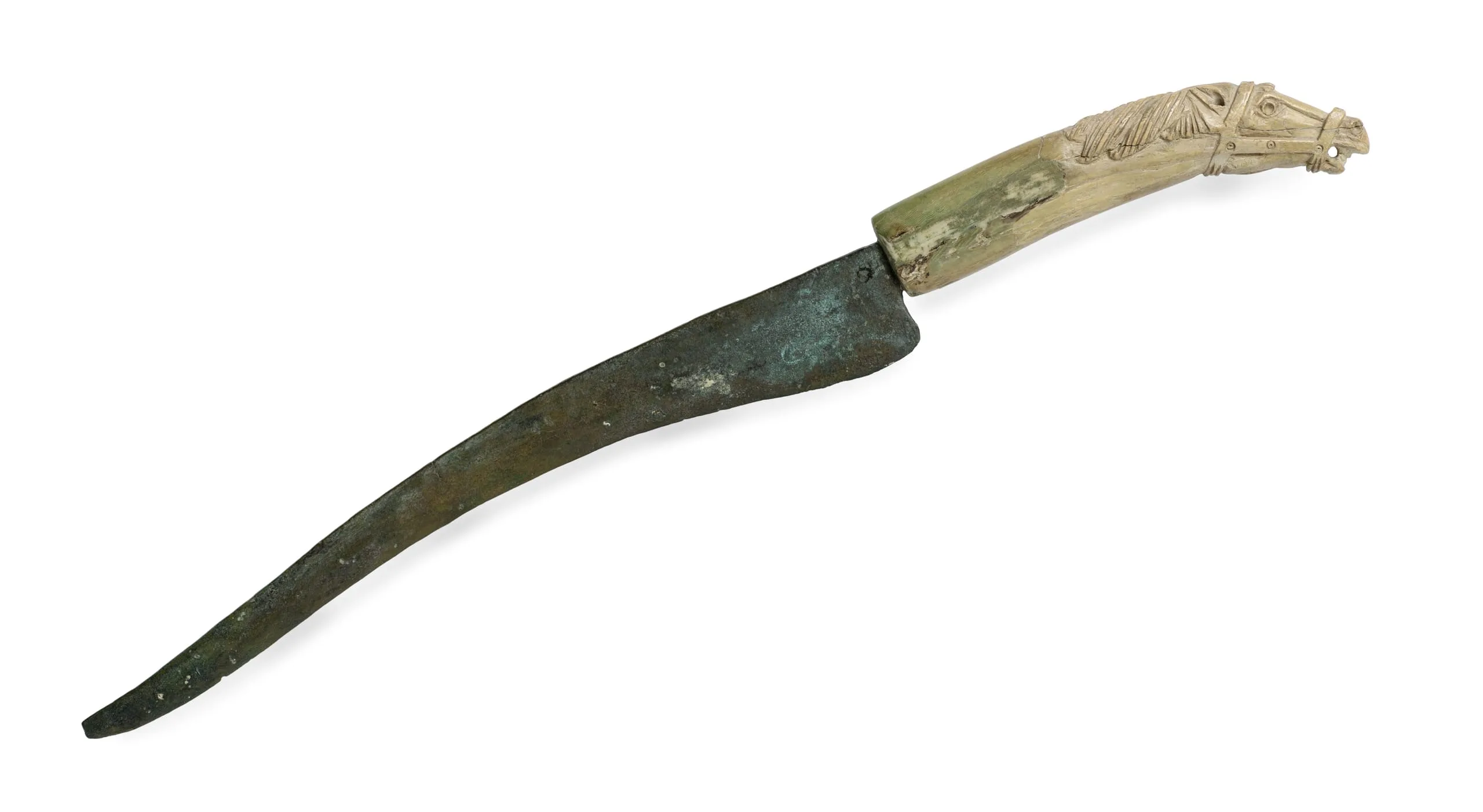
While several ivory horse-head handles have been preserved from this period, it is remarkable that this delicate example is the only one to have survived with its bronze blade intact. The expressive carving depicts a bridled horse, lunging forward with dilated nostrils, bared teeth, ears pressed back along the neck, and a windblown mane twisted into locks. The bridle’s series of concentric rings might represent rivets. The knife is reported to have come from Egypt, coinciding with a very similar example from Alexandria originally in the Norbert Schimmel collection, New York.
Provenance: Wilhelm Henrich, Frankfort am Main, sold to Hans Cohn, 1960. Gift to LACMA, 1992
Publications
Hornbostel, Hornbostel. “Erwerbungen der Antikenabteilung, 19651975.” Jahrbuch der Hamburger Kunstsammlungen 19 (1974): 165.
Thomas, Nancy, and Constantina Oldknow, eds. By Judgment of the Eye: The Varya and Hans Cohn Collection. Los Angeles: Hans Cohn, 1991, 8889.