LACMA

ShopMembershipMyLACMATickets
LACMA
Los Angeles County Museum of Art
5905 Wilshire Blvd.
Los Angeles, CA 90036
info@lacma.org
(323) 857-6000
Sign up to receive emails
Subscribe
© Museum Associates 2025

Museum Hours

Monday

11 am–6 pm

Tuesday

11 am–6 pm

Wednesday

Closed

Thursday

11 am–6 pm

Friday

11 am–8 pm

Saturday

10 am–7 pm

Sunday

10 am–7 pm


  • About LACMA
  • Jobs
  • Building LACMA
  • Host An Event
  • Unframed
  • Press
  • FAQs
  • Log in to MyLACMA
  • Privacy Policy
© Museum Associates 2025
Collections

Unknown
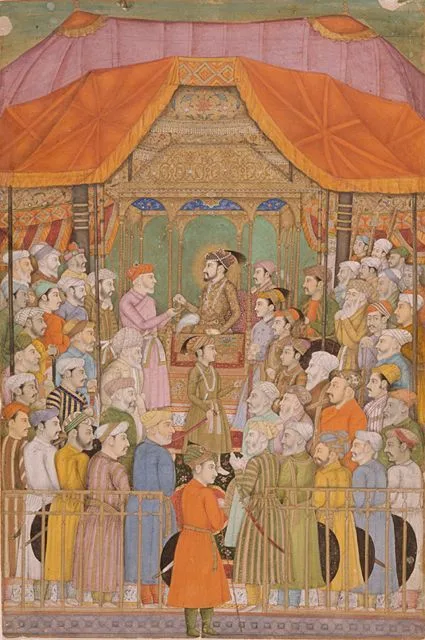
Emperor Shah Jahan (r. 1628-1658) in Audiencecirca 1700-1725

Not on view
Mughal-style court painting showing an enthroned ruler receiving a courtier under a gilded pavilion, surrounded by dozens of turbaned figures in a dense, colorful crowd beneath an orange tent canopy
Artist or Maker
Unknown
Title
Emperor Shah Jahan (r. 1628-1658) in Audience
Place Made
India, Delhi, Mughal Empire
Date Made
circa 1700-1725
Medium
Opaque watercolor, gold, and ink on paper
Dimensions
12 1/4 x 8 in. (31.12 x 20.32 cm); 12 5/16 x 8 in. (31.12 x 20.32 cm)
Credit Line
Gift of Neil Kreitman
Accession Number
AC1992.94.1
Classification
Drawings
Collecting Area
South and Southeast Asian Art
Curatorial Notes

This painting presents a rich artistic record of an Imperial Mughal court scene. Representations of the emperor formally receiving officials and visitors, known as durbar or audience scenes, are among the most persistent in the three centuries of Mughal painting. Inspired by earlier Islamic and contemporary European imagery, Mughal audience scenes fulfilled similar political and propagandistic purposes by portraying the emperor in a hierarchical manner that emphasizes his power and grandeur. In an era before the advent of photography, such realistic portraits of foreign dignitaries, princes, and officials served to record the attendance at ceremonial or historic occasions, and to augment written reports gauging the bureaucrats’ strengths and personalities.

Emperor Shah Jahan (r. 1628-1658) is elevated on a throne and centered in the composition, with visitors and royal subordinates symmetrically arranged according to protocol. Each figure is identified by minute Arabic labels. (Translations by John Seyller.) The emperor’s divine presence and hereditary right to rule are indicated by his golden nimbus. Shah Jahan is accepting a pearl necklace presented by his father-in-law, Asaf Khan (c. 1569-1641). Below him stands Prince Murad Bakhsh facing his royal siblings, Princes Dara Shikoh (1615-1659), Shah Shuja (1616-1659) and Aurangzeb (1618-1707).

Based on a minute signature, this painting is likely a copy of a durbar scene painted by Inayd Inayat (India, active circa 1590-1615?).
Selected Bibliography
  • Pal, Pratapaditya, Janice Leoshko, Joseph M. Dye, III, Stephen Markel. Romance of the Taj Mahal. Los Angeles: Los Angeles County Museum of Art, 1989.
  • Los Angeles County Museum of Art Members' Calendar 1993, vol. 31, no. 1-11 (January-November, 1993).