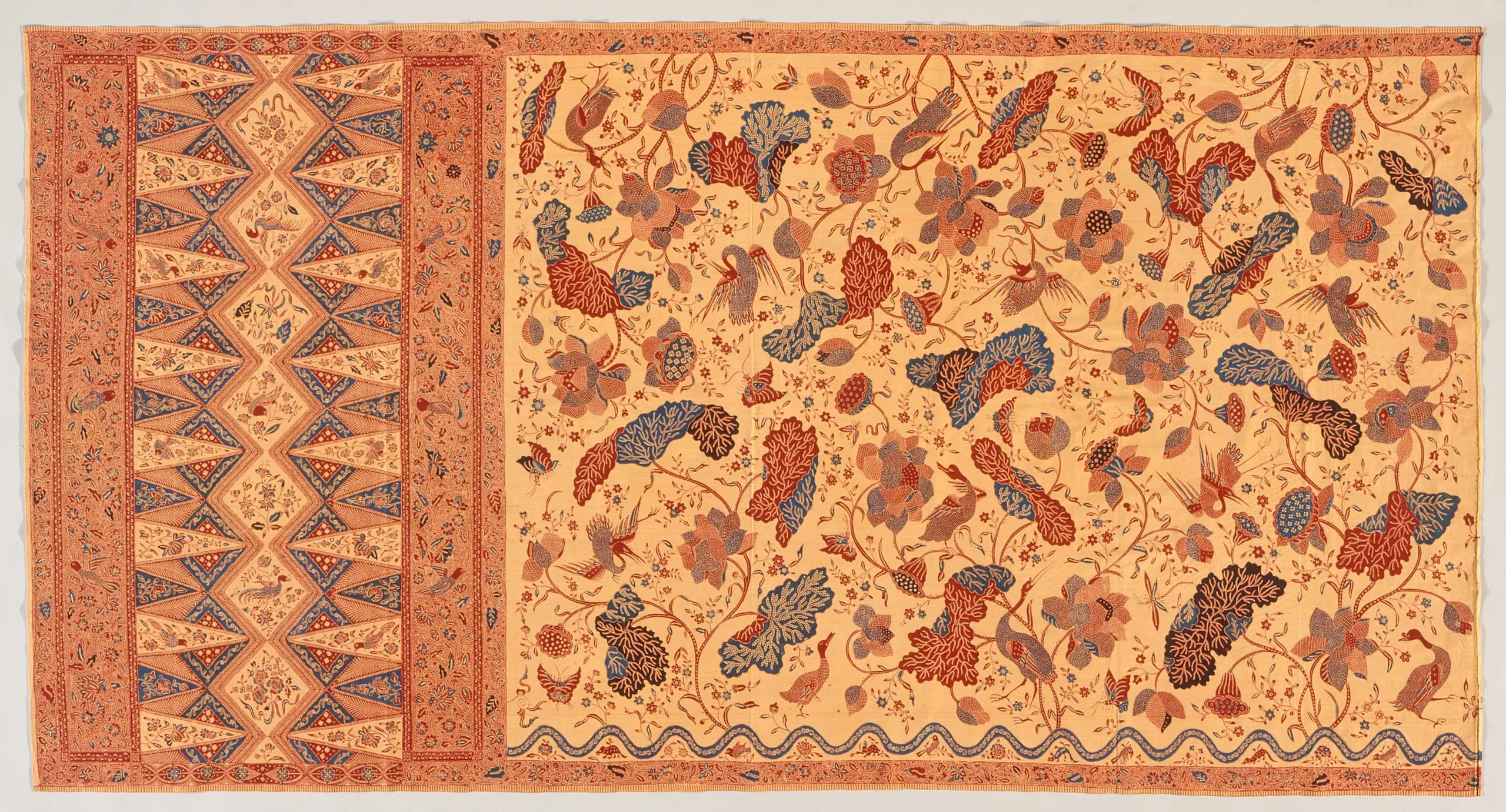
Hip wrapper, m.91.184.309
Overview
Excerpted from Herina, Rens, and Harmen C. Veldhuisen. Fabric of Enchantment: Batik from the North Coast of Java. Los Angeles: Los Angeles County Museum of Art; New York: Weatherhill, Inc., 1996, Catalogue no. 16.
Large, elegant lotus flowers, depicted in a European, three-dimensional manner, bloom on trees growing from the borders of this batik. Three trees, each different, mirror each other at the upper and lower ends of the badan. Smaller floral clusters sprout from the branches. Ducks waddle below, while egrets, butterflies, and other insects fly above. Each motif is enriched with delicate fillers. The kepala gigi balang shows a well-organized version of the Peranakan style, a pleasing composition of three rows of central diamonds, two of which underlie alternately long and short triangles on a dark ground. The lower border, in the form of a sinuous “snake,” shows a unique feature: a small bird, mammal, or rosette filling the space under each curve. The animals impart a European sensibility. Red, blue, and somewhat faded green combine with the plain, ivory ground in this most elaborate color combination, bang biru hijau, of traditional Pasisir style.
Maker
This batik was made in the workshop of a Peranakan who imitated an Indo-European design. The large variety of filler motifs is characteristic of Indo-European batiks from Semarang dating from the second half of the nineteenth century. The design is Chinese, but the style of the lotus flowers is Indo-European. The ducks are typical of Indo-European batiks from Semarang and later, around 1890, Pekalongan.1 The jaunty impression created by the design has much in common with the following textile (catalogue no. 17) probably made by Carolina von Franquemont.
Wearer
This fine and intricate batik contains a multitude of lucky symbols for a Peran¬ akan bride. Ducks, commonly depicted with the full-blown lotus of summer, stand for conjugal fidelity. The egret is here associated with the phoenix, summer, and harvest; the butterflies, sipping nectar from the flowers, are an emblem of felicity and the joys of married life. Together the living creatures express bounty and prosperity.2
Notes
1. H. C. Veldhuisen, Batik Belanda 1840–1940 (Jakarta: Gaya Favorit, 1993), no. 48.
2. C. A. S. Williams, Outlines of Chinese Symbolism and Art Motives, 3d ed. (New York: Dover, 1976), 51, 147, 323.