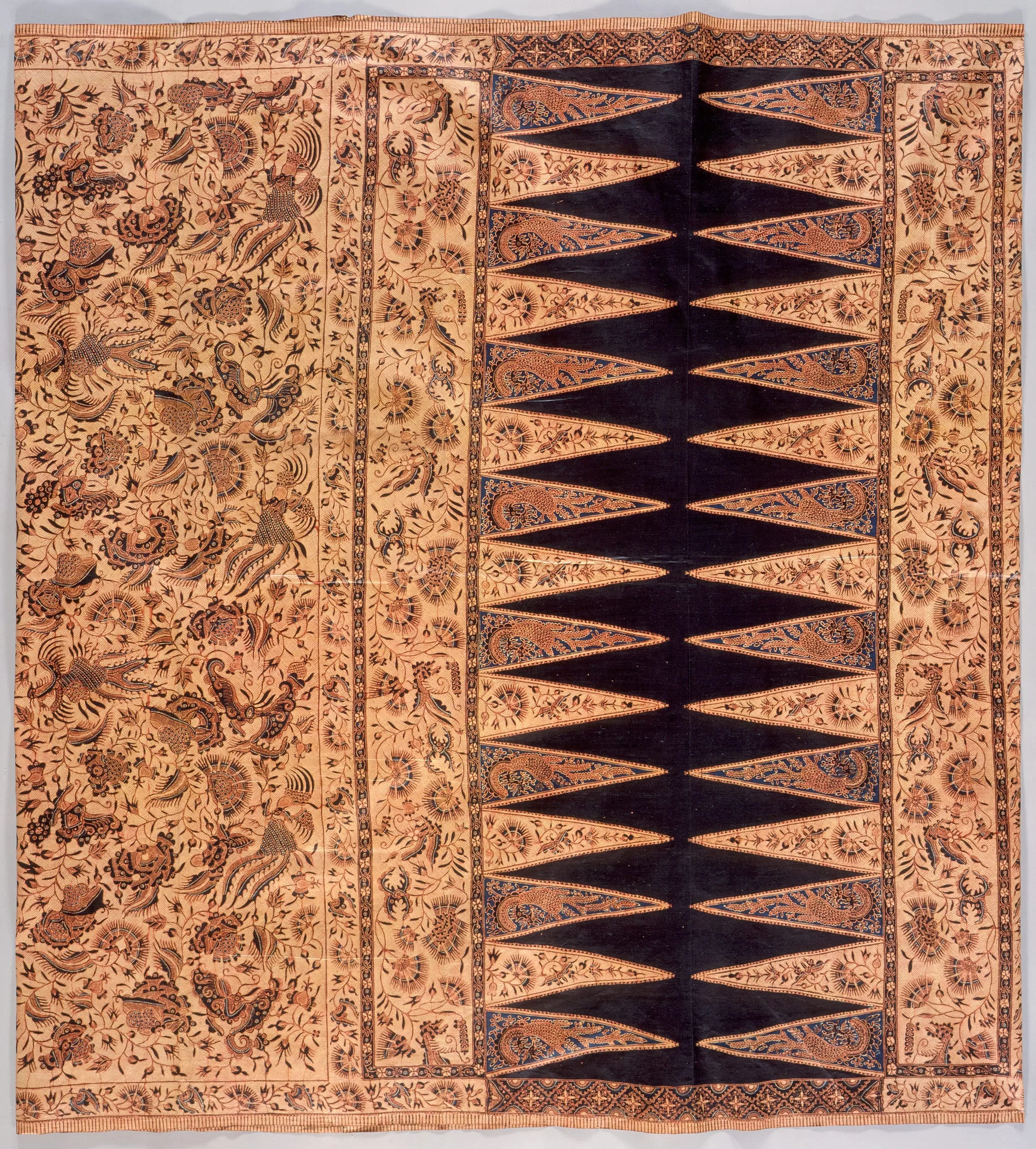
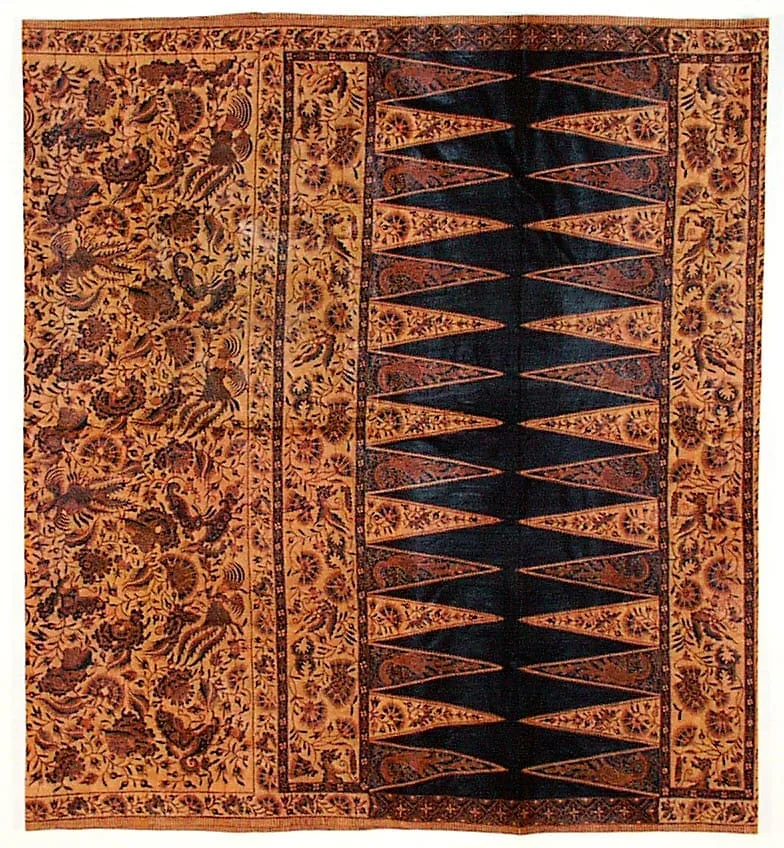
Hip wrapper, m.91.184.340
Overview
Excerpted from Herina, Rens, and Harmen C. Veldhuisen. Fabric of Enchantment: Batik from the North Coast of Java. Los Angeles: Los Angeles County Museum of Art; New York: Weatherhill, Inc., 1996, Catalogue no. 6.
An interesting mixture of elements marks the design of this sarung, still sewn to form a tubular cloth.1 The kepala pasung, with its double row of triangles, is positioned at one end in late nineteenth-century fashion. The undecorated lozenges between the triangles represent a style that was current at least fifty years earlier. The vigorous motifs of the badan are specific to Semarang during the last quarter of the nineteenth century. The motif type is called Laseman (in the style of Lasem), but the flowers and birds in the foreground are much larger than those in the classical Lasem style. Among the flowers and birds the poisonous kembang sungsang vine, the voluptuous Chinese butterfly (kupon), the fruit bat (kalong), and the bird of paradise (cenderawasih), with its long tail feathers, stand out. A subsidiary pattern of smaller floral creepers and a background dotted with cocohan add dimension to the design. The motifs in the symmetrical kepala and borders are of a more modest size. Carnations (celuki) abound; birds and corncobs (janggel) adorn both papan; the tumpal are alternately blue and cream. The gandawari border runs uninterruptedly along the kepala section and lacks the tassels in the middle. The colors show the irengan version of the western Pasisir, with its heavily oiled yellowish cream ground (gumading) and small accents of blue and red that set off the predominant blue-black of the motifs.
Maker
This batik was made in a Peranakan workshop. It is a copy of an older Peranakan example, indicated by the undecorated field between the elongated triangles in the kepala, the oldest Pasisir style, and the Chinese motifs in the papan and badan, including a fluttering butterfly, which became a standard feature of Peranakan batik Pekalongan at the beginning of the twentieth century. One surface is glazed, a practice also common in the manufacture of Indian chintz for the European market and sembagi for the archipelago.
Wearer
Affluent Peranakan matrons expressed their status by wearing such batiks for weddings and other festive gatherings. This style with its large motifs does not suit young girls or slim women. The bat is a Chinese emblem for longevity and wealth, the butterfly stands for conjugal happiness, while the bird of paradise is linked to the mythical phoenix, which only appears in times of prosperity.2 This particular cloth was never worn, as it still retains its luxurious glazed surface (garusan). It may have been part of a wedding gift and was probably kept as an heirloom for many years.
Notes
1. Many sarung in private and museum collections have had the seam opened and therefore are displayed flat.
2. C. A. S. Williams, Outlines of Chinese Symbolism and Art Motives, 3d ed. (New York: Dover, 1976), 34, 51, 325.