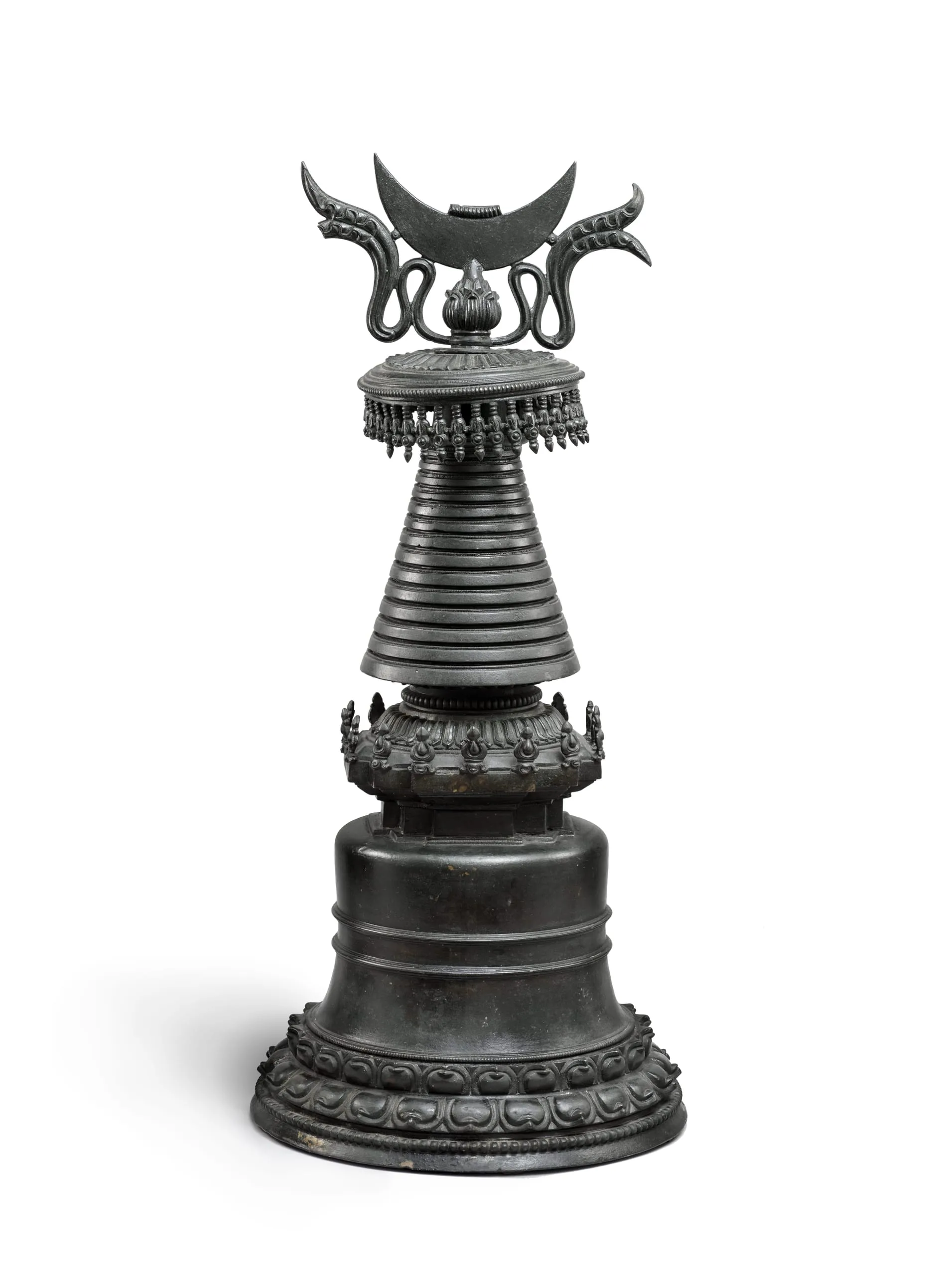
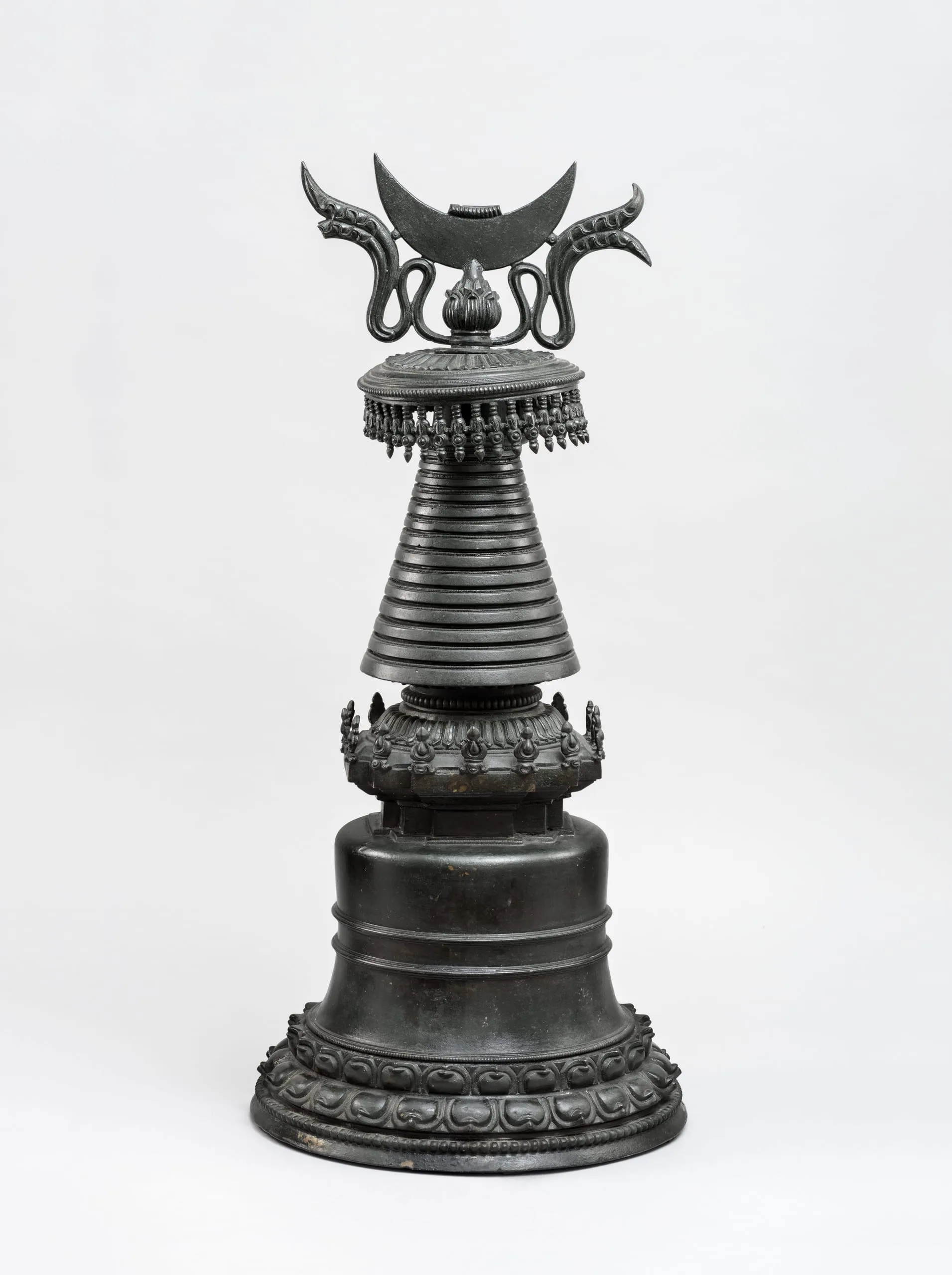
A stupa is a funerary or reliquary monument for Buddhists, or in ancient India, for Jains as well. The earliest Buddhist stupas held the Buddha’s cremation ashes and relics, but later ones also interred the remains of the Buddha’s renowned acolytes, important laity, or commemorated significant sites or events in the life of the Buddha. Miniature stupas made of schist, copper alloy, rock crystal, or ivory were used either as votive objects for worship or, when hollow, as consecrated reliquaries containing precious or auspicious offerings, such as flower petals made of gold sheet or seeds; relics, such as cremation ashes, bone and tooth fragments, fragments of garments worn by the personage; written or printed prayers and texts; and protective charms. In Tibet, a stupa is called a chöten. Reliquary stupas in Tibet were often made for the Kadampa sect.
Although individual stupas differ in design details, the general form of this type of Tibetan stupa consists of a circular base with a double band of lotus petals (padmasana), bell-shaped dome (anda) with a residual ambulatory ring, cruciform or quadrangular terrace (harmika) topped by antefixes, conical spire of typically thirteen disks representing umbrellas, honorific parasol (chattra), billowing victory streamers, lotus bud finial, crescent moon, and a sun disk (here missing).
See also M.76.130 and M.82.200.3. Comparable Tibetan stupas are in the Metropolitan Museum of Art, New York (2016.21.2), Newark Museum of Art (20.424), Rubin Museum of Art, New York (C2003.12.2 and C2004.17.1), and Victoria and Albert Museum, London (IM.25-1910).