- Title
- Powder Flask
- Date Made
- 17th-18th century
- Medium
- Shell of a Green Sea Snail (turbo marmoratus) with mother-of-pearl, wood, and lac; copper, steel, and leather fittings
- Dimensions
- 4 1/4 x 5 x 4 1/4 in. (10.8 x 12.7 x 10.8 cm)
- Accession Number
- AC1992.36.1
- Curatorial Notes
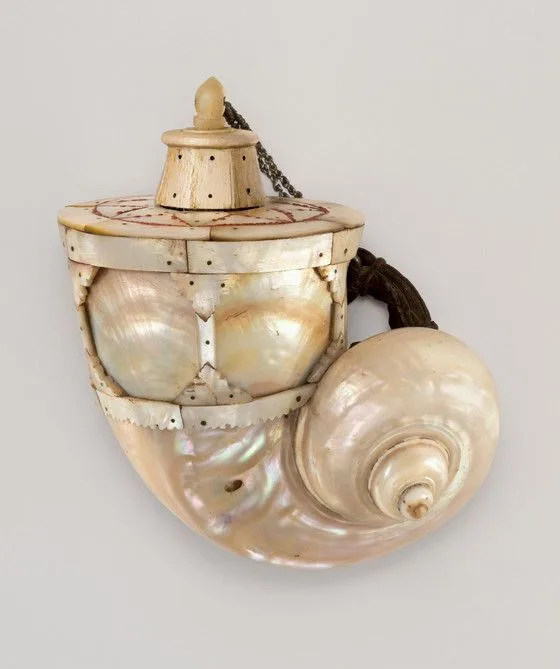
Formed from a hollowed-out shell of a Green Sea Snail, this iridescent powder flask is embellished around its wide mouth with a cylindrical shoulder extension to increase capacity and provide for a sealable lid. This is a common design feature of shell primer flasks, but it varies widely in decoration. Here, it is in the form of an arcaded register composed of mother-of-pearl plaques framed with strips of mother-of-pearl affixed with copper pins. The lid has two concentric bands. The outer band is plain. The inner band has a seven-pointed rosette or lotus design made of mother-of-pearl plaques set with red lac or mastic. The spout is a modern replacement, with the original stopper in the form of a knop finial attached to a thin gauge double chain leading to a copper connection ring of a leather suspension loop.
Mother-of-pearl was prized in South Asia for making or decorating sumptuous tableware, furniture, and weapons. Produced in the modern Indian state of Gujarat in western India and in the Sindh region of present-day Pakistan, these luxury goods were made primarily as export ware for the international maritime market with Portugal and the Middle East in the 16th and 17th centuries. Powder flasks continued to be produced in various regional centers through the 19th century in a wide variety of materials.