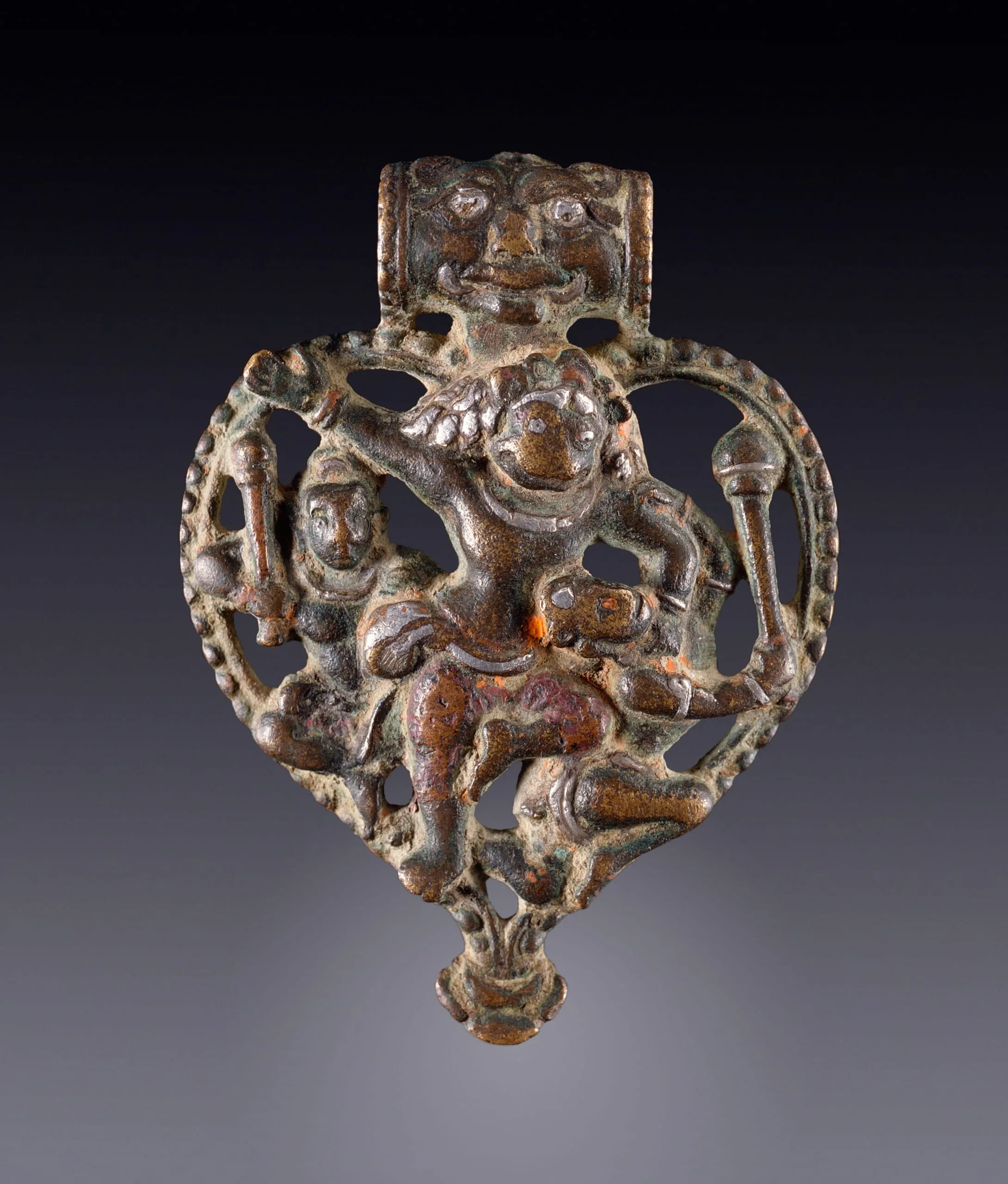
To fulfill his role as the guardian of the world and savior of humanity, the Hindu god of Preservation, Vishnu, appears as a succession of heroic animals and semi-mortal saviors, called avatars, through which he intervenes in times of crisis or unrighteousness. The tale of Narasimha, the fourth avatar, embodies the sectarian rivalry present in Hinduism from its earliest times and eventually expressed primarily through Vaishnavism and Shaivism. As recounted in the Bhagavata Purana (Ancient Stories of the Lord), traditionally ascribed to the legendary poet-sage Vyasa in the 8th-10th century CE, Vishnu manifested as Narasimha (literally, "man-lion") to save the pious Prahlada from his bigoted father, King Hiranyakashipu, to whom Brahma had given a boon making him invulnerable to man or beast, unable to be killed indoors or outdoors, and unconquerable in day or night. To subvert the boon, Vishnu ingeniously assumed a form that was half-man and half-lion (neither man nor beast), and he attacked while his foe was standing on a porch (neither indoors nor outdoors) during the twilight hour (neither day nor night) (Bhagavata Purana 7:8:12-29).
Representations of Narasimha in Indian art date back to at least the 2nd century CE when they were shown in a benign theriomorphic form as a seated lion (see M.82.18.1). By the Gupta period in the 4th-6th century, Narasimha was portrayed as an iconic image (see M.81.90.20) or in a fierce form engaged in combat with King Hiranyakashipu (for example, see Cave 3 at Badami, Karnataka, dating from 578). Medieval sculptures of Narasimha often emphasize his yogic aspect (see M.91.232.8). Later paintings typically depict Narasimha disemboweling Hiranyakashipu (see M.82.42.8).
In this heart-shaped openwork pendant with a cylindrical bail fastener adorned with a Face-of-Glory (kirttimukha), Narasimha is envisioned in combat mode as he grasps Hiranyakashipu by the neck with his left hand and prepares to strike him with his right hand. The female figure behind Narasimha is probably Hiranyakashipu’s wife, Kayadhu, who wields a mace like her husband.