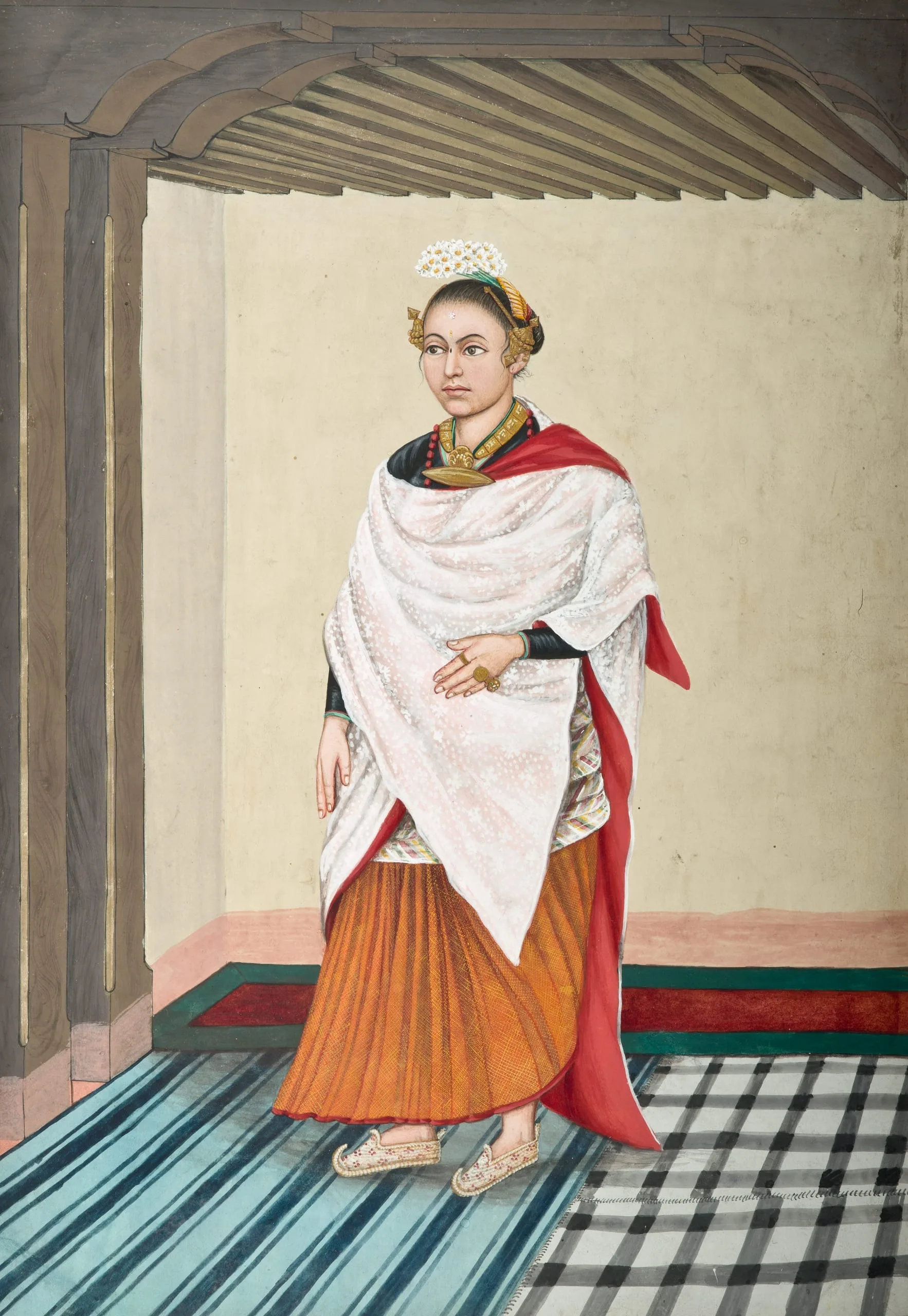
Probably part of a series with M.91.206, this idealized portrait likely portrays Queen Tripurasundari (or Lalit Tripura Sundari Devi, 1794-1832). She was a Queen consort of King Rana Bahadur Shah (r. 1777–1799). Along with Prime Minister Bhimsen Thapa (served 1806–1837; see M.91.206), she was regent of the kingdom for her stepson King Girvan Yuddha Bikram Shah (r. 1799-1816; see M.76.129) and for her step-grandson King Rajendra Bikram Shah (r. 1816-1847).
Queen Tripurasundari is depicted as an elegantly attired noble or wealthy woman with a devotional dot (bindi) on her forehead. She has a bouquet protruding from a headband, elaborate gold ear ornaments, gold finger rings, a necklace of red spinels (balas rubies), and the distinctive ceremonial necklace of elite Newar women and Nepal’s Living Goddess (Kumari). The lozenge-shaped horizontal pendant is an amulet container for symbolic grains of purified rice, gemstones, or a sacred verse (see M.79.242). She wears the traditional garb of a Newar woman consisting of a transparent white shawl, black coat, multicolored waist wrap, and an orange sari with a red border (haku parsi). The interior setting is adapted from contemporaneous European studio portraiture.