The Yashodhara Charita or Charite (Life of Yashodhara) was written in 1209 CE by Janna, the Jain court poet and minister (Dandanayaka) to King Narasimha I (r. 1152–1173) and King Veera Ballala II (r. 1173–1220) of the Hoysala Dynasty in Karnataka (950–1346). This Digambara Jain purana of 310 verses recounts the cautionary tale of the morally weak but ultimately repentant King Yashodhara, his conspiring mother Chandramathi, and his unfaithful wife Queen Amritamati. King Yashodhara and his mother are eventually poisoned by the Queen and subjected to a gruesome cycle of animal rebirths that viciously destroy each other. After many torturous rebirths, they are reborn as the twin children Abhayaruci and Abhayamati of King Yashomati (Yashodhara’s ultimate successor). When Yashomati takes them to a Jain monk, their past lives are revealed. They, alongside King Yashomati, realize the nature of worldly suffering, renounce their crowns, and attain spiritual liberation (moksha).
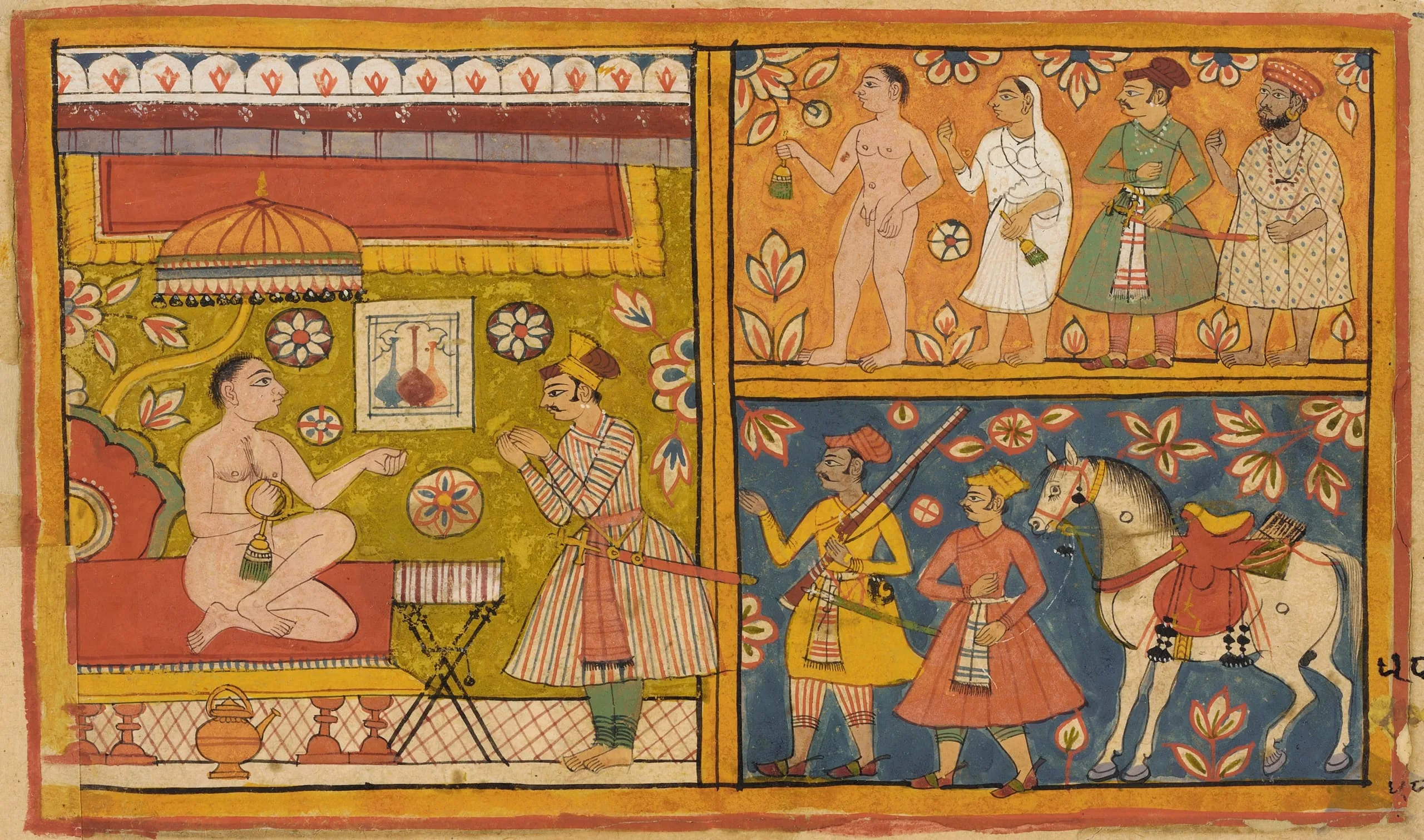
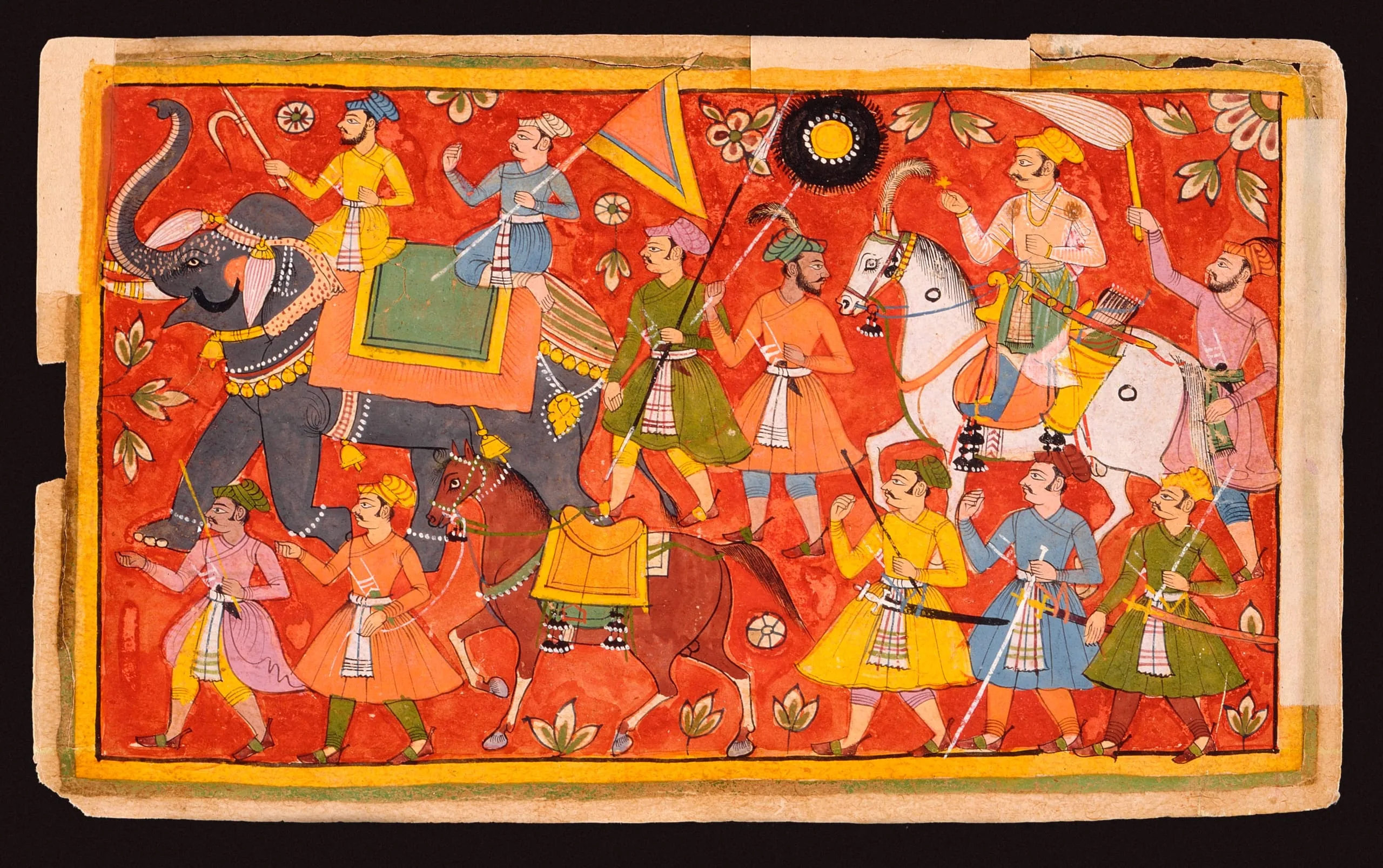
The verso of this double-sided folio depicts King Yashomati’s royal procession to see the Jain monk Sudatta. The king is riding a white horse and has attendants bearing the royal standards of an honorific fly whisk made with a white yak tail (cauri or chowri) and a Mewar solar standard with a golden Sun in the center and a black areola made of ostrich feathers (changir/changi). The recto has three panels. On the left, King Yashomati meets with the Jain monk Sudatta. His procession’s arrival is in the lower right panel. The upper right panel illustrates the twin children, shown as a Jain monk and nun.
For the attribution of the Idar manuscript, and by extension this folio, to Manohar (active circa 1635–1650), see Andrew Topsfield, Court Painting at Udaipur: Art Under the Patronage of the Maharanas of Mewar, Artibus Asiae Supplementum 44 (Zurich: Museum Rietberg, 2008), pp. 57, 75, n. 165.
Additional folios from this manuscript are in the San Diego Museum of Art (1990.595–.599). See also M.71.49.10 and M.90.86.1.