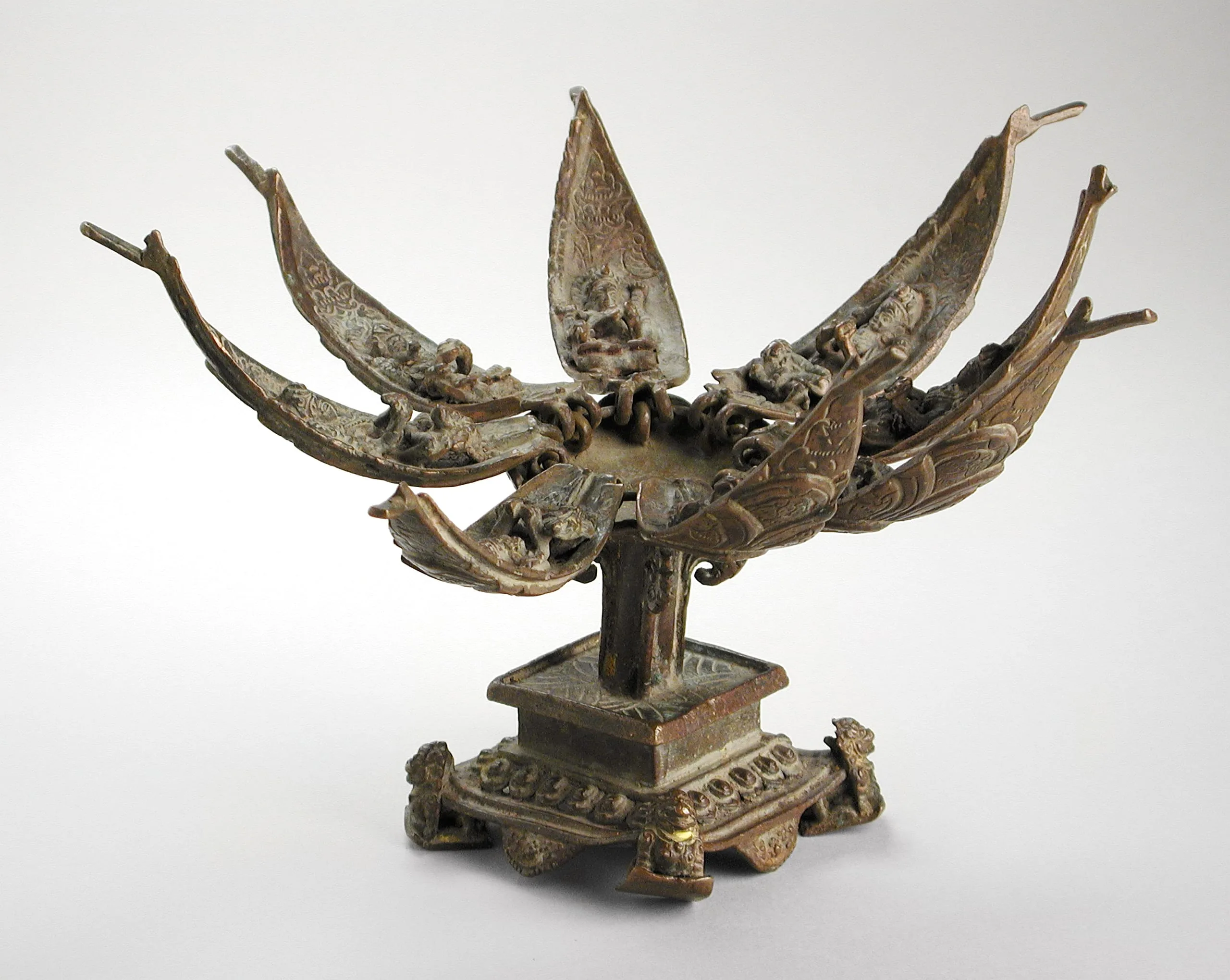
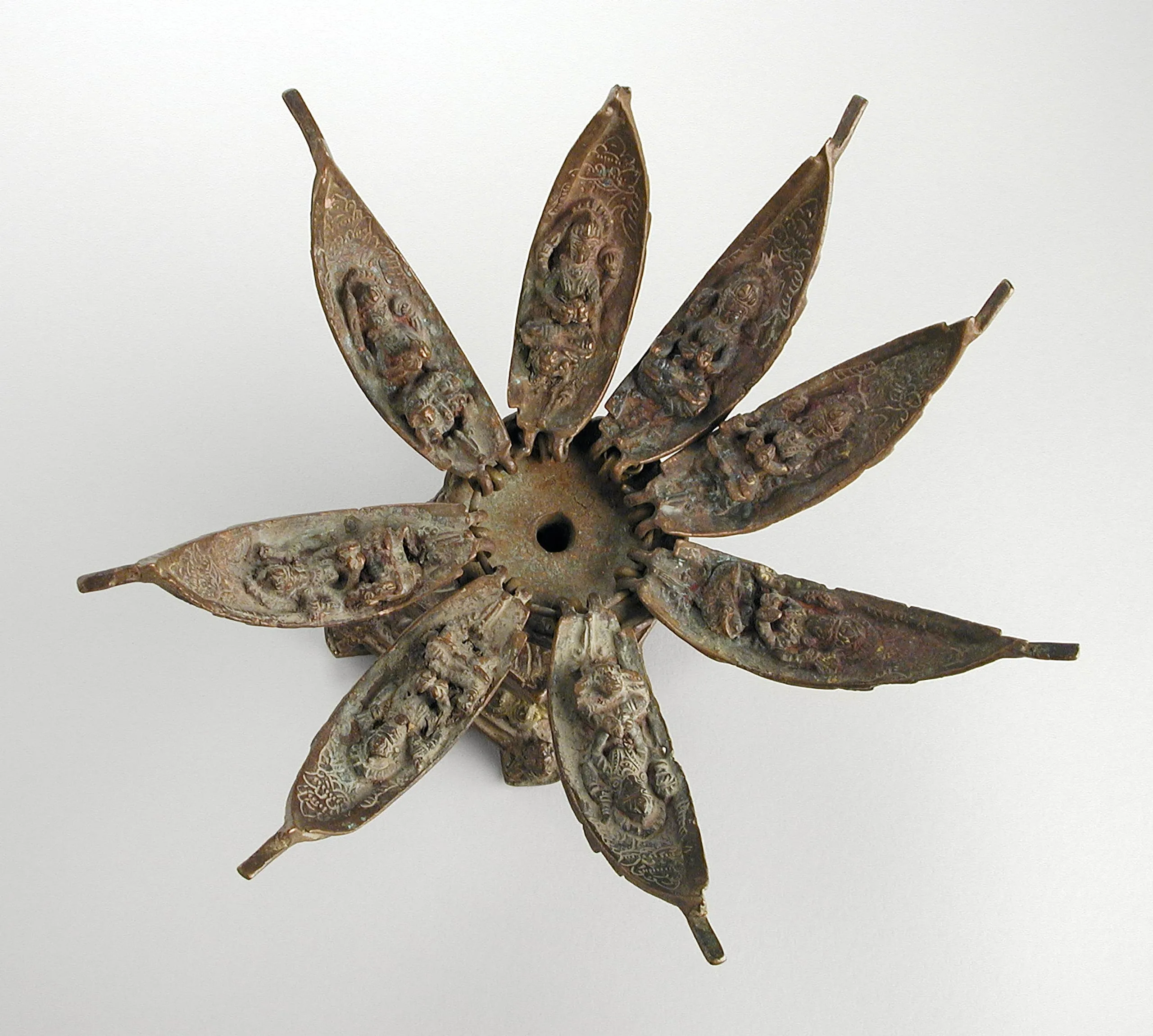
This is a three-dimensional copper sculpture of a lotus blossom on a stem rising out of a square water tank (kunda), which is supported by a lotus base with a guardian lion at each of the four corners and decorated with carpet swags draped over the sides.
The eight-petaled lotus blossom is hinged so that it can open to reveal the central deity (now missing) and, on the individual petals, relief sculptures of the Eight Mother Goddesses (Ashta Matrikas) seated beneath incised lotuses forming honorific canopies for each deity. Although coarsely rendered and partially damaged, the four-armed goddesses are identified by their attributes and mount (vahana). Varahi rides a buffalo, Mahalakshmi rides a lion, Maheshvari rides Nandi (the bull mount of Shiva), Vaishnavi rides Garuda (the half-avian, half-human mount of Vishnu), Indrani rides an elephant, Kumari rides a peacock, Brahmani rides a goose, and Chamunda rides a corpse.
Additional extant three-dimensional lotus mandalas, primarily from eastern India, variously feature Shaiva, Vaishnava, or Vajrayana Buddhist central deities. If the missing central deity of this lotus mandala was the goddess Durga slaying the Buffalo Demon, Mahishasura, then it originally represented the nine manifestations of the goddess Durga known as the Nava Durga (Nine Durgas). The Eight Mother Goddesses and Durga symbolize the supreme goddess’s various powers and energies (shaktis), ultimately representing the unity and multifaceted nature of the divine feminine. The Nava Durga are worshiped by both Hindus and Buddhists in the Kathmandu Valley, especially during the festival of Navaratri (Nine Nights) where each of the nine manifested forms are visualized by devotees and venerated respectively for each night.
Comparable Nepalese three-dimensional lotus mandalas with the Eight Mother Goddesses are in the Newark Museum of Art (90.400) and the Norton Simon Museum, Pasadena (N.1977.14.S). For Nepalese painted Nava Durga mandalas, see M.72.53.10 and one attributed to circa 1450-1550 in the Asian Art Museum, San Francisco (B87D22).