- Title
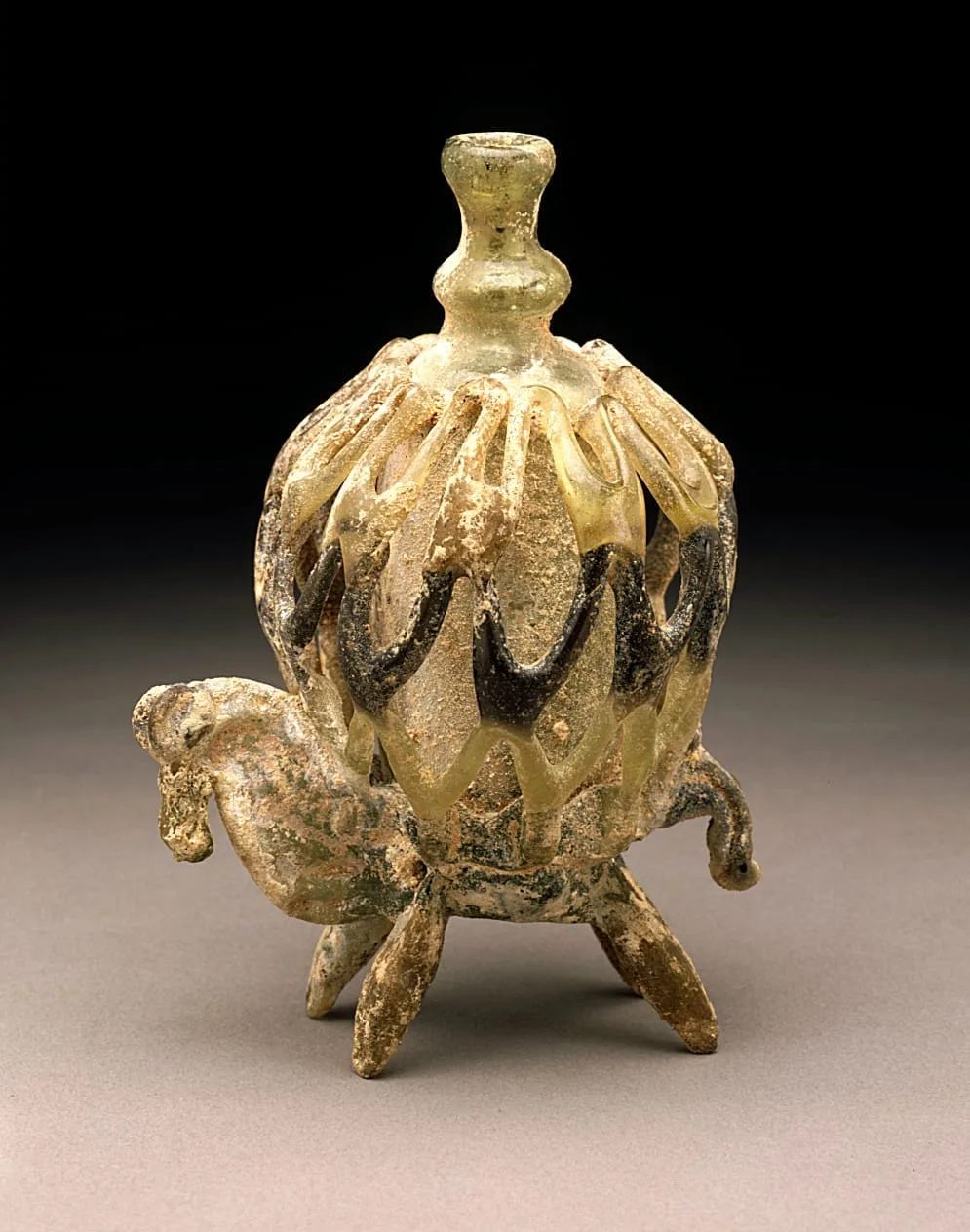
- Cosmetic container
- Date Made
- 7th-8th century
- Medium
- Glass, free-blown, tooled with applied decoration
- Dimensions
- 5 1/16 x 3 7/16 x 3 1/16 in. (12.80 x 8.70 x 7.78 cm)
- Accession Number
- M.88.129.188
- Curatorial Notes
Glassmaking, one of many crafts that flourished in the lands that would form the early Islamic empire in the mid-seventh through the eighth century, continued to thrive under the new faith and leadership. On that account, it is sometimes difficult to determine when and where some glasswares were made. This cosmetic container echoes the glassmaking traditions of Late Antique Syria in terms of the applied glass decoration on the flask, which is often more tube-shaped than rounded as here. The flask is supported on the back of a horse, making the piece both functional and playfully attractive. It was probably used as a container for perfume or kohl, a mixture of lead or charcoal combined with oil and used since ancient times as eyeliner.
2024
- Selected Bibliography
- Saldern, Axel von. Glass 500 B.C. to A.D. 1900: The Hans Cohn Collection. Mainz: Philipp von Zabern, 1980.
- Komaroff, Linda. Islamic Art at the Los Angeles County Museum of Art. Los Angeles: Museum Associates, 2005.
Pal, Pratapaditya, Thomas W. Lentz, Sheila R. Canby, Edwin Binney, 3rd, Walter B. Denny, and Stephen Markel. "Arts from Islamic Cultures: Los Angeles County Museum of Art." Arts of Asia 17, no. 6 (November/December 1987): 73-130.