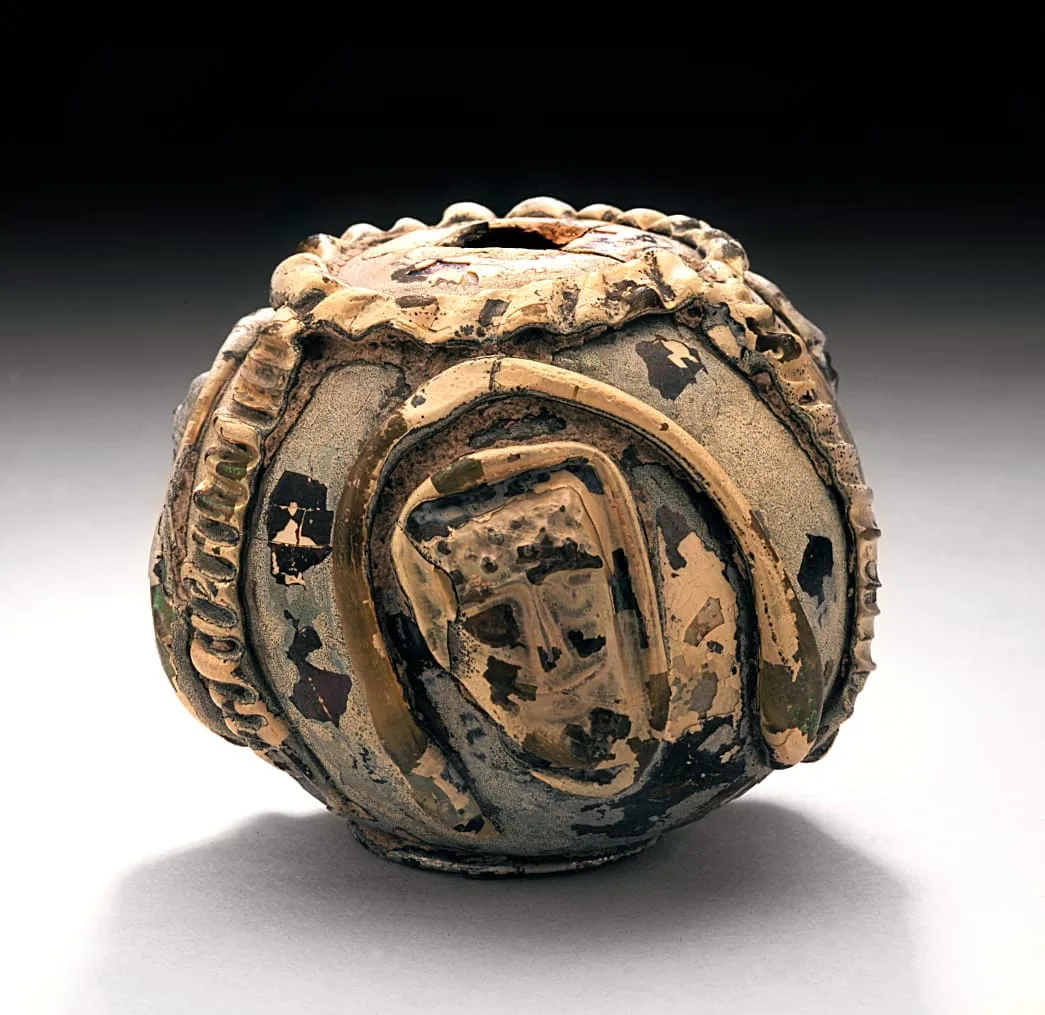
- Title
- Base of a bottle
- Date Made
- late 7th to early 8th century
- Medium
- Glass, free-blown, with applied decoration
- Dimensions
- 2 3/8 x 3 in. (6.00 x 7.60 cm)
- Accession Number
- M.88.129.186
- Curatorial Notes
Glassmaking, one of many crafts that flourished in the lands that would form the early Islamic empire in the mid-seventh through the eighth century, continued to thrive under the new faith and leadership. On that account, it is sometimes difficult to determine when and where some glasswares were made. This rare type of bottle (now missing its neck) echoes the glassmaking traditions of Late Antique Syria in its decoration of applied mold-pressed masks in the form of smiling faces. These masks, or grotesques, were probably derived from the larger-scale molded decoration found on so-called “head flasks” (see M.88.129.54). Here, however, the faces, with wide eyes and gashlike mouths, have been reduced to stylized ornaments, far removed from their late Roman prototypes.
2024
- Selected Bibliography
- Saldern, Axel von. Glass 500 B.C. to A.D. 1900: The Hans Cohn Collection. Mainz: Philipp von Zabern, 1980.
- Komaroff, Linda. Islamic Art at the Los Angeles County Museum of Art. Los Angeles: Museum Associates, 2005.
Pal, Pratapaditya, Thomas W. Lentz, Sheila R. Canby, Edwin Binney, 3rd, Walter B. Denny, and Stephen Markel. "Arts from Islamic Cultures: Los Angeles County Museum of Art." Arts of Asia 17, no. 6 (November/December 1987): 73-130.