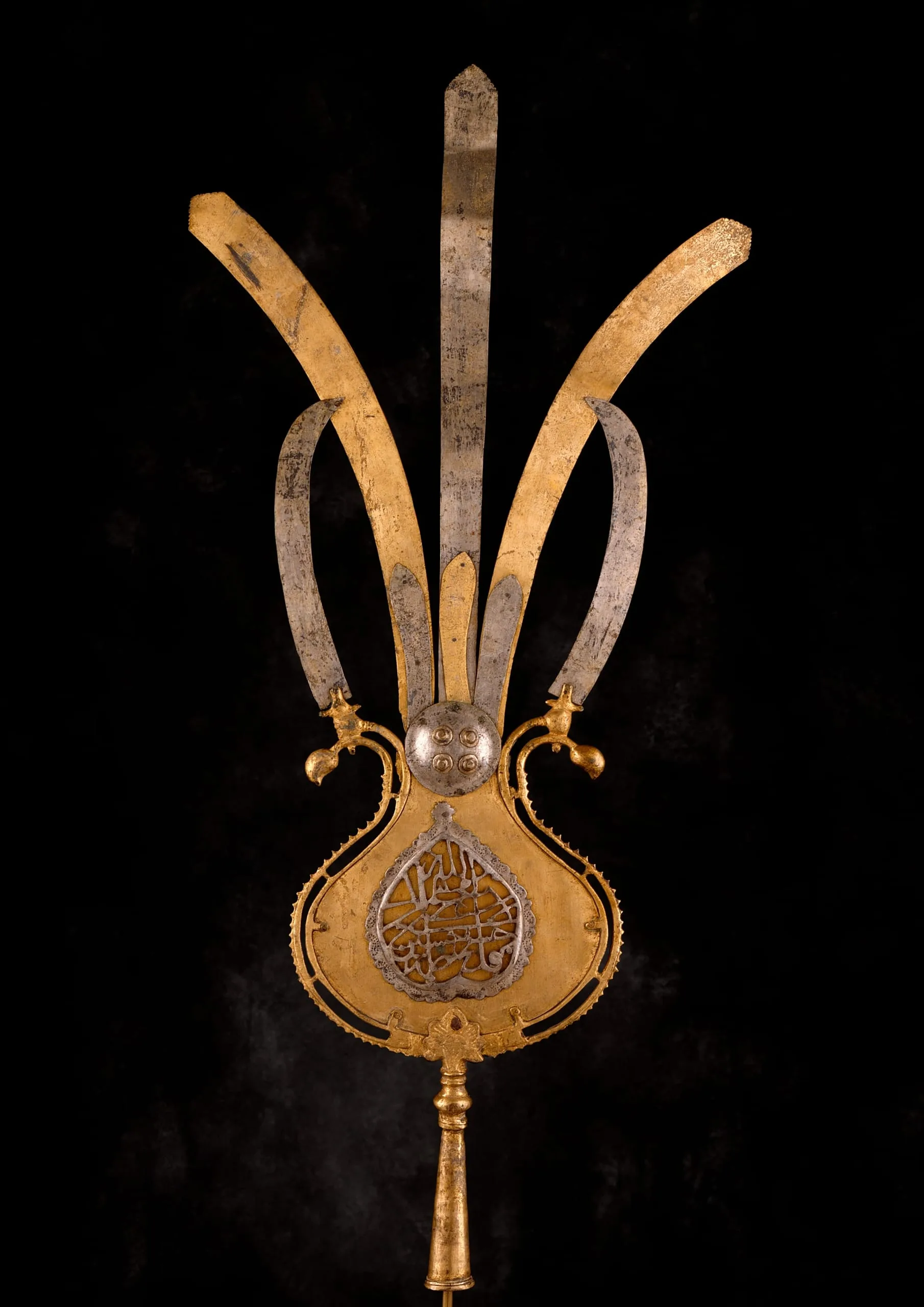
Known as an alam, this type of religious standard would have been carried in the Shia mourning observance of Muharram to commemorate the martyrdom of Husain, grandson of the Prophet Muhammad who founded the Muslim religion. Husain’s massacre at the Battle of Karbala in Mesopotamia (modern Iraq) in 680 helped foster a severe sectarian schism. Shia Muslims diverge from the more numerous Sunnis in that they consider the true successors of Mohammed (c. 570–632) to be Ali (600–661) and the People of the Household (Ahl al-Bayt): Muhammad; his daughter, Fatima; his son-in-law, Ali; and their children, Hasan and Husayn. Processional and ceremonial standards were fashioned in a variety of materials, including bronze, copper, brass, steel, silver, and rarely bejeweled gold. They were also represented in stucco or ceramic on Shia architecture.
The LACMA standard follows the conventional teardrop-shape with a central cartouche bearing an openwork inscription reading (top to bottom): Allah, Muhammad, Ali, Hasan, Husayn, Fatima. (Translation by Marika Sardar.) The three flaring upper terminals refer to the scissorlike double-bladed Zulfiqar sword of Ali. The military association is reenforced by the flanking depictions of two curved shamshir sabers with talwar hilt, and a central shield with four bosses used in attaching the interior handgrips. Unusually, in place of the customary snarling dragon heads, the terminals of the crenelated outer border are enlivened with pendent mangoes.