LACMA

ShopMembershipMyLACMATickets
LACMA
Los Angeles County Museum of Art
5905 Wilshire Blvd.
Los Angeles, CA 90036
info@lacma.org
(323) 857-6000
Sign up to receive emails
Subscribe
© Museum Associates 2026
  • About LACMA
  • Jobs
  • Building LACMA
  • Host An Event
  • Unframed
  • Press
  • FAQs
  • Log in to MyLACMA
  • Privacy Policy
© Museum Associates 2026
Collections

Unknown
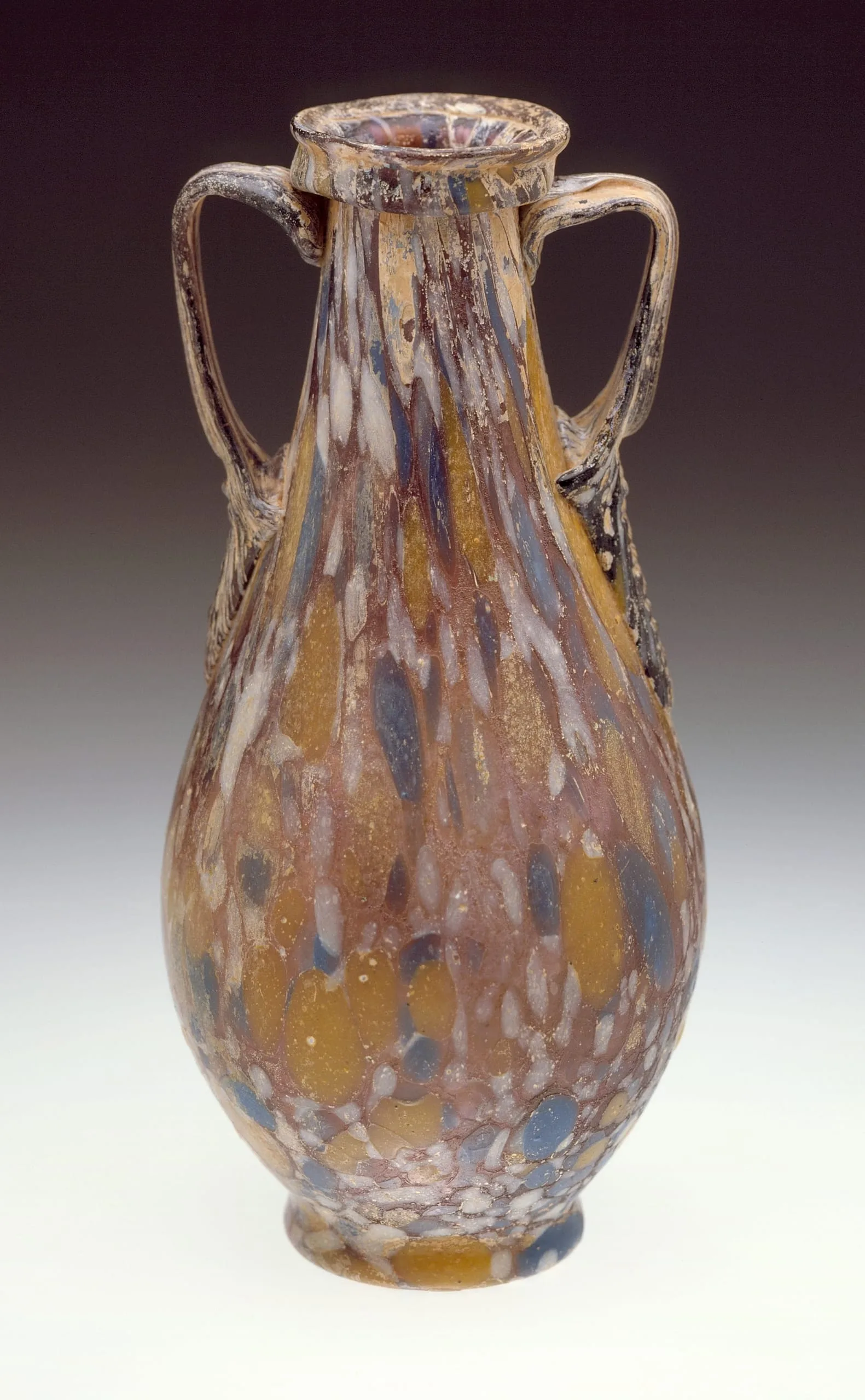
Amphorasecond or third quarter of the 1st century

On view:
Geffen Galleries, floor 1
Ancient glass amphora with two looping handles, pear-shaped body covered in marbled amber, slate blue, mauve, and white swirling patterns, with a weathered, encrusted surface

Unknown, Amphora, second or third quarter of the 1st century, Los Angeles County Museum of Art, Gift of Varya and Hans Cohn, photo © Museum Associates/LACMA

Artist or Maker
Unknown
Title
Amphora
Place Made
East Mediterranean or Italy
Date Made
second or third quarter of the 1st century
Medium
Glass with splash decoration
Dimensions
5 1/8 x 2 5/8 in. (13 x 6.7 cm)
Credit Line
Gift of Varya and Hans Cohn
Accession Number
M.88.129.41
Classification
Furnishings
Collecting Area
European Painting and Sculpture: Greek and Roman
Curatorial Notes

This amphora, a miniature version of the two-handled ceramic vessels used to store oil and wine, likely served a cosmetic purpose, holding perfume or oil. It is made from pale purple glass with polychrome “splashed” decoration, and age has turned it slightly iridescent and frosted. The free-blowing technique was used to shape the vessel’s concave base, pear-shaped body, and tapered neck, where the glass was inflated by a blowpipe and shaped with tools. The handles were applied separately and feature several crimped extensions emanating from their ends.

The “splash” decoration effect is achieved by sprinkling or rolling bits of multicolored glass (here, turquoise blue, yellow, and white) onto a partially blown vessel. Further inflation of the vessel distends the molten fragments into drop-shaped splashes. This technique was especially popular in northern Italy and adjoining regions in modern-day Switzerland, though similar vessels have also been made in the eastern Mediterranean.
Selected Bibliography
  • Saldern, Axel von. Glass 500 B.C. to A.D. 1900: The Hans Cohn Collection. Mainz: Philipp von Zabern, 1980.

Related Unframed

50 Works 50 Weeks: The Hope Athena
  • September 30, 2025
  • Alexander Schneider