- Title
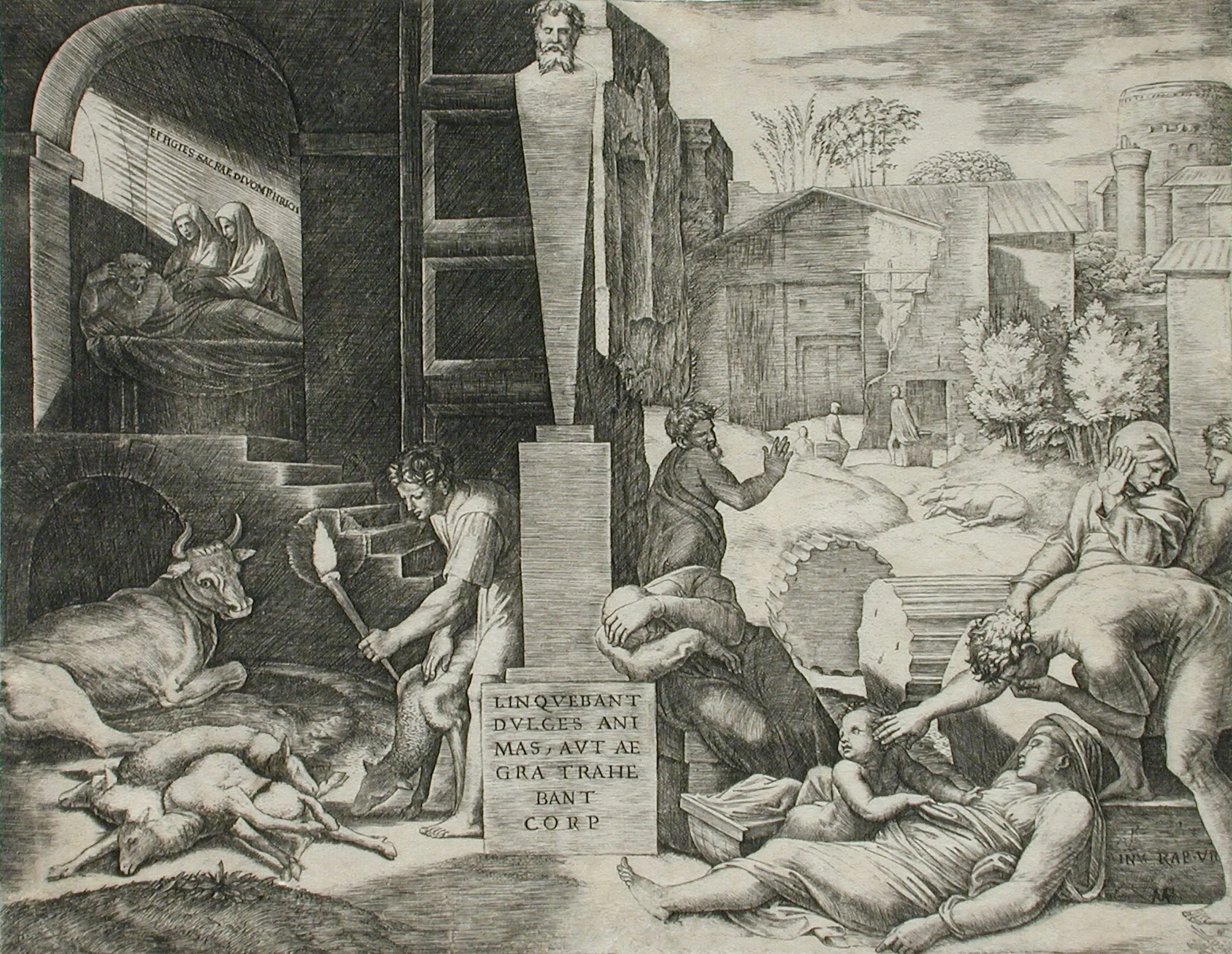
- The Plague of Phrygia, or The Morbetto
- Date Made
- circa 1515-1516
- Medium
- Engraving
- Dimensions
- Sheet: 7 3/4 × 9 7/8 in. (19.69 × 25.08 cm)
Image: 7 3/4 × 9 7/8 in. (19.69 × 25.08 cm)
- Accession Number
- M.88.91.211
- Curatorial Notes
Called in Italian “the little plague” for its dimensions, this somber small-scale composition tells parallel stories about destruction and change. The print’s subject is an epidemic that afflicted humans and animals on the island of Crete, detailed in Virgil’s epic the Aeneid, a passage from which appears on the center pedestal. A vignette at upper left shows the hero Aeneas receiving a message in a dream that he should leave the devastated Crete to settle Italy. This story was relevant to Renaissance Roman audiences, whose city had fallen into ruin and disease following invasions by the Goths and the exile of the papacy to Avignon during the medieval period. By the second decade of the sixteenth century, when Raphael produced the drawings for this engraving, art and architecture in Rome had experienced a renewal. This transformative Renovatio Romae was spurred by Renaissance humanists’ interest in the aesthetics and culture of ancient Rome, and produced new art from the destruction. As broken columns and bodies suggest the city’s decay, young survivors encourage hope that Rome will blossom again. Raphael died before his drawings could be engraved, and his work was carried on by collaborator Marcantonio Raimondi.
Claire Spadafora Baes
2024
- Selected Bibliography
- Bartsch, Adam von. The Illustrated Bartsch. New York: Abaris Books, 1978.