LACMA

ShopMembershipMyLACMATickets
LACMA
Los Angeles County Museum of Art
5905 Wilshire Blvd.
Los Angeles, CA 90036
info@lacma.org
(323) 857-6000
Sign up to receive emails
Subscribe
© Museum Associates 2025
  • About LACMA
  • Jobs
  • Building LACMA
  • Host An Event
  • Unframed
  • Press
  • FAQs
  • Log in to MyLACMA
  • Privacy Policy
© Museum Associates 2025
Collections

Unknown
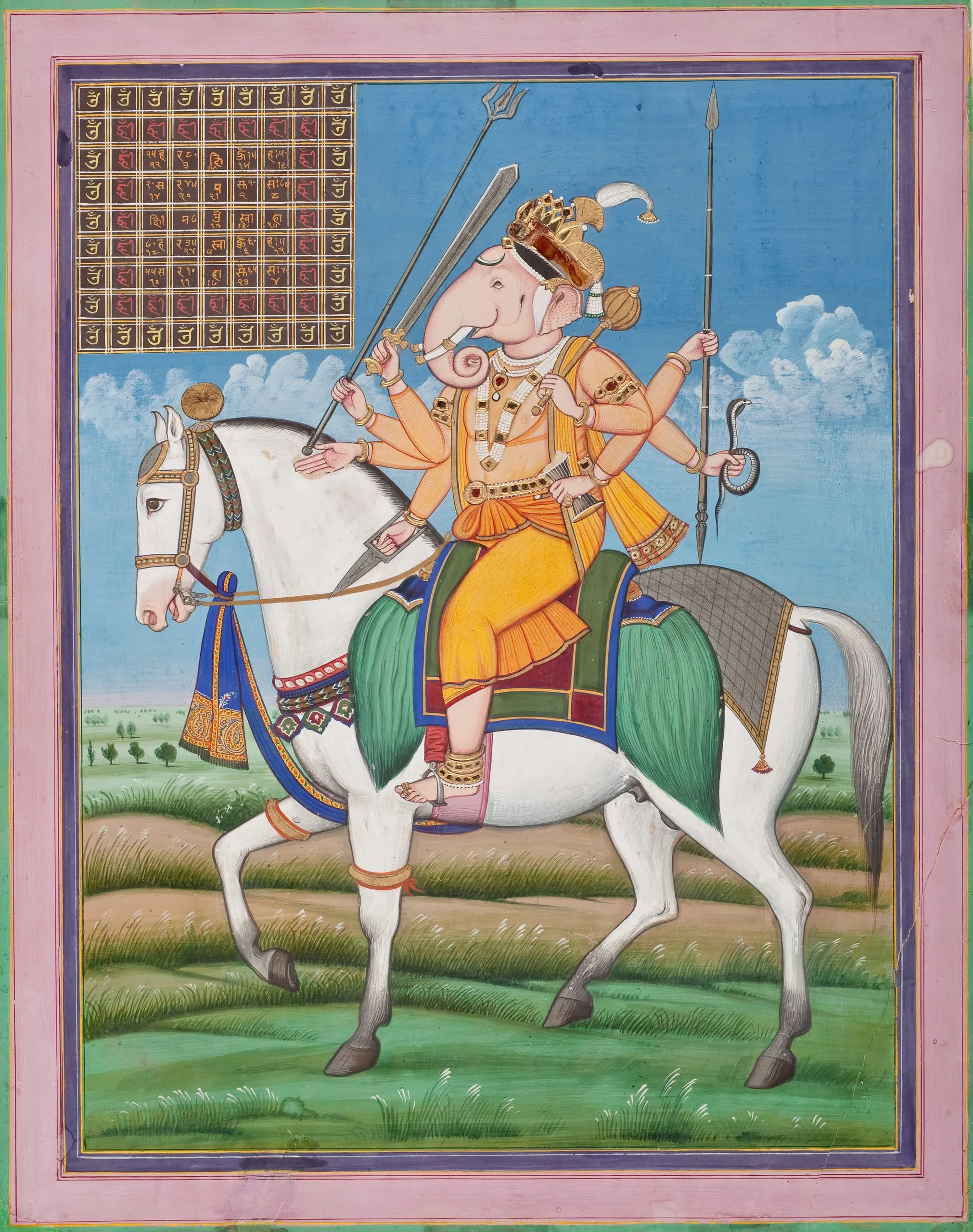
The Yaksha Purnabhadracirca 1850-1900

Not on view
Opaque watercolor painting of a multi-armed, elephant-headed deity in orange and gold regalia riding a white horse across a green landscape, with a grid of script characters in the upper left corner
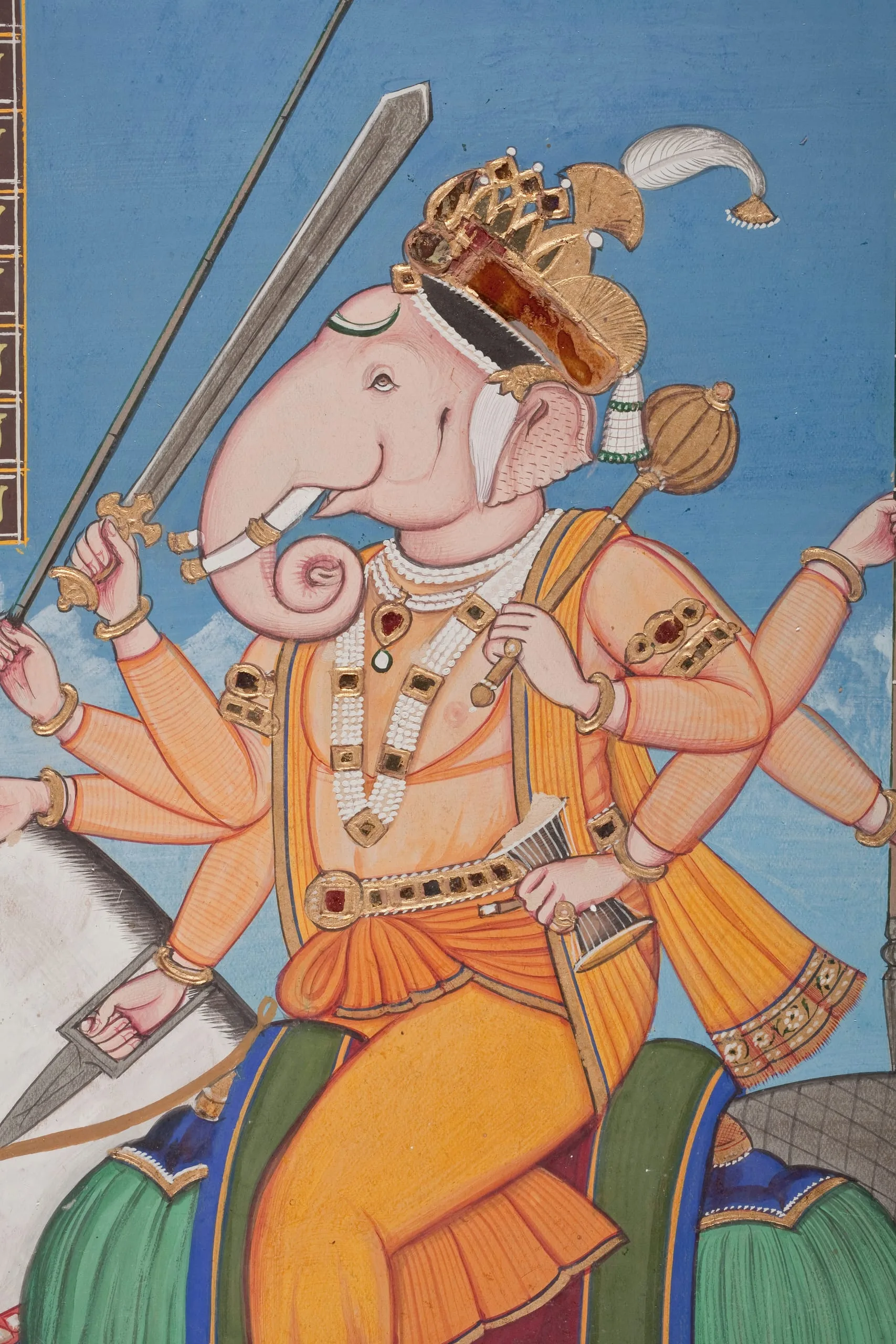
Indian miniature painting of a multi-armed, elephant-headed deity seated against a light blue sky, wearing an ornate gold crown with white feather, pearl and gem necklaces, and saffron-orange robes; multiple hands hold a sword, a mace, a knife, and other objects; fine detailed brushwork with gold embellishment.
Artist or Maker
Unknown
Title
The Yaksha Purnabhadra
Place Made
India, Rajasthan, Jaipur
Date Made
circa 1850-1900
Medium
Opaque watercolor, gold, and silver on paper; colored foil
Dimensions
Image: 17 x 13 in. (43.18 x 33.02 cm); Sheet: 19 7/8 x 15 3/4 in. (50.48 x 40.01 cm)
Credit Line
Gift of Mr. and Mrs. Harry Lenart
Accession Number
M.88.33
Classification
Drawings
Collecting Area
South and Southeast Asian Art
Curatorial Notes

Purnabhadra (Fully Auspicious) is revered by Jains, Hindus, and Buddhists as a benevolent king of the yakshas (nature-spirits). His veneration predates even the Jain savior Mahavira and the Buddha in the 6th century BCE. Elaborate shrines are known to have been erected for his worship, such as the one at Champa in ancient Anga, Bihar.

Buddhist texts describe Purnabhadra as being blue-skinned and holding a citron and mongoose, like the Buddhist god of wealth, Jambhala. This eight-armed, elephant-headed form of Purnabhadra is apparently a late Jain conception and may derive in part from the following legend. When Purnabhadra’s wife, Bhadravati, accidentally hit the god Kubera with a flywhisk while she was thinking about an elephant, Kubera cursed the couple to make them take the form of elephants. Purnabhadra's protective function as a yaksha probably explains why he is shown in this painting carrying several weapons, including a sword, trident, punch-dagger (katar or jamadhar), mace, and lance. He also holds a cobra and an hourglass-shaped hand drum with rope laces for tuning (dholaka). Purnabhadra's tusks are of equal length, which iconographically differentiates him from the elephant-headed god Ganesha, who according to one legend broke off one of his tusks to hurl it at the moon.

The grid in the upper left corner of the painting contains mystical characters symbolizing esoteric Jain religious concepts used in meditative worship and rituals.
Selected Bibliography
  • El Universo de la India: Obras Maestras del Museo de Arte del Condado de Los Angeles. Santiago: Centro Cultural Palacio La Moneda, 2012.