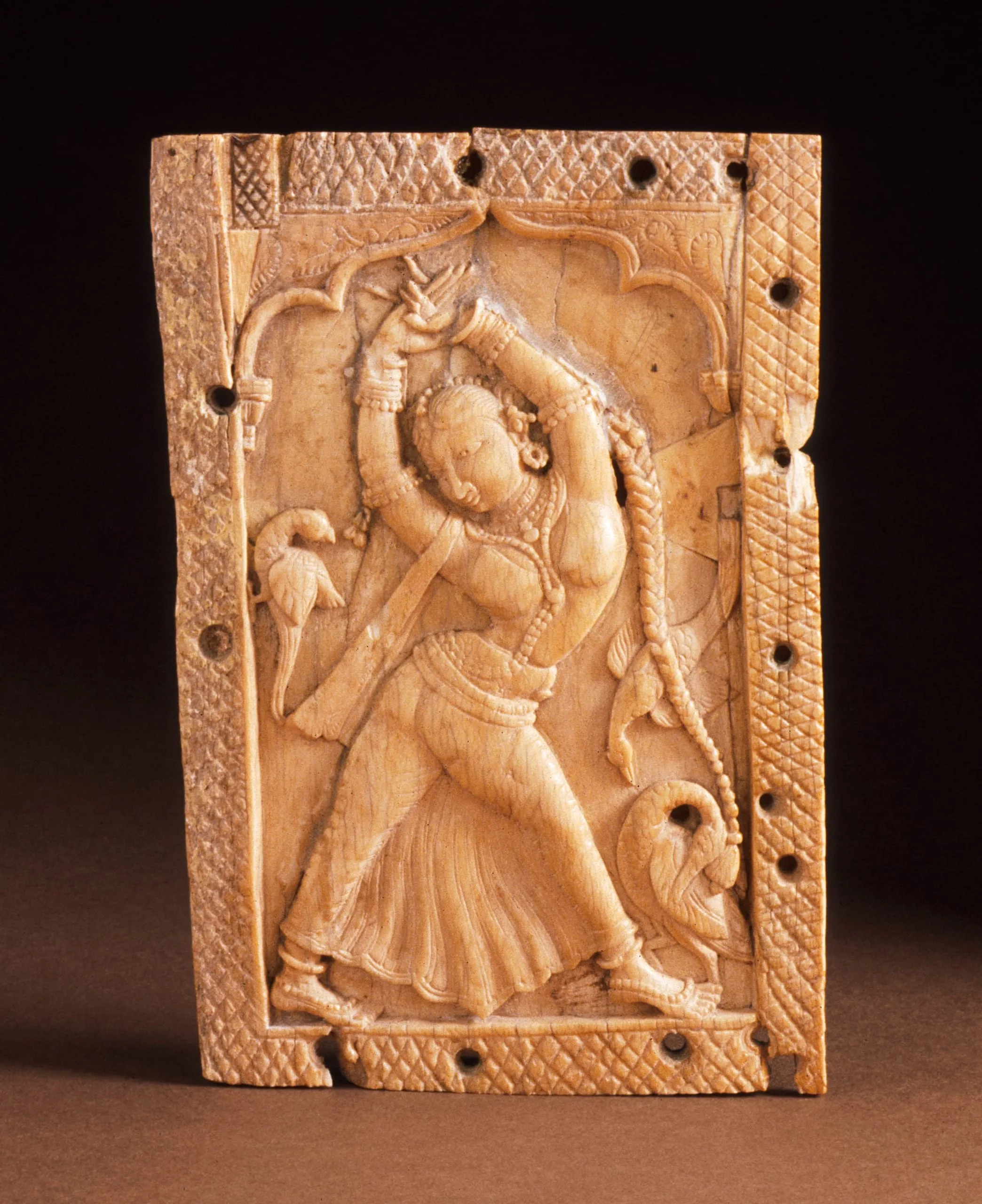
Madurai, the principal capital of the Nāyak Dynasty (1529–1736) in Tamil Nadu, is renowned for its temple and palatial architecture, especially under the reign of the illustrious King Tirumala Nayaka (r. 1623–1659). It was also an important center for the pictorial and decorative arts, particularly painting and ivory carving. In addition to freestanding ivory representations of royal and amorous couples, Hindu deities, and religious personages, sets of ivory plaques carved in low-relief or openwork were used to adorn furniture (principally jewelry boxes and thrones) and palatial and temple portals.
This plaque and two others in LACMA’s collection (M.80.232.5–.6), as well as plaques in the Metropolitan Museum of Art, New York (2011.576.3) and the Polsky collection, New York (published in 2004), are likely from the same dispersed set judging from the distinctive crosshatched outer border, as well as the stylistic similarities of well rendered figures and animals set against a plain solid background in simple compositions. Other sets vary considerably in subject, size, aesthetic quality, and technical expertise, but are consistent in featuring Nāyak figural style and personal ornamentation. The dancer illustrated here wears Nāyak-period jewelry, notably her tripartite koppu type earring and her rigid torque necklace with a pendant solid disk called a tālipottu, which was worn by Nāyak women of all levels of society as a symbol of marriage.