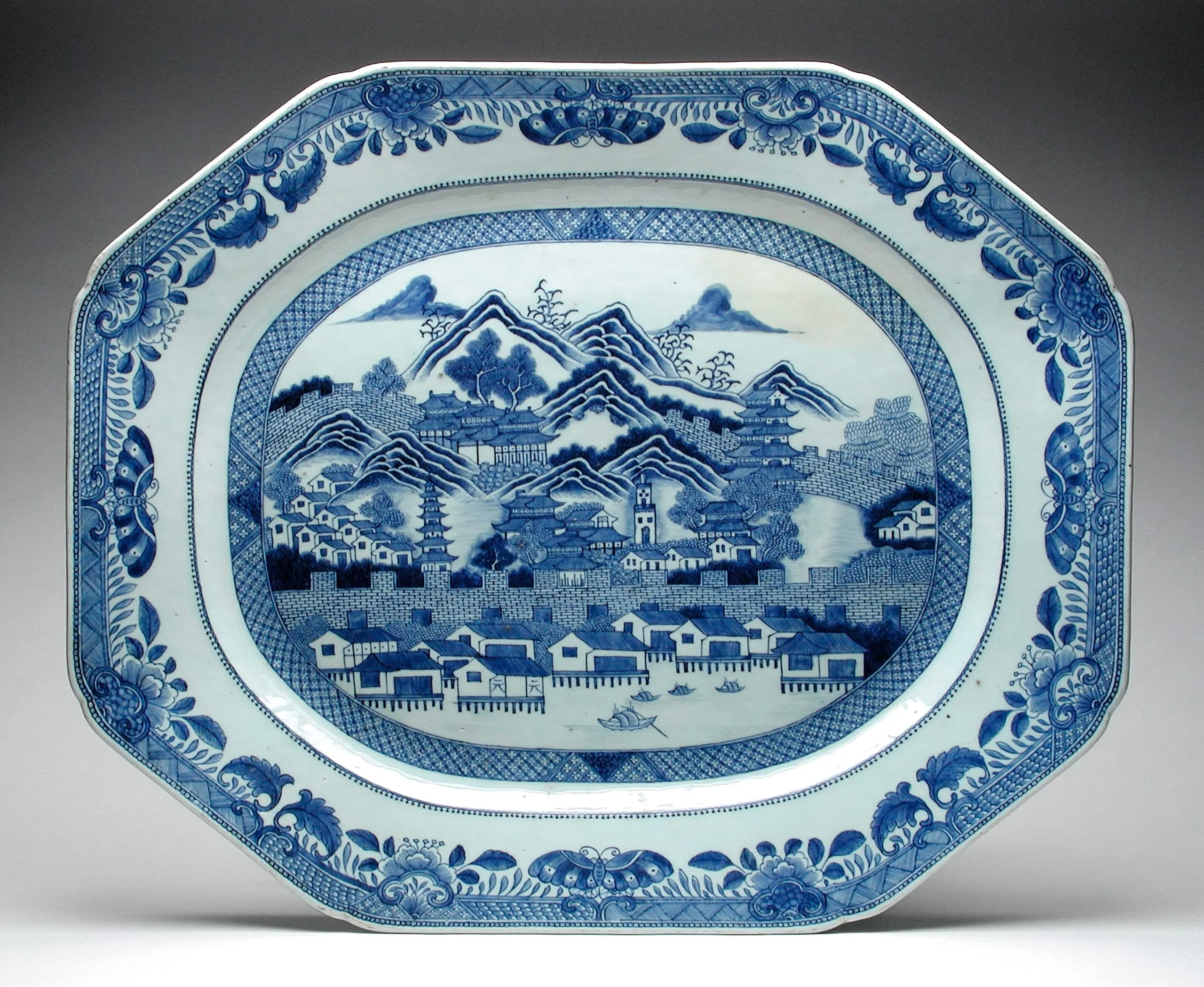
Beginning in the sixteenth century, Chinese manufactories produced porcelain for a European, and later North American, market. A segment of these wares included shapes and designs specifically requested by European consumers. Scholars now often refer to porcelain made in response to European specifications as “Chinese export porcelain.” European trading companies would place orders for European utilitarian shapes, such as sets of plates and serving dishes, and communicate desired designs, like a family armorial crest.
This octagonal plate likely belonged to a larger service, mass-produced in Canton (present-day Guangzhou) in the late eighteenth century. This type of blue-and-white underglaze porcelain was especially popular, and the generic stylized landscape with mountains and a village along a lake or river was characteristic of porcelain hand-painted in Canton during this period. Because porcelain was heavy, it often served as ballast for stabilizing trade ships destined for Europe and the Americas.
By the eighteenth century, such wares were relatively affordable, compared to customized armorial dining services, and could be found in many households in Europe and in settler-colonial cities along the Atlantic coast. The stylized imagery fed into fantasies of East Asia and influenced European and American ceramic designs.
Cynthia Kok
April 2025