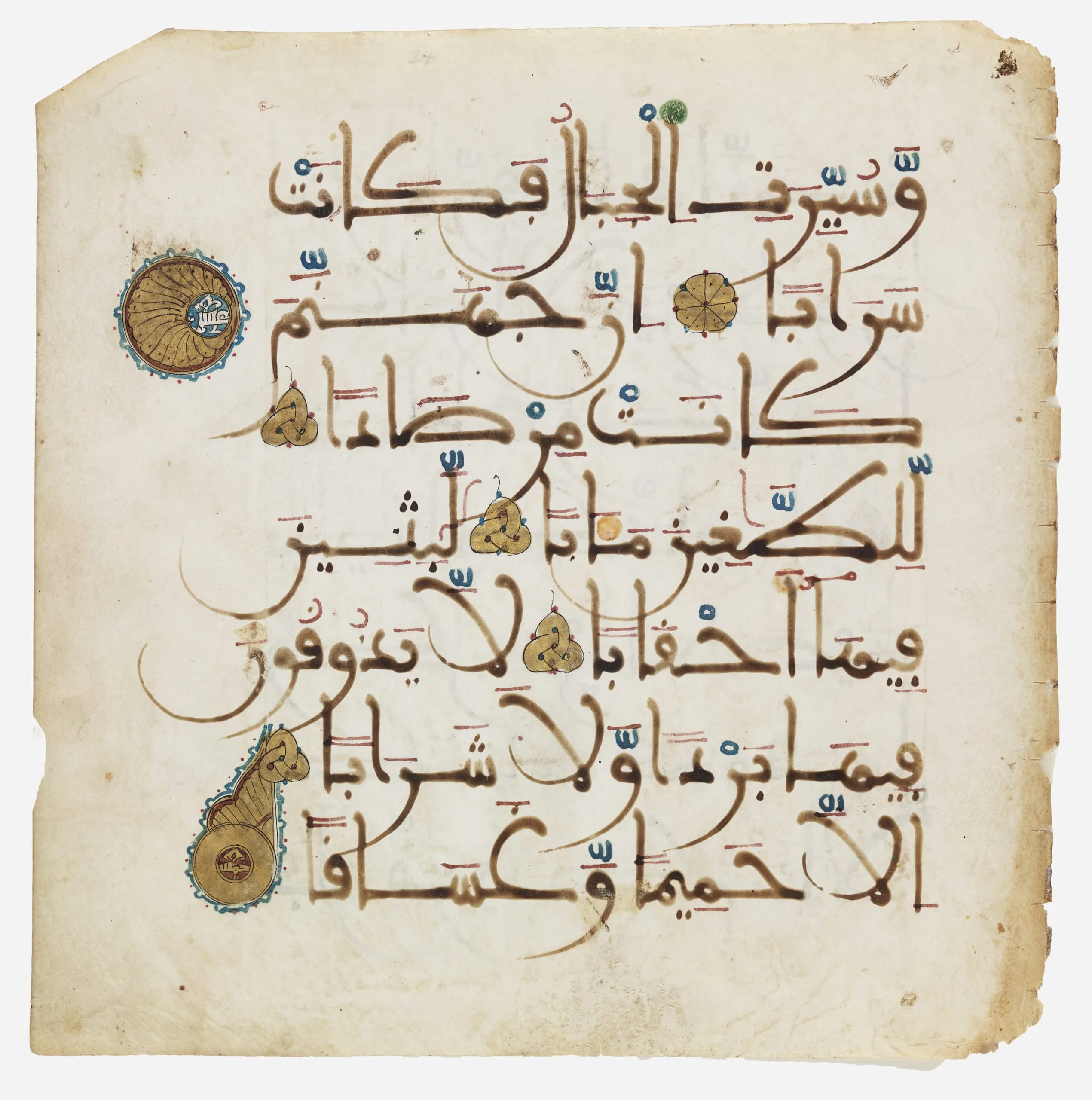
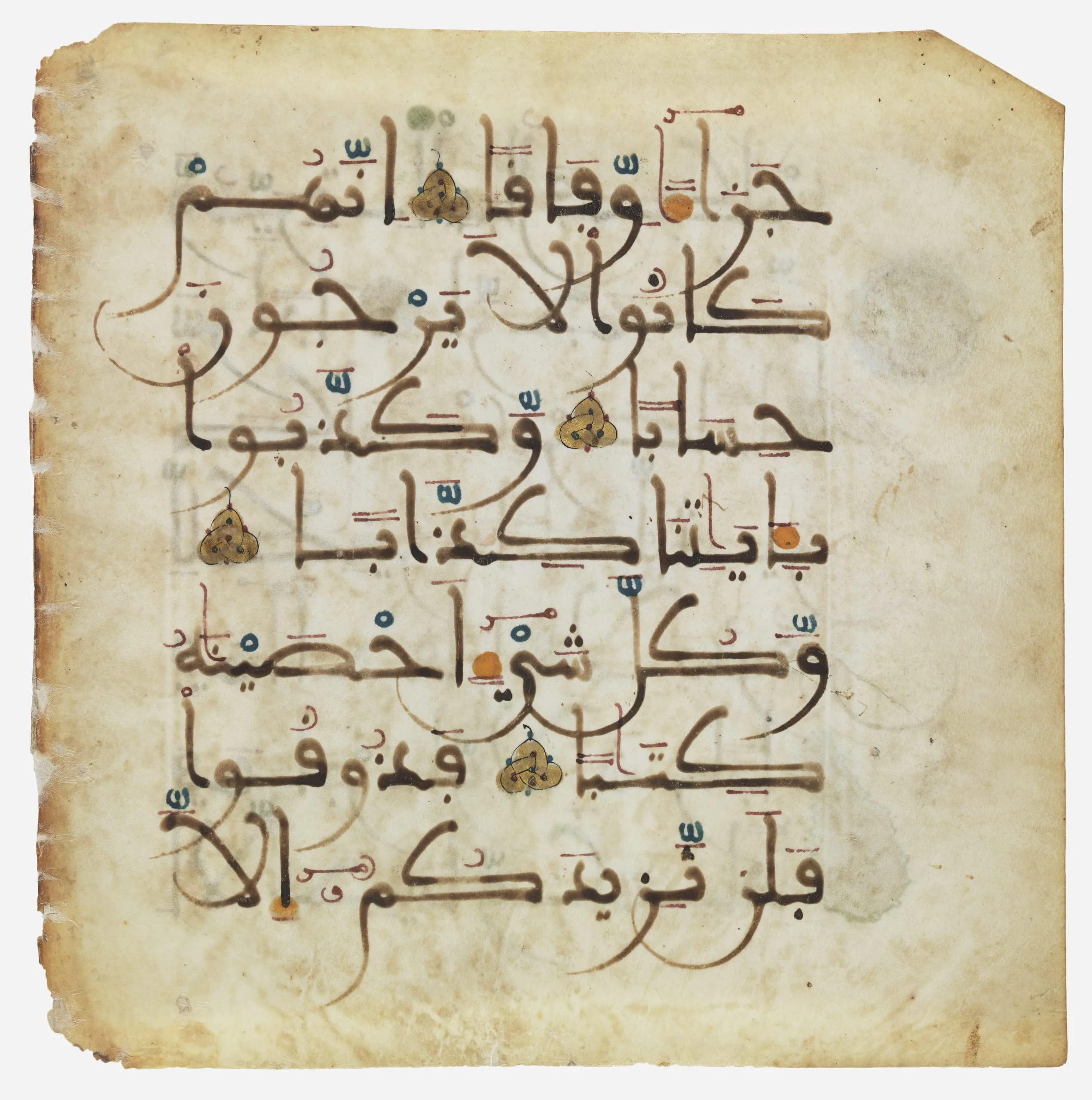
The art of writing in Arabic has been, and is, a signifier and shaper of both Muslim and Arab identity. It became central to all aspects of daily life in the Islamic world on account of the language-specific nature of the faith: the language of divine revelation is Arabic, preserved and transmitted in writing through the Qur’an. As Islam spread outward from Arabia, so too was Arabic writing brought to new lands, where the script was modified and beautified so that it might be worthy of holy scripture. The practice of calligraphy transformed and evolved specifically for copying the Qur’anic text.
From the early eighth century until 1492, Spain, known as Al-Andalus, was the western frontier of Islam. This page from a dispersed manuscript, in its use of parchment and its distinctive script, is typical of Qur’an production in Al-Andalus. Parchment remained popular in the region for copying the sacred text even after it had been supplanted by paper elsewhere in the Islamic world. The cursive script, known as maghribi, descended from kufic, but its graceful, deeply curved lines are specific to the Islamic west. The text is finely written in brown ink with seven lines per page, while the vocalization and other reading marks are rendered in yellow, red, blue, and green. The single verse markers take the form of golden knots; every fifth and tenth verse is indicated by a stylized palmette and by a medallion illuminated in gold.
2025