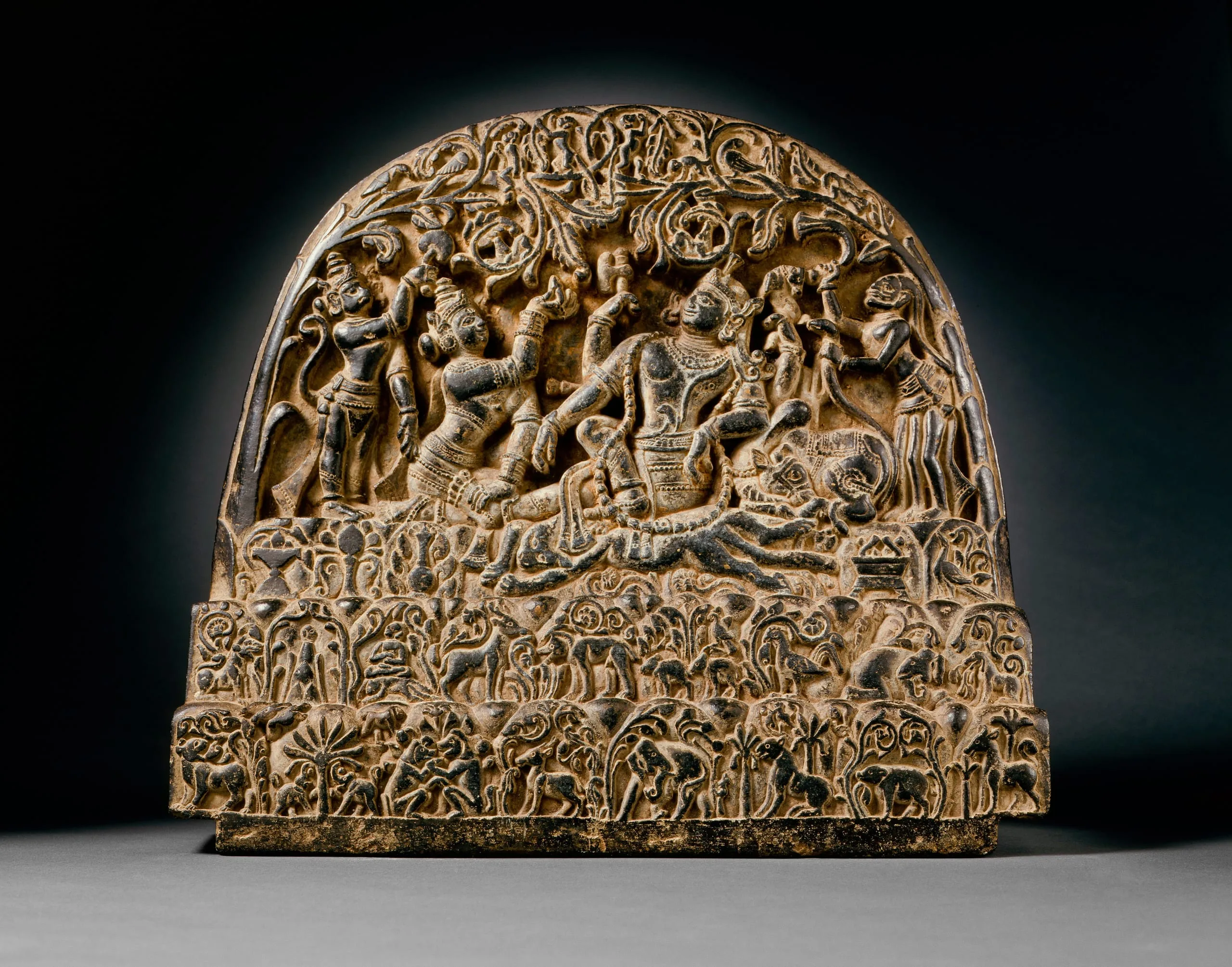
- Title
- Shiva's Family on Mount Kailasha
- Date Made
- 14th-15th century
- Medium
- Black schist
- Dimensions
- 12 5/8 x 14 1/4 x 3 1/8 in. (32.06 x 36.2 x 7.93 cm)
- Accession Number
- M.88.51
- Curatorial Notes
In Hinduism, mountains symbolize the sacred home of the gods. This sculpture of Mount Kailasha, which replicates the hemispherical shape of the actual mountain, depicts the great god Shiva and his wife Parvati seated in their abode above the earthly realm, indicated by two tiers of undulating hills filled with animals and lush vegetation. Shiva and Parvati are portrayed in a family scene as devoted spouses. Parvati is offering a beetle nut quid (pan) to Shiva, who is seated in a relaxed posture using his bull mount Nandi as a bolster. Shiva is four-armed and holds his axe and antelope attributes in his upper hands. Behind Parvati, the Divine Monkey-General Hanuman waves a fan-shaped honorific fly whisk (cauri or chowri). Behind Shiva, the three-legged sage Bhringi waves an honorific peacock feather fly whisk (morchal) and holds a serpent sacred to Shiva. Two gracefully bending trees form an elaborate floral frame around the deities. The holy couple’s children, the elephant-headed Ganesha and their eternally young son Kumara, are represented in panels on the lower sides of the relief. The back of the sculpture has a smooth finish and a semicircular outline near the top edge suggesting that is intended to represent Shiva’s aniconic emblem, a Shivalinga. The sculpture’s composition and painterly artistic style of shallow carving resembles that of early manuscript painting.
- Selected Bibliography
- Pal, Pratapaditya. Indian Sculpture, vol.2. Los Angeles: Los Angeles County Museum of Art; University of California Press, 1988.