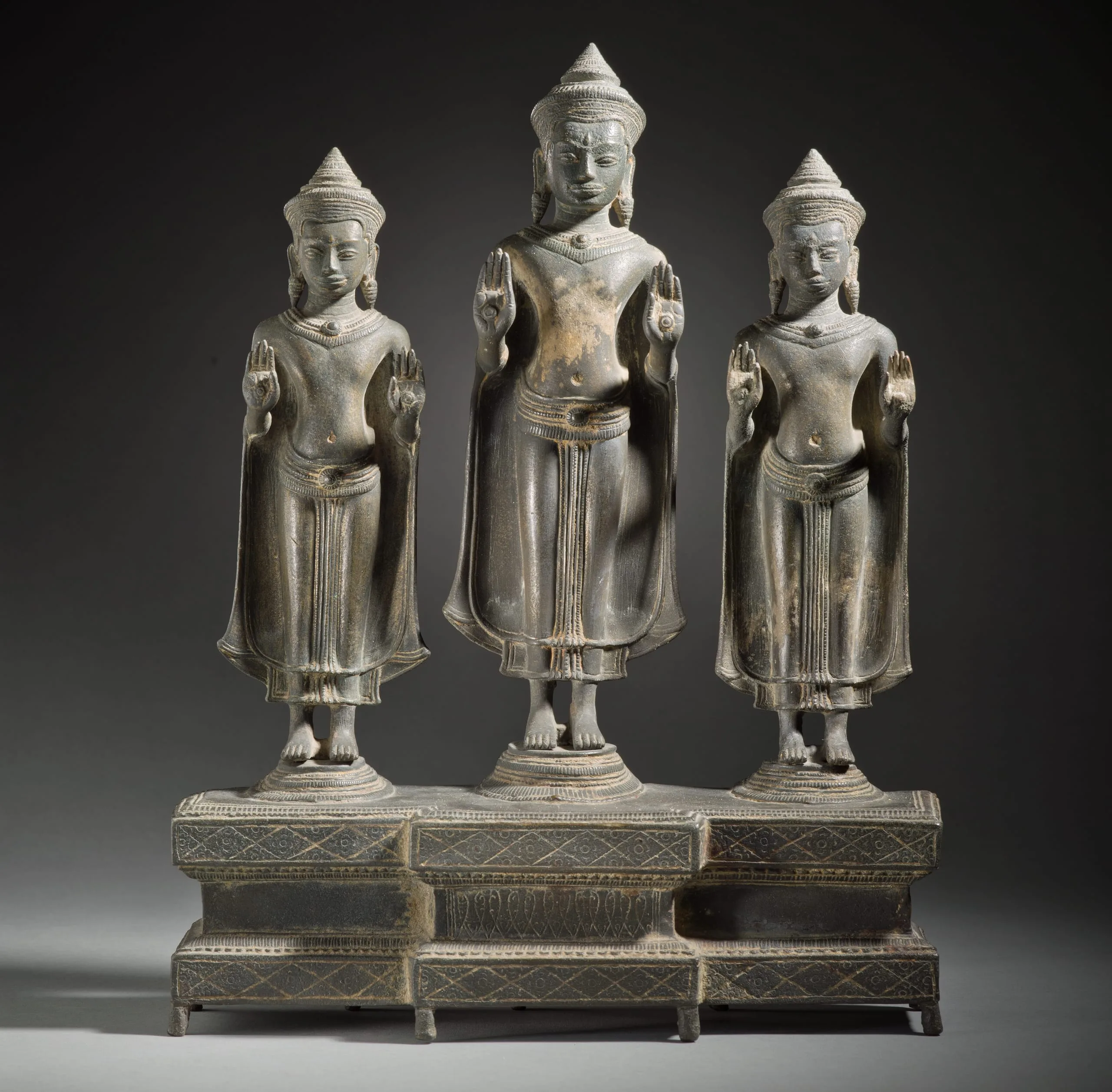
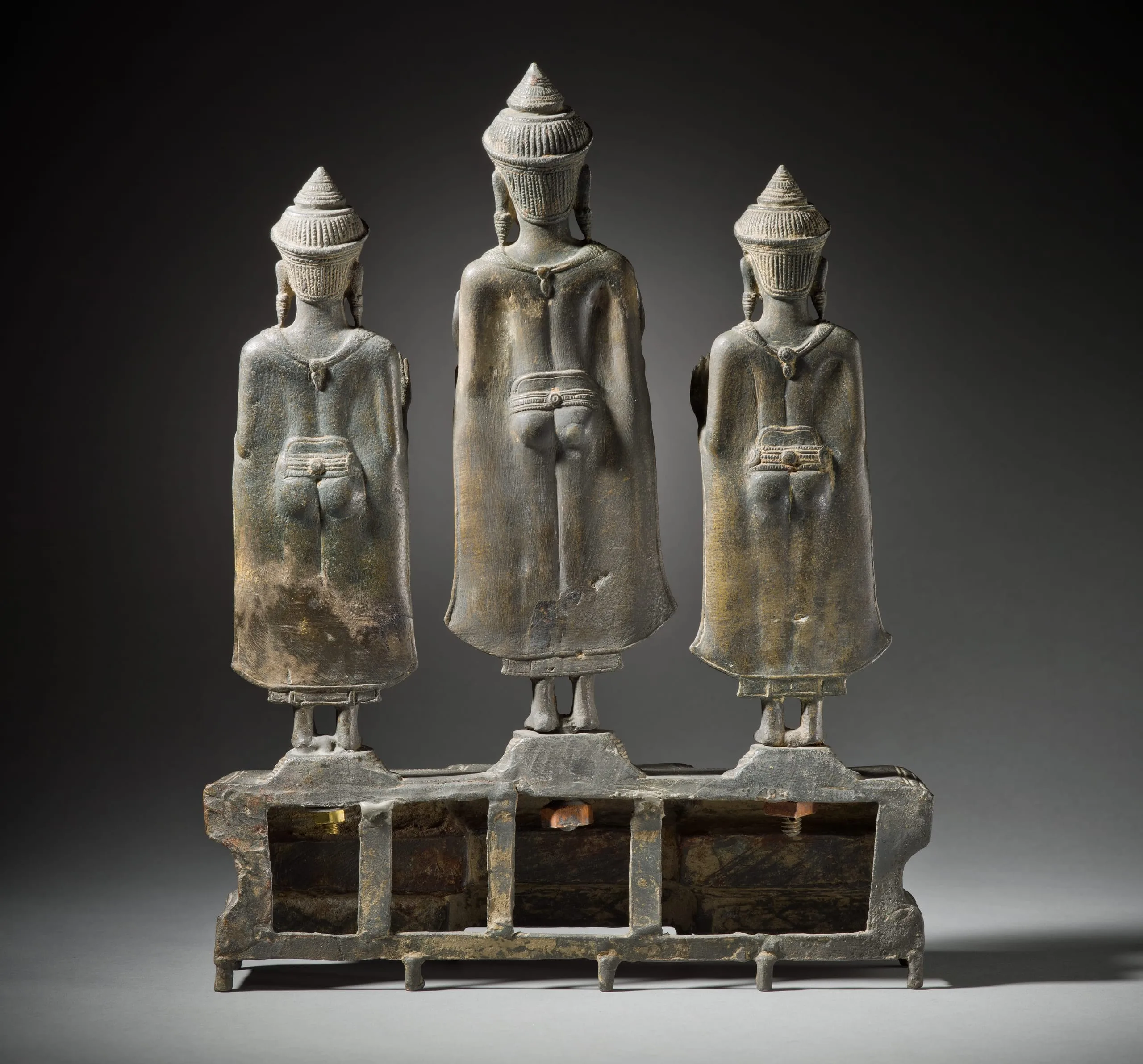
Buddhist triads often depict the historical Buddha Shakyamuni (traditionally dated to 563–483 BCE) flanked by the bodhisattvas Avalokiteshvara and Maitreya. The latter two are distinguished iconographically by their crown insignias, the Amitabha Buddha and a stupa (funerary monument) respectively. Here, however, the three virtually identical Buddhas (the central one is slightly larger) may represent the historical Buddha Shakyamuni (traditionally dated to 563–483 BCE) flanked by Dipankara Buddha, the Buddha of the Past, and Maitreya, the Buddha of the Future.
A second but less likely interpretation given its limited emphasis in the Theravada form of Buddhism practiced in most of Southeast Asia, is that in Mahayana Buddhism the three Buddhas may also represent the concept of the Trikaya (three bodies): dharma kaya (body of law), the sum of the historical Buddha’s teachings; sambhoga kaya (body of enjoyment), the Buddhas of the heavenly realms; and nirmana kaya (body of transformation), the Buddha in human form.
A third interpretation is that the three Buddhas represent Universal Monarchs (Chakravartin) in a merger of the spiritual and political realms.
A fourth interpretation is that the three Buddhas may have had an esoteric meaning in the limited Tantric Buddhism begun at Phimai, Thailand.
The three Buddhas are crowned and have pointed cranial protuberances symbolizing their omniscience (ushnisha). Their hands are held in the double ‘fear-not’ gesture (abhaya mudra), which is often displayed by early Buddhas in Thailand, Cambodia, and Laos. The specific meaning of the dual gesture is unknown.
See Robert L. Brown, "Triad of Buddhas," Southeast Asian Art at LACMA: An Online Scholarly Catalogue (Los Angeles: Los Angeles County Museum of Art, 2013). http://seasian.catalog.lacma.org/#section/334/p-334-1