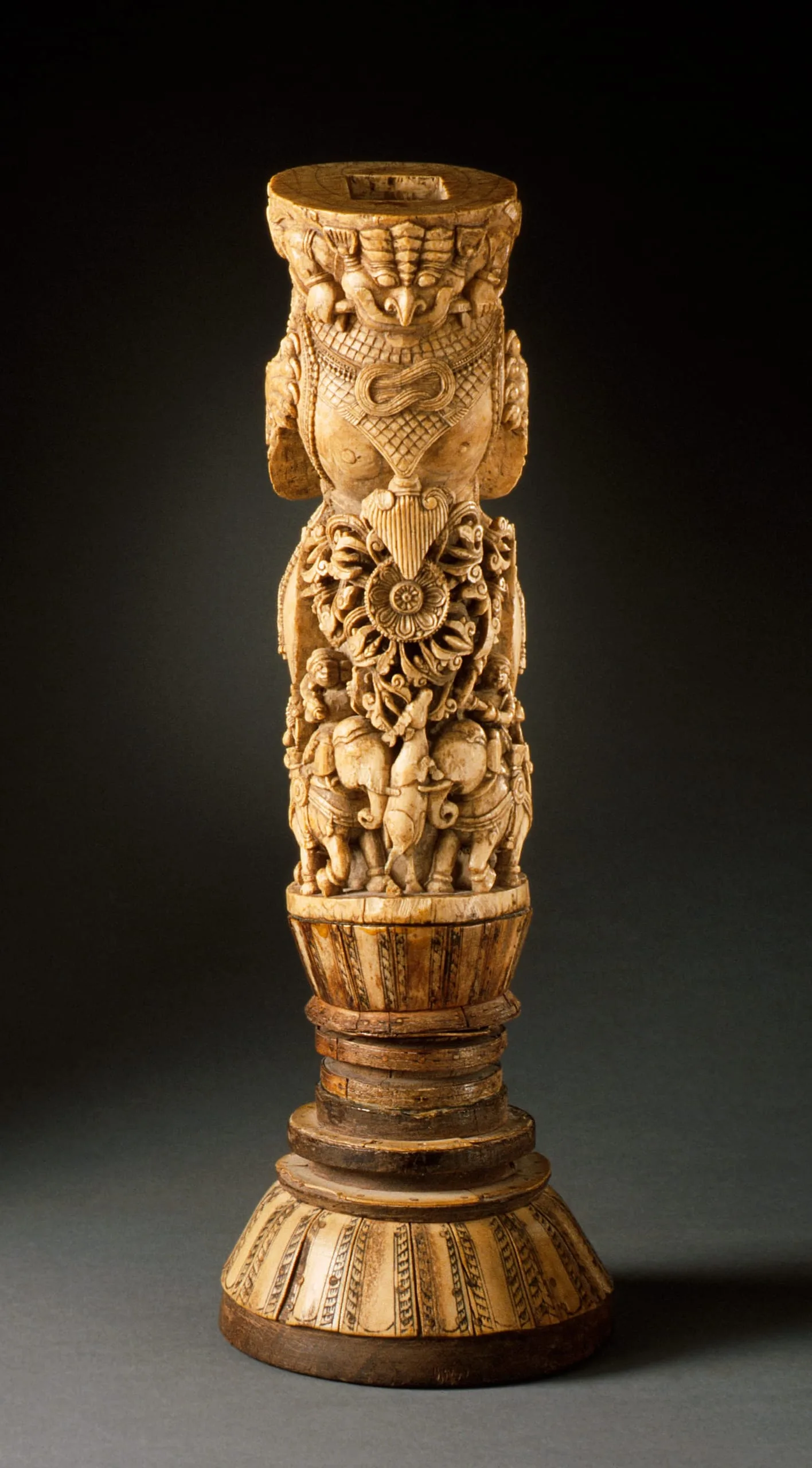
- Title
- Throne Leg in the Form of a Rampant Leonine Creature (yali or vyala) and Figures
- Date Made
- 16th century
- Medium
- Ivory; wood base with ivory veneer and lac-filled designs
- Dimensions
- overall: 15 1/8 × 5 1/4 × 5 1/4 in. (38.42 × 13.34 × 13.34 cm)
- Accession Number
- M.87.279.1
- Curatorial Notes
This intricately carved Orissan ivory throne leg is exceptional in that it retains its ivory veneer-covered wooden base, which allows for a more complete understanding of the original structure of such throne legs.
Orissan ivory throne legs are often fashioned in the form of a rampant animal that is stylistically derived from earlier architectural and sculptural conventions. Most common is a mythical leonine creature (yāli or vyāla) or, occasionally, a hybrid elephant-lion (gajasimha). The representations of both fantastical beasts are idiosyncratic in that the animals’ heads are rotated 90° and portrayed in the impossible posture of facing completely backwards in relation to the rest of its body. Orissan ivory yālis have a stylized mane that drapes over their back and arms like a cape, fan-shaped ears pointing upward, three or four rows of bushy eyebrows, a thick and multifaceted moustache, almond-shaped eyes, a long pointed nose with prominent nostrils, and a tongue that protrudes to the point of touching its shoulders. Their bejeweled bodies have the tail of an elephant, short and stubby. In front of the exposed underside of the yālis is normally a lotus blossom, birds, and/or foliate filigree. At the base are various figures and riders on horses and elephants in procession. Frequently depicted at the top opposite the yāli heads is a crouched figure with a leonine head and human arms with hands grasping bejeweled garlands. It represents a "Face of Glory" (kīrttimukha).