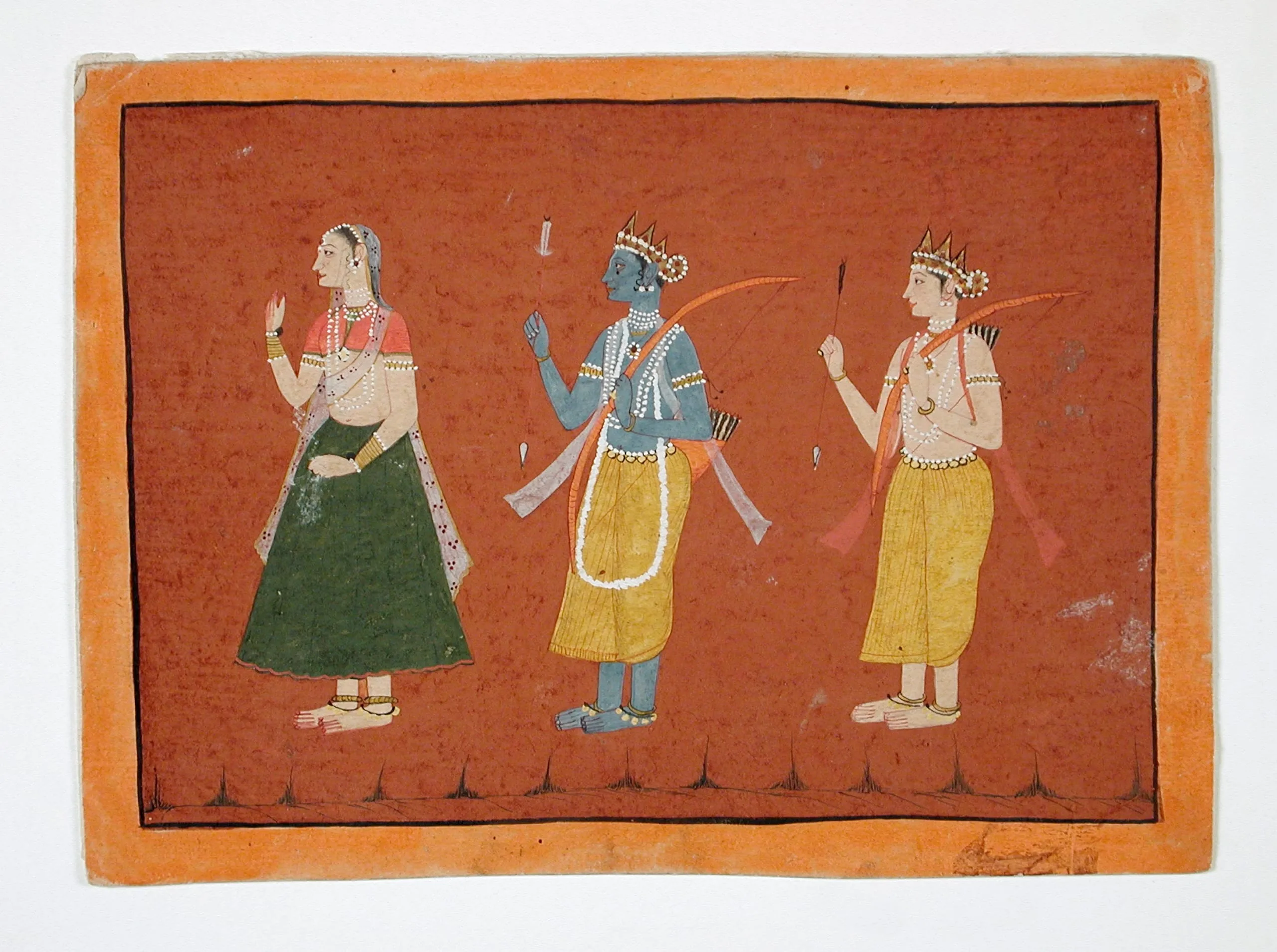
The Ramayana (Adventures of Rama) narrates the epic saga of the valiant Prince Rama and his dutiful wife, Princess Sita, who was abducted by Ravana, the arrogant ten-headed King of Lanka (probably modern Sri Lanka), during Rama's unjust fourteen-year forest exile from his capital of Ayodhya, Uttar Pradesh. To rescue Sita, Rama and his faithful brother Lakshmana assembled a great army of monkeys and bears led by the Monkey-King Sugriva and his Monkey-General Hanuman. After several magical battles, the princess was freed, and the happy couple triumphantly returned home to rule their kingdom. Rama and Sita epitomize the ideal ruler and the paragon of fidelity in Hindu culture.
This unidentified episode likely depicts Rama, Sita, and Lakshmana proceeding to their forest exile, or it may be an iconic image. In the center of the tripartite composition, the blue-skinned and crowned Rama holds a bow and arrow. He is flanked on the left by Sita, who holds her hands in positions analogous to Rama’s. On the right, the pale-skinned and crowned Lakshmana holds a bow and arrow.
Stylistically comparable Bilaspur paintings are in the Victoria and Albert Museum, London (IS.124-1954 and IS.119-1951).