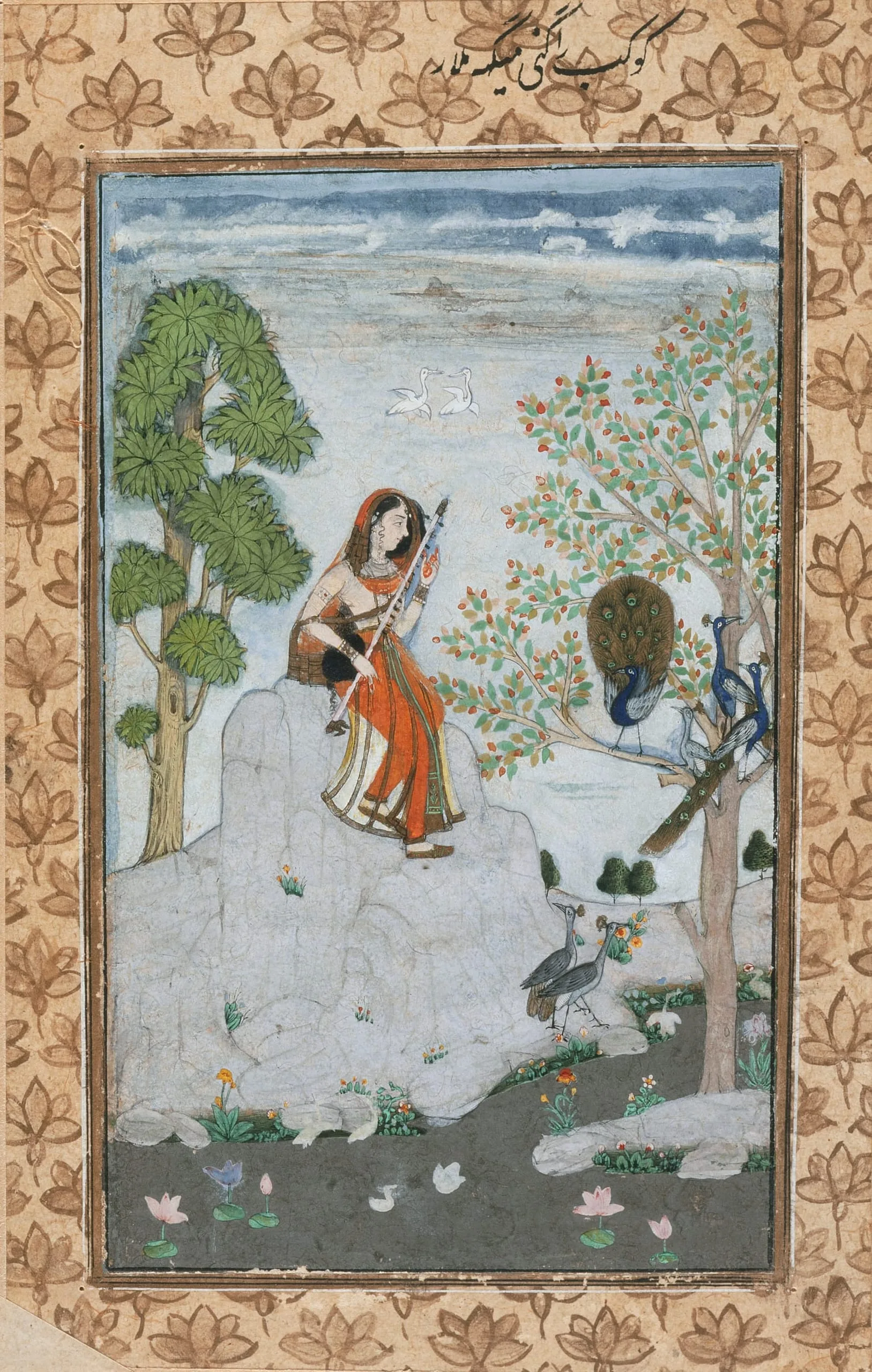
- Title
- Kakubha Ragini, Third Wife of Megha Mallar Raga, Folio from a Ragamala (Garland of Melodies)
- Date Made
- circa 1770
- Medium
- Opaque watercolor, gold, and ink on paper
- Dimensions
- Sheet: 7 1/4 x 4 5/8 in. (18.41 x 11.75 cm); Image: 5 1/2 x 3 3/8 in. (13.97 x 8.57 cm)
- Accession Number
- M.87.278.16
- Curatorial Notes
According to the inscription in the upper border, this melody is identified as “Kaukab ragini Magha-mal[har].” (Translation by Z.A. Desai.) Kakubha Ragini is the third wife of Megha Mallar Raga in the predominant ragamala (garland of melodies) classification system generally known as the Rajasthani system and in some 18th-century Deccani pictorial traditions, such as here. (The third wife of Megha can also be identified in visually similar Deccani representations as Sorathi Ragini; see M.85.290.4.) Kakubha Ragini is an early morning melody expressing the torment of a heroine separated from her lover who has fled into the solitude of the wilderness.
This painting is derived compositionally from slightly earlier representations of Kakubha Ragini attributed to the workshop of the Salabat Jang Master active in Aurangabad, Maharashtra and Hyderabad, Telangana (Seyller and Mittal, 2018). See its archetypes in the British Library, London (Johnson Album 37, no. 21) and the Jagdish and Kamla Mittal Museum of Indian Art, Hyderabad (76.435 D34), both attributed to circa 1760. In all three works, the heroine distinctively sits on a hillock or small peak (kakubha). She plays a vina with her face silhouetted by the upper resonator gourd. Peafowl are sporting in and below a nearby tree and unfinished waterfowl enjoy the stream in the foreground. Slight differences in the articulation of details exist between the three versions, but the compositions and iconographies are identical.