- Title
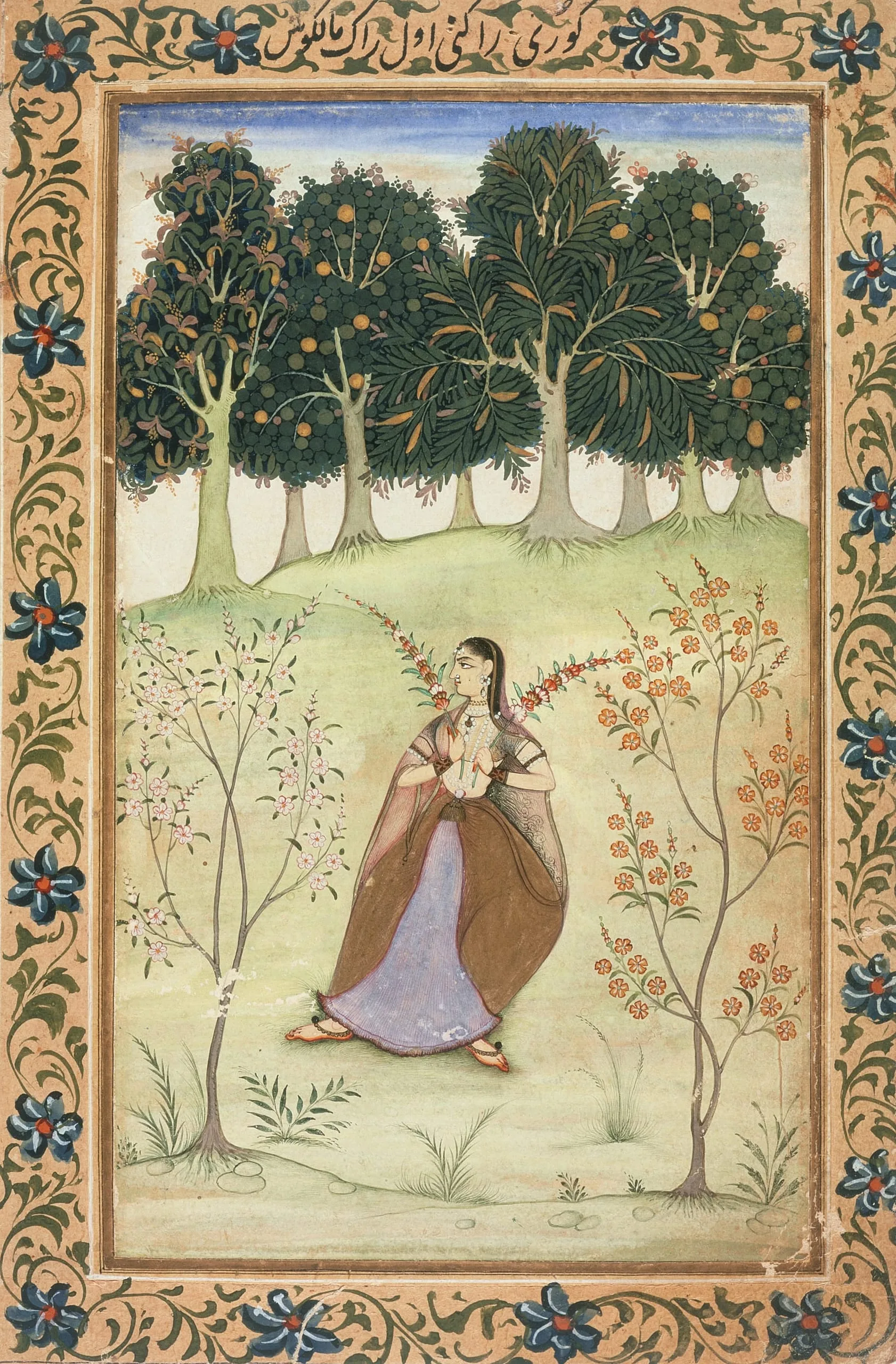
- Gauri Ragini, First Wife of Malkos Raga, Folio from a Ragamala (Garland of Melodies)
- Date Made
- circa 1625-1650
- Medium
- Opaque watercolor, gold, and ink on paper
- Dimensions
- Image: 7 1/2 x 4 1/2 in. (19.05 x 11.43 cm); Sheet: 9 x 6 in. (22.86 x 15.24 cm)
- Accession Number
- M.87.278.14
- Curatorial Notes
Two short Persian inscriptions in the upper border amidst the flowering vine and on the reverse identify the subject as Gauri Ragini, the first wife of Malkos Raga, and provide the time when it should be sung.
Gauri (or Gaudi) Ragini is the first wife of Malkos Raga in the predominant ragamala (garland of melodies) classification system generally known as the Rajasthani system. It is a soulful melody associated with the late afternoon and Winter (December-January). It expresses the lamentation of a heroine over her unfaithful lover. Here, the heroine carries flower wands while walking or possibly dancing in a forest glen beside two flowering trees, perhaps cotton trees (Bombax ceiba). She has long curly hair down to her hips. She has abundant pearl jewelry and enameled cuff bracelets. She wears a transparent shawl (dupatta or odhni), a beige midriff-baring blouse (choli), and brown and purple skirts (ghagra or lhenga). See also M.74.5.14 and M.90.141.2.