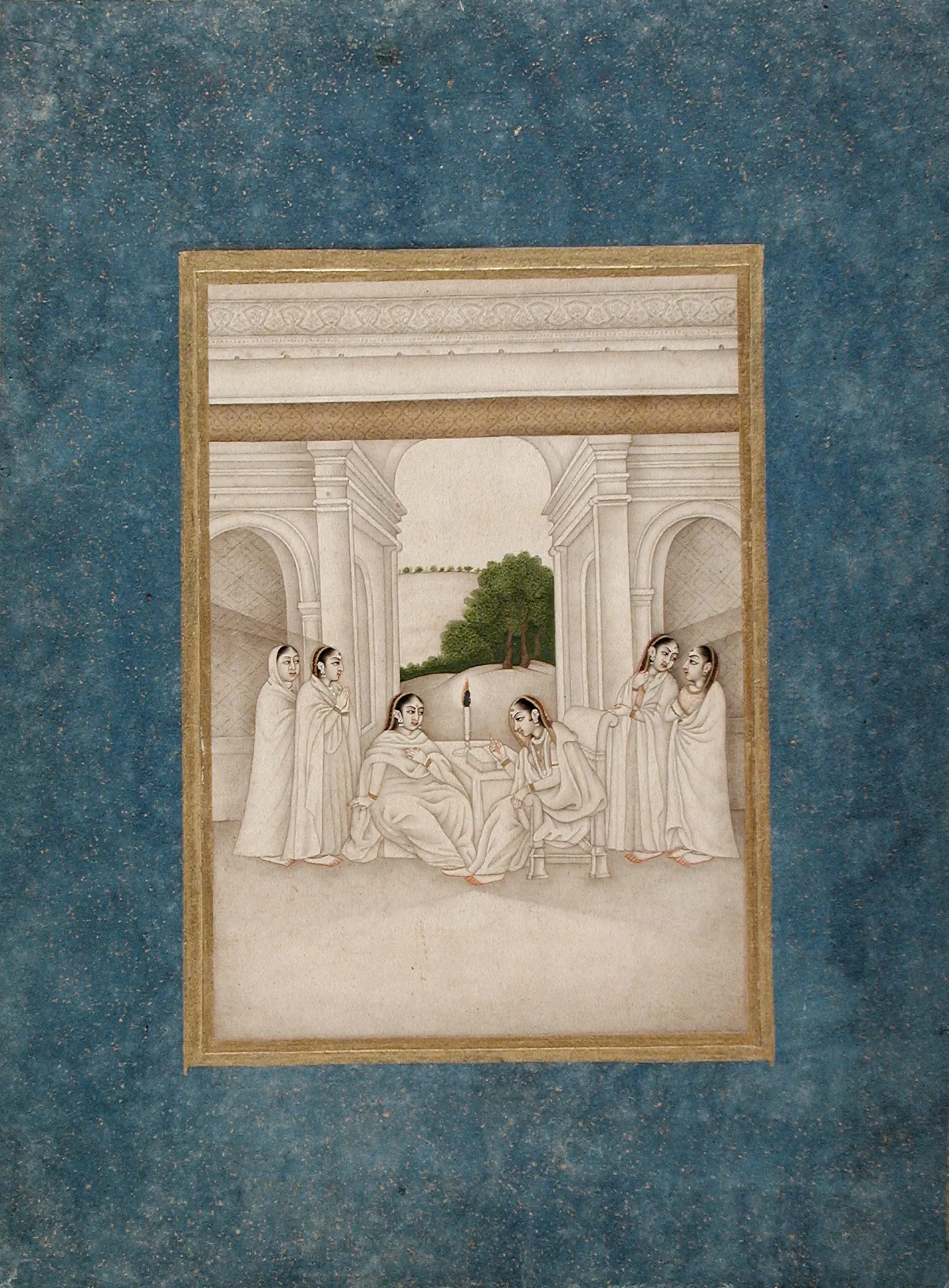
This ethereal painting of women reading by candlelight in a Classical architectural setting was likely inspired compositionally by an unidentified European engraving of two nuns in disputation or Saint Anne teaching the Virgin Mary to read. The latter scene was particularly popular from the 14th century onward in northern European art, including prints, manuscript illuminations, and works of diverse media displayed in cathedrals.
Regardless of the original source, the figures have been reinterpreted with Indianized facial features, hairstyles, head coverings, jewelry, the application of henna on the women’s hands and feet, and the transparent bodice worn by the gesticulating woman seated in the tall-backed European chair. The enduring Western stylistic characteristics are evident in the treatment of the light and shadows cast from the lit candle, the use of receding perspective, and the architectural detailing of the entablature. The piousness of the discourse is conveyed by the second woman from the left holding her hands together in a gesture of veneration or prayer.
The folio once belonged to Robert Gregory (1727-1810), a merchant in the English East India Company and one of its directors (1769-1782). He also served as a member of Parliament (1768-1784).